







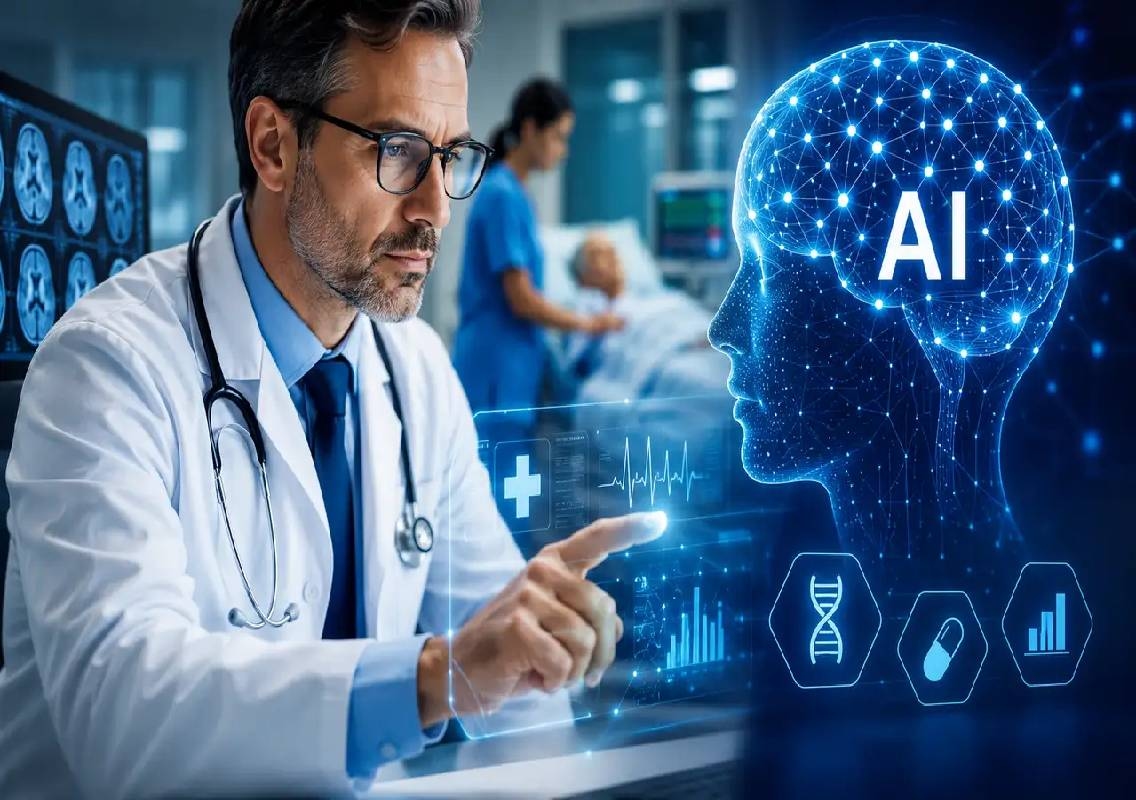


New Delhi: Artificial intelligence (AI) is rapidly transforming healthcare by helping doctors analyse medical data faster, reduce administrative work and improve patient care. However, the technology is unlikely to replace doctors or nurses, according to Christopher DeFlitch, Chief Medical Information Officer at Penn State Health.
Speaking about AI’s growing role in medicine, DeFlitch said the technology should be viewed as a support system that enhances clinical decision-making rather than replacing healthcare professionals.
AI to assist, not replace healthcare workers
DeFlitch believes AI can help medical professionals make faster and more informed decisions by identifying relevant clinical information that may otherwise be difficult to locate.
“I think AI can really be used to help care for patients. If it’s used smartly, it’s not going to replace the nurse. It’s not going to replace the doctor,” he said.
He added that healthcare will continue to rely on human interaction, with AI acting as a tool to improve efficiency.
According to DeFlitch, technology that enables doctors to spend more time with patients instead of searching through records can significantly improve the quality of care.
Reducing paperwork and organising medical data
Modern healthcare generates enormous amounts of information, including electronic medical records, laboratory reports, imaging scans and research publications.
DeFlitch said AI can help organise this information and present it in a meaningful way, making it easier for clinicians to access relevant details during patient consultations.
He also noted that AI-powered documentation tools can reduce the administrative burden of preparing clinical notes, allowing doctors to devote more attention to patient care.
Improving diagnosis through medical imaging
One of AI’s most promising applications is medical imaging.
According to DeFlitch, AI systems are already being used to identify potential signs of conditions such as strokes on MRI and CT scans.
Rather than making medical decisions independently, these systems highlight urgent cases so radiologists, neurologists and emergency physicians can review them more quickly.
This helps doctors prioritise patients requiring immediate attention while retaining full responsibility for diagnosis and treatment.
Accelerating medical research
AI is also expected to play a growing role in medical research and drug discovery.
DeFlitch said research fields involving large volumes of complex data are particularly well suited to AI-assisted analysis.
The technology can help researchers examine genetic information, medical histories and treatment outcomes to identify which medicines may work best for specific patients.
He believes such capabilities could advance personalised medicine and improve treatment outcomes in the future.
Human oversight remains essential
Despite AI’s growing capabilities, DeFlitch cautioned against relying on the technology without verification.
He recommended a “trust but verify” approach, emphasising that AI systems are only as reliable as the data and instructions provided to them.
Incorrect prompts or poor-quality data can lead to inaccurate results, making human expertise essential in interpreting AI-generated recommendations.
Healthcare professionals, he said, must continue to exercise clinical judgment before making decisions affecting patient care.
Future of AI in healthcare
DeFlitch expects AI to become an integral part of healthcare by reducing administrative workload and helping clinicians process information more efficiently.
He believes the future lies in collaboration between technology and healthcare professionals rather than competition between humans and machines.
As AI continues to evolve, its greatest value will be enabling doctors and researchers to focus on delivering better patient outcomes while technology handles repetitive, data-intensive tasks.
Conclusion
AI is reshaping healthcare by improving efficiency, supporting diagnosis and accelerating research. However, experts say the technology is best viewed as an assistant that complements medical professionals, with human judgment remaining the foundation of safe and effective patient care.