







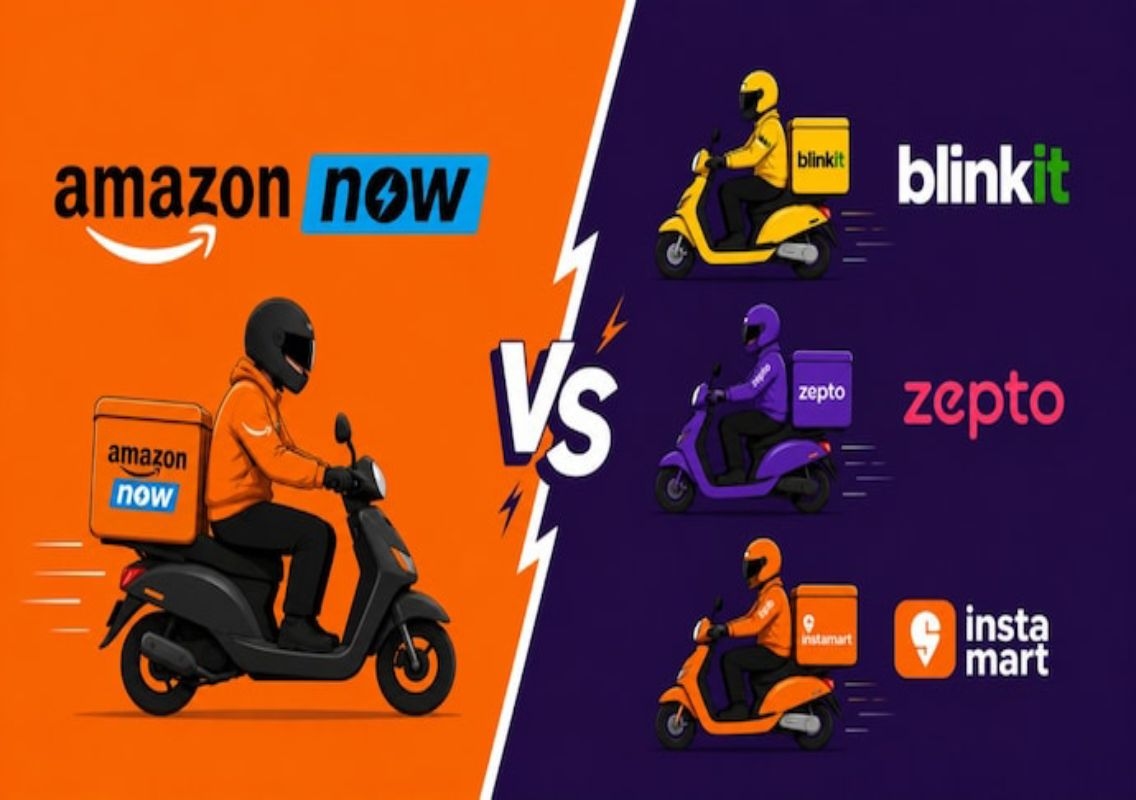


New Delhi: Amazon has rolled out one of the most aggressive cashback offers in India’s quick commerce space, as it intensifies efforts to compete with established players like Blinkit, Zepto, and Instamart. Through its quick delivery service Amazon Now, the company is offering customers Rs 100 cashback on orders worth Rs 200, effectively translating to a 50 per cent return.
The move marks a significant escalation in the ongoing battle for dominance in India’s fast-growing quick commerce market, where delivery speed, pricing, and customer retention strategies play a crucial role.
Aggressive cashback strategy to gain market share
Amazon Now’s cashback offer is straightforward: customers placing a minimum order of Rs 200 receive Rs 100 back as Amazon Pay balance. This cashback remains fixed at Rs 100 for orders up to Rs 1,400, after which it increases to Rs 200 for higher-value purchases.
This effectively reduces the cost of essential grocery purchases by nearly half for smaller orders, making it one of the most lucrative deals currently available in the segment. For price-sensitive Indian consumers, such deep discounts could act as a strong incentive to try the service.
The strategy reflects Amazon’s willingness to leverage its financial strength to gain a foothold in a market it entered relatively late. The company recently reported quarterly profits exceeding Rs 2,91,000 crore, highlighting its ability to sustain aggressive customer acquisition campaigns.
Late entry but rapid expansion
Although Amazon Now was launched in December 2024, its visibility and reach have expanded significantly in 2026. The service offers deliveries within 30 minutes and has been gaining traction, particularly among Prime users.
According to company leadership, orders on Amazon Now have been growing at approximately 25 per cent month-on-month, with Prime members reportedly tripling their usage frequency after adopting the service.
A key factor behind this expansion is Amazon’s investment in dark stores—small warehouses that enable quick deliveries. The company currently operates around 750 to 800 such facilities across India. While this is still lower than Blinkit’s estimated 2,200 dark stores, Amazon appears confident of delivering efficient service in major urban centres.
Leadership focus and competitive intent
The quick commerce push is reportedly being overseen by Amit Agarwal, a senior Amazon executive known for building the company’s India operations. His return to lead this initiative signals the strategic importance Amazon places on succeeding in this space.
Industry observers believe the cashback campaign is designed not just to attract users but also to disrupt competitors who may find it difficult to match such deep discounts consistently.
Cashback limits and user experience
Despite the attractiveness of the offer, there are indications that the cashback may not be entirely unlimited. Some users have reported receiving multiple Rs 100 cashbacks across orders, significantly lowering their monthly grocery expenses. However, others have noted that the offer disappears after a few days, suggesting possible caps or targeted rollout mechanisms.
When combined with additional benefits such as the Amazon-ICICI credit card cashback of 5 per cent, the overall savings can be substantial. However, the lack of clear terms and conditions has led to some uncertainty among users.
Can Amazon disrupt established players?
Amazon faces stiff competition from Blinkit, Zepto, and Instamart, which have already built strong brand recall and customer loyalty. In fact, some of these platforms have become synonymous with quick grocery delivery in urban India.
However, aggressive cashback offers have historically proven effective in attracting users, particularly for late entrants. Similar strategies have been used successfully in India’s digital payments space, where companies like Google Pay gained market share through incentives.
The long-term success of Amazon Now will depend not just on discounts but also on service reliability, delivery speed, and product quality. While cashback offers can bring users to the platform, retention will hinge on overall customer experience.
Conclusion
Amazon’s entry into quick commerce with a high-impact cashback strategy signals a new phase of competition in the sector. While the company’s financial muscle gives it a clear advantage, sustaining user interest beyond promotional offers will be crucial.
As the battle intensifies, consumers stand to benefit the most in the short term. Whether Amazon can convert these initial gains into long-term dominance remains to be seen.