









Chennai: Homegrown messaging platform Arattai will disable its username-based account feature following increased regulatory scrutiny by the Government of India over usernames on messaging applications, Zoho co-founder Sridhar Vembu announced on Friday.
The move comes days after the Ministry of Electronics and Information Technology (MeitY) sought explanations from WhatsApp, Telegram and Signal regarding the privacy and security implications of username-based messaging systems. Although the government has not banned usernames, it has raised concerns that the feature could be misused for impersonation and cyber fraud.
Vembu confirmed that Arattai would remove the feature to comply with the evolving regulatory landscape, making it one of the first messaging platforms to publicly respond to the government’s concerns.
Sridhar Vembu confirms change on X
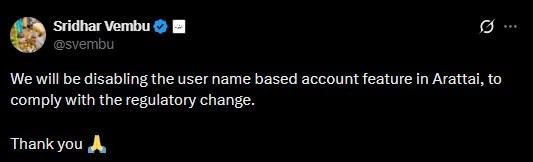
Announcing the decision on X, Sridhar Vembu said Arattai would discontinue its username-based account system.
“We will be disabling the username based account feature in Arattai, to comply with the regulatory change,” Vembu wrote.
The username feature allowed users to connect with others on Arattai without sharing their mobile numbers, offering a layer of privacy similar to messaging platforms such as Telegram and Signal.
While Vembu referred to a regulatory change, Indian authorities have not formally prohibited username-based messaging. Instead, they have sought clarifications from several platforms before deciding on any further action.
Government raises concerns over usernames
The development follows the government’s notice to Meta after WhatsApp recently announced plans to introduce usernames for its users.
According to reports, MeitY directed Meta’s Chief Compliance Officer to explain within three days why regulatory action should not be considered if the new feature increases cybercrime or online fraud.
The ministry has reportedly issued similar notices to Telegram and Signal, both of which already allow users to communicate through usernames instead of mobile numbers.
Government officials are examining whether such features could make impersonation scams easier on encrypted messaging platforms.
Why are usernames under scrutiny?
Unlike traditional messaging systems that require users to exchange phone numbers, username-based messaging enables communication through unique identifiers.
Supporters argue that usernames enhance privacy by allowing users to keep their mobile numbers confidential while still communicating securely.
However, authorities fear scammers could create usernames resembling government agencies, public officials, celebrities or well-known organisations to deceive users.
Given WhatsApp’s massive user base in India, officials are particularly concerned that impersonation attempts could become more widespread if additional safeguards prove inadequate.
WhatsApp says safeguards are already in place
Meta has maintained that WhatsApp’s planned username feature includes several security measures designed to prevent misuse.
According to the company, usernames linked to prominent public figures, brands and organisations will be reserved to reduce impersonation risks.
WhatsApp also plans to introduce a four-digit username PIN, allowing users to receive messages only from people who know both their username and the additional security code.
The company has further clarified that it will not create a public username directory, limiting the ability of strangers or scammers to search for users through the platform.
Despite these safeguards, Indian regulators continue to examine the broader implications of introducing usernames on one of the country’s most widely used messaging services.
Arattai emerged as a homegrown alternative
Launched in 2021, Arattai gained wider public attention last year as interest grew in Indian-developed alternatives to global messaging platforms.
The application offers messaging, voice and video calling features while focusing on privacy and local innovation.
Its username-based system was introduced to make it easier for users to connect without revealing personal contact details, a feature that has become increasingly common across modern messaging services.
With Vembu’s announcement, Arattai is now expected to revert to a phone number-based system for user identification.
Debate over privacy and cyber safety continues
Cybersecurity experts remain divided over the government’s concerns.
Some believe usernames could actually improve user privacy by reducing the need to share personal mobile numbers online.
Others argue that stronger verification mechanisms and anti-impersonation tools are essential before such features are rolled out at scale, particularly on platforms with hundreds of millions of users.
For now, the government has not prohibited username-based messaging but is continuing discussions with major technology companies to assess the potential risks.
Meta, Signal and Telegram are expected to respond to the government’s queries before any decision is taken on future regulation.
Arattai’s decision to voluntarily disable usernames marks the first visible industry response to the government’s ongoing review of messaging platform safety and cybersecurity.