









Florida: Jeff Bezos has sparked debate after suggesting that lower-income groups should not pay any income tax at all. Speaking during an interview on CNBC’s Squawk Box from Merritt Island, Florida, Bezos argued that taxing the lowest earners contributes little to government revenue but places a significant burden on households already dealing with rising living costs.
Citing data to support his argument, Bezos said the top 1 per cent of taxpayers contribute roughly 40 per cent of total tax revenue, while the bottom half accounts for just around 3 per cent. He suggested that even this small contribution from lower-income groups should be eliminated entirely.
“I don’t think it should be 3 per cent. I think it should be zero,” Bezos said, emphasising that the financial relief could make a meaningful difference to millions of families.
Focus on financial strain of lower-income households
To illustrate his point, Bezos referred to the example of a healthcare worker earning about $75,000 annually. He argued that individuals in such roles, especially those facing increasing living expenses, should not be required to contribute income tax.
“We shouldn’t be asking this nurse in Queens to send money to Washington,” he said, adding that such workers deserve support rather than additional financial pressure.
His remarks align with broader discussions around tax equity and the role of progressive taxation systems, particularly in developed economies where income inequality remains a key concern.
Billionaires and value creation debate
Bezos also used the platform to present a wider argument about wealth and the role of billionaires in society. According to him, the most significant contribution wealthy individuals can make is through building companies that generate large-scale economic value, rather than relying solely on charitable donations.
He pointed to Amazon as an example of how businesses can create jobs, improve infrastructure and reduce costs for consumers. Bezos argued that if companies are managed effectively, their overall contribution to society could exceed that of traditional philanthropy.
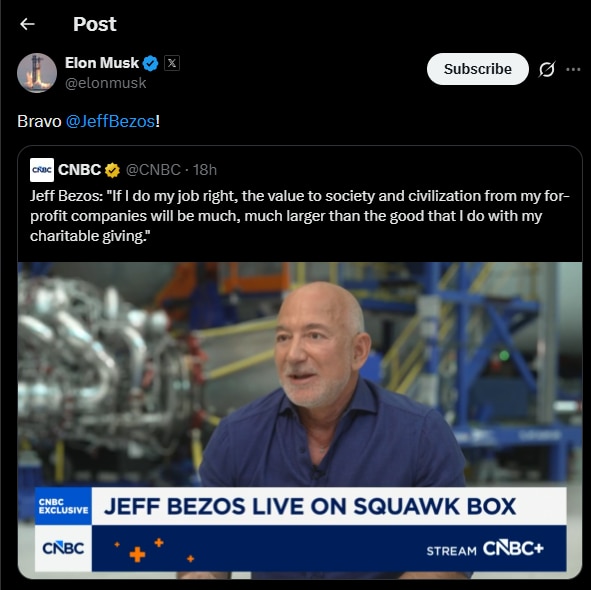
“If I do my job right, the value to society and civilisation from my for-profit companies will be much, much larger than the good that I do with my charitable giving,” he said.
The remarks reignited long-standing debates about whether corporate success or direct philanthropy plays a more meaningful role in addressing societal challenges.
Elon Musk reacts amid broader tech tensions
Interestingly, Elon Musk publicly supported Bezos’ comments, responding online with a brief message of approval. The reaction drew attention given the complex and often competitive relationship between the two tech leaders.
The exchange comes at a time when Musk has been involved in a high-profile dispute over the direction of OpenAI. Musk has previously criticised the organisation’s shift from a non-profit model to a more profit-driven approach, arguing that it undermines its original mission.
Against that backdrop, Musk’s agreement with Bezos on the value created by for-profit companies marked a notable moment of alignment between two of the most influential figures in the technology industry.
AI seen as productivity booster, not job killer
Bezos also addressed concerns about artificial intelligence replacing human workers, particularly in software engineering. He rejected the idea that AI would eliminate such jobs, instead describing it as a powerful tool that enhances human productivity.
Comparing the technology to a bulldozer replacing a shovel, Bezos suggested that AI would enable workers to achieve significantly more with less effort. This, he argued, would lead to increased efficiency across industries.
Rather than reducing employment opportunities, Bezos believes AI will transform the nature of work, allowing professionals to focus on higher-value tasks while automation handles repetitive processes.
Could AI lower prices in the future?
One of Bezos’ most notable predictions was that AI-driven productivity could eventually lead to lower prices for goods and services. He argued that if governments allow innovation to progress without excessive regulation, the resulting efficiency gains could benefit consumers directly.
According to Bezos, sectors such as logistics, healthcare, manufacturing and retail could see substantial cost reductions over time. In some cases, he suggested, prices might even decline—a phenomenon known as deflation.
“Because of the productivity gains, you’re going to be able to afford things,” Bezos said, adding that essential items like food could become cheaper in the long run.
While the idea remains speculative, it reflects a growing belief among technology leaders that artificial intelligence could reshape economic structures and improve affordability.
Conclusion
Jeff Bezos’ remarks on taxation and artificial intelligence have added to ongoing discussions about economic inequality, corporate responsibility and the future of work. His proposal to eliminate income tax for lower-income groups highlights concerns about financial pressure on households, while his views on AI underscore optimism about technological progress.
As governments and industries navigate rapid change, such perspectives are likely to influence policy debates and shape how societies balance growth, fairness and innovation in the years ahead.