







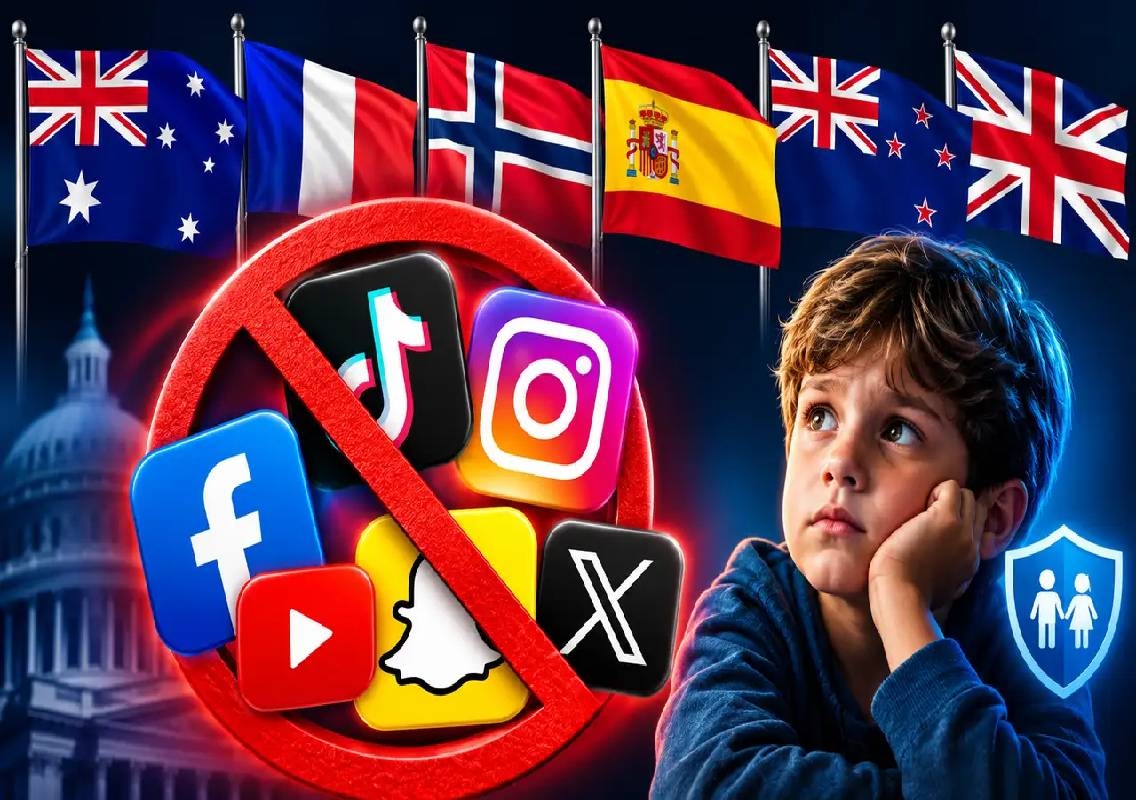


Governments across the world are tightening regulations on children’s access to social media as concerns grow over the impact of addictive algorithms, harmful content, cyberbullying and mental health. Following Australia’s landmark legislation, countries including France, Norway, Spain, New Zealand and the United Kingdom have either introduced or proposed stricter rules aimed at limiting young users’ access to platforms such as TikTok, Instagram, Facebook, Snapchat, X and YouTube.
India is also examining similar safeguards, with the Centre holding consultations on age-based restrictions while several states have proposed measures to strengthen online safety for children.
Australia leads with world’s first nationwide ban
Australia became the first country to introduce a nationwide restriction on children’s access to social media through the Online Safety Amendment (Social Media Minimum Age) Act.
Under the legislation, children below the age of 16 are prohibited from maintaining accounts on major social media platforms, including TikTok, Instagram, Facebook, Snapchat, X and YouTube. The law places responsibility on technology companies to enforce the restrictions, making Australia a global leader in regulating children’s online access.
France moves closer to under-15 ban
France has taken another significant step towards limiting children’s use of social media after a parliamentary committee approved legislation banning users under the age of 15 from accessing social media platforms.
French President Emmanuel Macron has urged lawmakers to implement the legislation before the beginning of the new academic year in September, highlighting the government’s focus on protecting minors from harmful online content and excessive screen time.
Norway proposes mandatory age verification
Norway is preparing legislation that would prohibit children under 16 from using social media.
Unlike traditional self-declared age systems, the proposed framework would require technology companies to implement robust age-verification mechanisms, shifting the responsibility from users to digital platforms.
Spain plans stricter age limits
Spain has also announced plans to raise the minimum age for social media use to 16 years.
Prime Minister Pedro Sánchez has argued that technology companies have failed to adequately protect children from addictive recommendation algorithms, misinformation and illegal online content, making stronger regulation necessary.
New Zealand considers Australia’s model
New Zealand is evaluating legislation modelled on Australia’s approach.
The proposed framework would restrict children under 16 from accessing social media while making digital platforms responsible for verifying users’ ages. The government has cited children’s mental health and online wellbeing as key reasons for considering the proposal.
United Kingdom strengthens online safety rules
The United Kingdom has primarily relied on its Online Safety Act to compel digital platforms to protect young users from harmful material.
Alongside the legislation, discussions continue around additional restrictions for children under 16, including tighter controls on late-night social media access and stronger platform accountability measures.
More countries join the crackdown
Several other countries are also exploring stricter regulations to safeguard children online.
Malaysia is reportedly considering banning social media access for children under 16 alongside mandatory age verification.
Denmark is working on proposals to prevent children below 15 from accessing social media platforms.
Germany is debating restrictions for users under the age of 14, while Italy currently requires parental consent for younger teenagers and supports broader European Union-wide child safety measures.
India studies global models
India has not introduced a nationwide social media ban for children but has begun evaluating international regulatory models.
Earlier this year, Union Information Technology Minister Ashwini Vaishnaw confirmed that the Centre was consulting major technology companies regarding age-based restrictions for social media platforms.
He said many countries now recognise the need for age-based regulations and linked the discussions to the Digital Personal Data Protection (DPDP) Act, particularly in addressing children’s online safety and deepfake-related risks.
At the state level, Karnataka Chief Minister Siddaramaiah proposed restricting social media access for children under 16 during the 2026-27 Budget, while Goa is considering measures including stronger parental controls, smartphone usage restrictions and age-based safeguards.
Global shift towards child online safety
The growing number of countries pursuing stricter social media regulations reflects a broader global shift towards prioritising child safety in the digital age.
While approaches vary—from outright bans and age verification requirements to stronger parental controls and platform accountability—the common objective is to reduce children’s exposure to harmful content, addictive algorithms and online exploitation.
For India, the ongoing consultations indicate that policymakers are carefully studying international models before introducing a regulatory framework that balances child protection with digital innovation.