







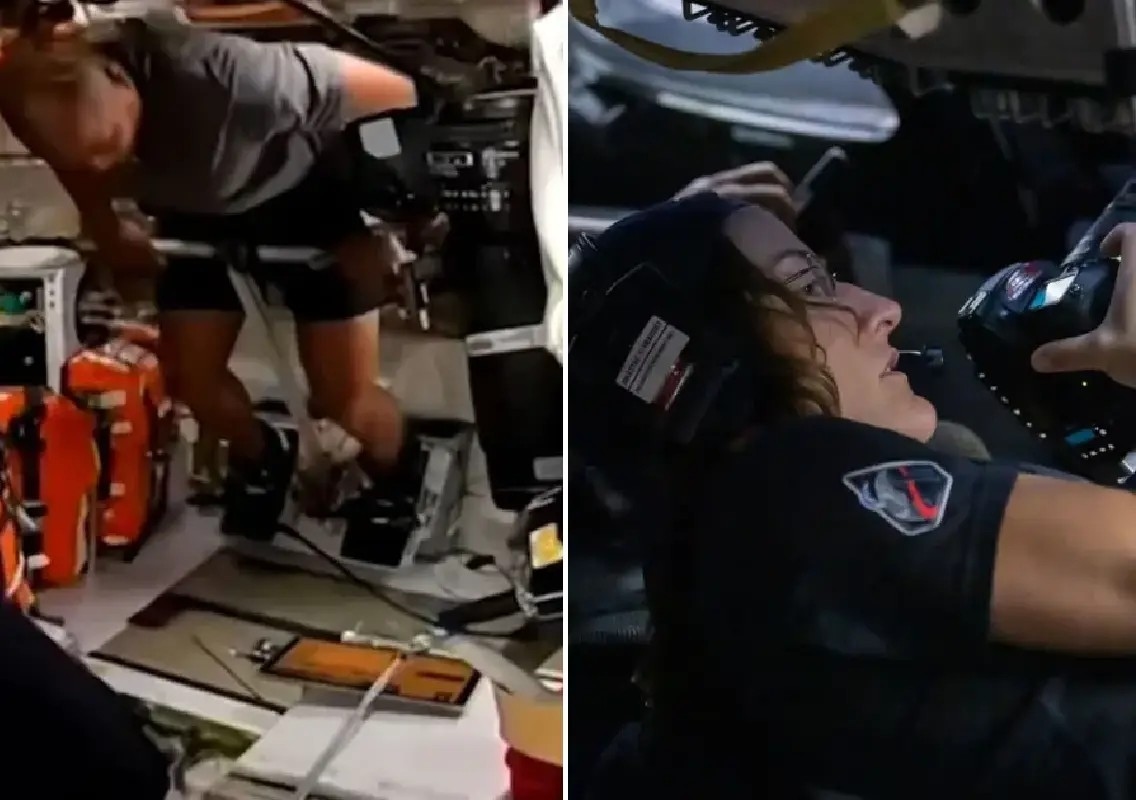


Scientists and engineers are developing advanced exercise equipment designed to keep astronauts fit during long-duration space missions, with a British invention now being tested under space-like conditions.
The device, called HIFIm (High-Frequency Impulse for Microgravity), was recently trialled aboard a parabolic flight that simulates weightlessness for short periods by repeatedly climbing and diving through the atmosphere.
Olympic medallist joins space fitness experiment
Matthew Wells, an Olympic bronze medallist, participated in the latest test by rowing on the experimental machine while floating in zero gravity conditions nearly 8,500 metres above the ground.
The project aims to reduce the amount of time astronauts currently spend exercising in space. Astronauts aboard the International Space Station typically spend nearly two hours daily maintaining muscle mass, bone density, and cardiovascular fitness.
Preparing for future moon missions
The equipment is being developed with involvement from organisations including the European Space Agency, NASA, the Canadian Space Agency, and the UK Space Agency.
Meganne Christian, a reserve astronaut with the European Space Agency, said the technology could support future lunar missions and next-generation space stations linked to NASA’s Artemis programme.
Why exercise matters in space
Experts say the human body rapidly loses muscle strength, bone density, and coordination in microgravity because it no longer experiences the forces generated by gravity on Earth.
Dan Cleather, a professor involved in the project, explained that without exercise, astronauts can suffer severe physical decline during long missions.
The HIFIm device is designed to support nearly 300 exercises while remaining compact and lightweight — a major advantage for space travel where equipment size and weight are critical.
Built with help from film industry experts
Interestingly, the machine was developed at Pinewood Studios with assistance from special-effects engineers who have worked on films including Star Wars, Mission: Impossible, and 1917.
Researchers believe reducing astronaut exercise time to just 30 minutes daily could allow more time for scientific experiments and research during future space missions.