







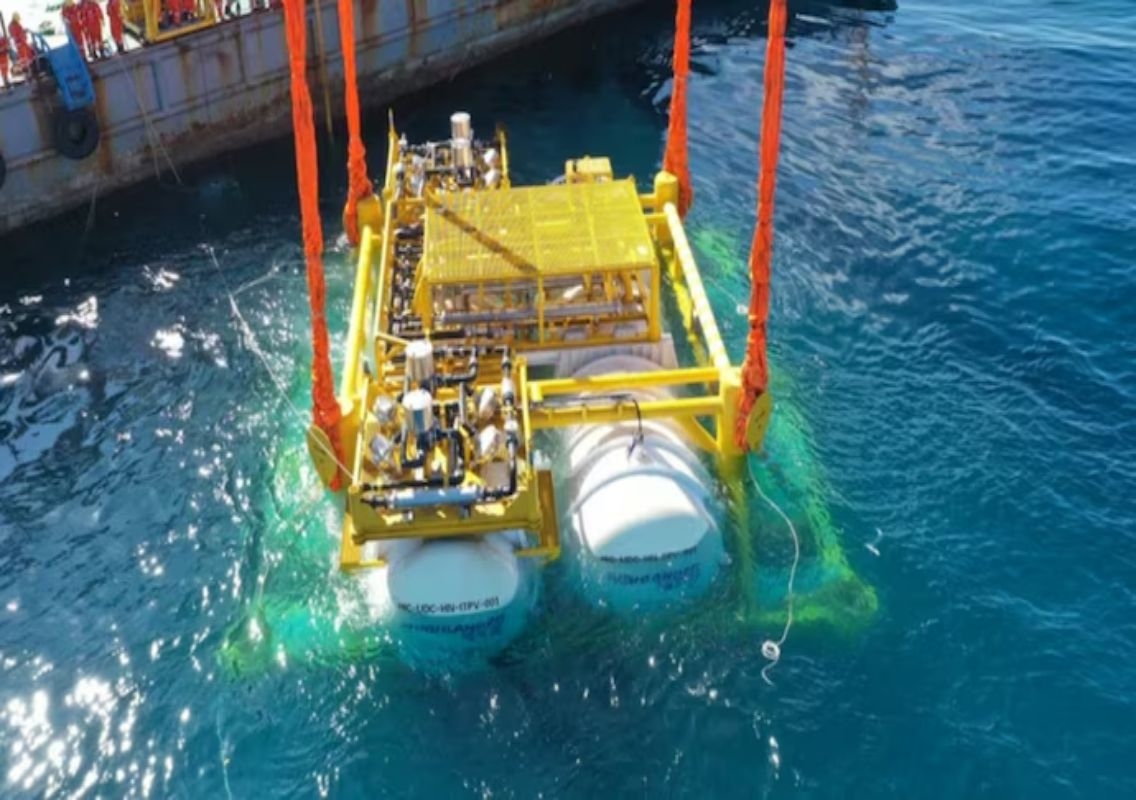


Shanghai: China has operationalised the world’s first underwater data centre powered primarily by offshore wind energy, marking a significant technological milestone in the global race to build sustainable artificial intelligence (AI) infrastructure.
The facility, known as the Shanghai Lingang Undersea Datacentre Demonstration Project, is located about 10 metres below the sea surface off the coast of Shanghai. Developed as a joint initiative between HiCloud Technology (Shanghai Hailanyun Technology) and state-owned China Communications Construction Company, the project began operations in May this year.
With a capacity of 24 megawatts (MW), the data centre is designed as a proof-of-concept facility aimed at showcasing the potential of underwater infrastructure in addressing the growing energy and resource demands of modern data centres.
Rising demand for AI drives innovation
The rapid expansion of artificial intelligence technologies has significantly increased the need for large-scale data processing and storage infrastructure. Data centres are critical to powering AI models, cloud computing services and digital applications.
However, conventional land-based data centres face challenges such as high energy consumption, extensive land requirements and heavy water usage for cooling systems. These constraints have prompted global technology firms and governments to explore alternative solutions, including underwater and space-based data centres.
China’s underwater project represents one of the most advanced implementations of such an idea, positioning the country at the forefront of innovation in this emerging field.
Energy efficiency and sustainability benefits
According to Chinese authorities, the underwater data centre offers notable efficiency gains compared to traditional facilities. It is reported to consume around 22 per cent less power than conventional data centres while operating on nearly 95 per cent green energy sourced from a nearby offshore wind farm.
One of the most significant advantages of the underwater setup is its reduced reliance on freshwater for cooling. Traditional data centres require large quantities of clean water to prevent servers from overheating. In contrast, the submerged facility benefits from the natural cooling effect of seawater.
Officials claim that the underwater system uses more than 90 per cent less water than land-based counterparts, making it a potentially sustainable solution in regions facing water scarcity.
Environmental concerns remain
Despite its efficiency benefits, the project has raised environmental concerns among experts. There are apprehensions that underwater data centres could disturb seabed ecosystems, resuspend sediments and cause localised warming of seawater due to heat discharge.
These potential impacts highlight the need for careful monitoring and environmental safeguards as such technologies are scaled up in the future.
A demonstration project with global implications
While the Shanghai facility is relatively small compared to large-scale data centres being developed globally, it serves as an important demonstration of underwater computing infrastructure. Its 24 MW capacity is modest when compared to gigawatt-scale projects planned elsewhere to meet rising AI demand.
China has previously experimented with underwater data centres. In 2023, HiCloud launched a commercial underwater data centre in Hainan province. However, the Shanghai project is the first to integrate offshore wind power at scale, enhancing its sustainability credentials.
Global competition intensifies
China’s advancement comes amid increasing global interest in unconventional data centre technologies. The United States has also explored underwater data centres, with Microsoft conducting a pilot project near the Orkney Islands in Scotland in 2018, which demonstrated promising results.
Meanwhile, new initiatives are emerging worldwide. Ocean technology startup Panthalassa is developing floating, wave-powered data centre nodes, backed by significant investment. At the same time, companies like SpaceX are exploring the possibility of deploying data centres in space.
India is also entering the race. Domestic firm Sarvam has partnered with Pixxel to explore an orbital data centre, which would use satellite-based systems to process AI workloads in space.
Conclusion
China’s underwater wind-powered data centre marks a pioneering step towards sustainable and efficient computing infrastructure. While still in its early stages, the project demonstrates how innovative approaches can address the environmental and resource challenges posed by traditional data centres. As global demand for AI continues to surge, such solutions could play a crucial role in shaping the future of digital infrastructure worldwide.