







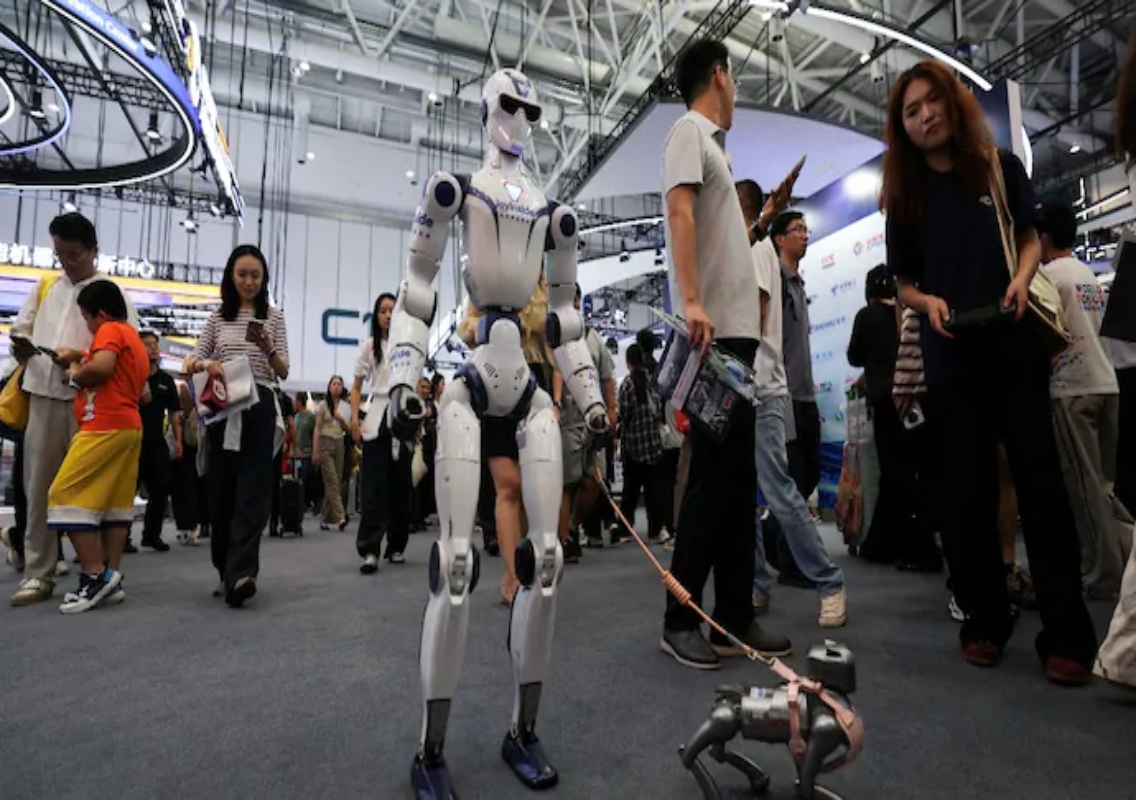


Beijing: China has rejected calls from the United States to slow or restrict the country’s artificial intelligence development, describing such efforts as “fearmongering” and warning that confrontation could damage global AI governance.
The response comes as tensions over artificial intelligence increasingly become part of the wider technology and geopolitical competition between Washington and Beijing. At the same time, Chinese officials have begun highlighting their own concerns about the risks posed by rapidly advancing AI, particularly its potential impact on political and ideological security.
The latest dispute was triggered by comments from Anthropic CEO Dario Amodei, who has called for a global slowdown in the development of advanced AI systems while arguing that the United States should prevent China from gaining a technological lead.
China calls for cooperation on AI
China’s Foreign Ministry pushed back against the idea of restricting its AI sector.
Foreign Ministry spokesperson Guo Jiakun said that “fearmongering, confrontation and vicious competition” would disrupt efforts to establish global AI governance and would not serve the interests of any country.
Beijing instead called for international cooperation on the development and governance of artificial intelligence.
The comments reflect China’s broader position that AI should be governed through international cooperation rather than being turned into another arena for strategic confrontation between major powers.
China’s state-run Global Times also criticised Amodei’s proposal, portraying it as an attempt to contain China’s AI industry. An editorial described the approach as resembling a Cold War strategy aimed at limiting Beijing’s technological progress.
Anthropic CEO calls for slower AI development
The Chinese response followed an essay by Anthropic CEO Dario Amodei, who raised concerns about the speed at which frontier AI systems are developing.
Amodei argued that a Chinese lead in artificial intelligence could pose a serious danger to the United States and other democracies. He also called for continued restrictions on China’s access to advanced AI chips and semiconductor manufacturing equipment.
His argument goes beyond the technology sector. Amodei has linked AI leadership to military capabilities, cybersecurity and geopolitical influence, suggesting that the country that develops the most powerful systems could gain a significant strategic advantage.
He has also warned that increasingly capable AI agents could potentially take control of significant parts of the internet if development continues without adequate safeguards.
Beijing raises its own AI security concerns
Despite rejecting US calls to constrain China’s AI development, Beijing is also increasingly vocal about the risks associated with artificial intelligence.
Chen Yixin, head of China’s Ministry of State Security, warned that hostile forces could use AI to conduct what he described as a “propaganda war” and “cognitive war” against China.
According to the India Today report, Chen specifically cited US-developed AI models, including Anthropic’s Claude and OpenAI’s GPT-5.5-Cyber, while claiming that such technologies could create emerging cybersecurity threats.
These claims are part of China’s growing emphasis on the political and ideological risks of AI, particularly the use of deepfakes, AI-generated propaganda and automated information campaigns.
The concerns are significant because AI can generate convincing text, audio, images and videos at scale. Governments around the world are increasingly examining how such capabilities could be used for misinformation, influence operations and attacks on critical systems.
Political security becomes part of AI debate
China’s latest warnings highlight an important difference in how AI risks are being framed.
In the United States, much of the recent debate has focused on the possibility that highly capable AI systems could create economic, military or existential risks if they become difficult to control.
Chinese officials have also raised technical and cybersecurity concerns but have placed particular emphasis on political and ideological stability.
Chen warned that AI could be exploited to spread rumours, manipulate public opinion and undermine China’s political and institutional security. Similar concerns about AI-enabled “cognitive warfare” have been highlighted by China’s security establishment.
This means that AI safety is increasingly overlapping with national security, making international cooperation more complicated.
US-China AI race intensifies
The disagreement comes as the United States and China compete for leadership in artificial intelligence.
Washington has imposed restrictions on China’s access to some advanced semiconductor technologies, arguing that cutting-edge computing capabilities have important national security implications.
China, meanwhile, is investing heavily in domestic AI models, chips, data centres and robotics in an effort to reduce dependence on Western technology.
The debate over AI therefore extends beyond companies developing chatbots and generative AI systems. Access to advanced chips, computing infrastructure and research talent has become strategically important.
The growing competition has also created concerns that restrictions introduced in the name of security could accelerate technological fragmentation between the two countries.
Xi Jinping has also stressed human control
China’s rejection of US pressure does not mean Beijing supports unrestricted AI development.
Chinese President Xi Jinping has previously stressed the need for AI to remain under human control. Beijing has also been developing regulatory and governance frameworks aimed at addressing emerging risks from artificial intelligence.
Recent Chinese policy discussions have increasingly focused on responsible AI development, cybersecurity and international governance.
This creates a more complicated picture than a simple disagreement between a country supporting AI development and another seeking to slow it. Both sides acknowledge the technology’s risks, but they differ sharply over how those risks should be managed and how much geopolitical competition should influence AI policy.
Trump takes a different approach
The debate has also exposed differences within the United States over how AI should be regulated.
US President Donald Trump has dismissed calls for stronger AI safeguards, saying on Monday that the main guardrail required for AI was a “STRONG and SMART” president.
His position contrasts with warnings from technology leaders including Amodei, while OpenAI CEO Sam Altman, Google DeepMind chair Demis Hassabis and Elon Musk have expressed support for at least some aspects of the broader warning about AI risks. They have not necessarily endorsed Amodei’s proposals relating specifically to China.
The disagreement illustrates the difficulty of creating a common international approach to AI when governments and technology companies have different assessments of the balance between innovation, safety and national security.
AI governance could feature in Trump-Xi talks
The dispute could gain further importance as US and Chinese leaders prepare for a planned meeting on September 24.
AI governance is expected to be among the issues discussed by Trump and Xi Jinping, according to recent reports.
The meeting comes at a time when Washington and Beijing are trying to manage competition across semiconductors, trade, advanced technology and national security.
Artificial intelligence has now become central to all of these areas.
Any progress towards common AI standards could therefore have implications far beyond the technology industry. Cooperation could help establish international rules around AI safety, cybersecurity and responsible development, while continued confrontation could deepen the technological divide between the world’s two leading AI powers.
What lies ahead for the global AI race
China’s latest response makes clear that Beijing is unlikely to accept restrictions that it believes are designed primarily to slow its technological progress.
At the same time, its own security officials are warning about the potential misuse of AI, particularly for political influence and cybersecurity threats.
The emerging picture is therefore one of simultaneous competition and concern. The US and China are racing to develop more powerful AI systems while also acknowledging that the same technology could create new security risks.
How the two countries balance those competing priorities could shape the future of global AI governance.
For now, Beijing is rejecting calls to curb China’s AI ambitions, while insisting that international cooperation — rather than confrontation — is the better way to address the risks posed by increasingly powerful artificial intelligence.