







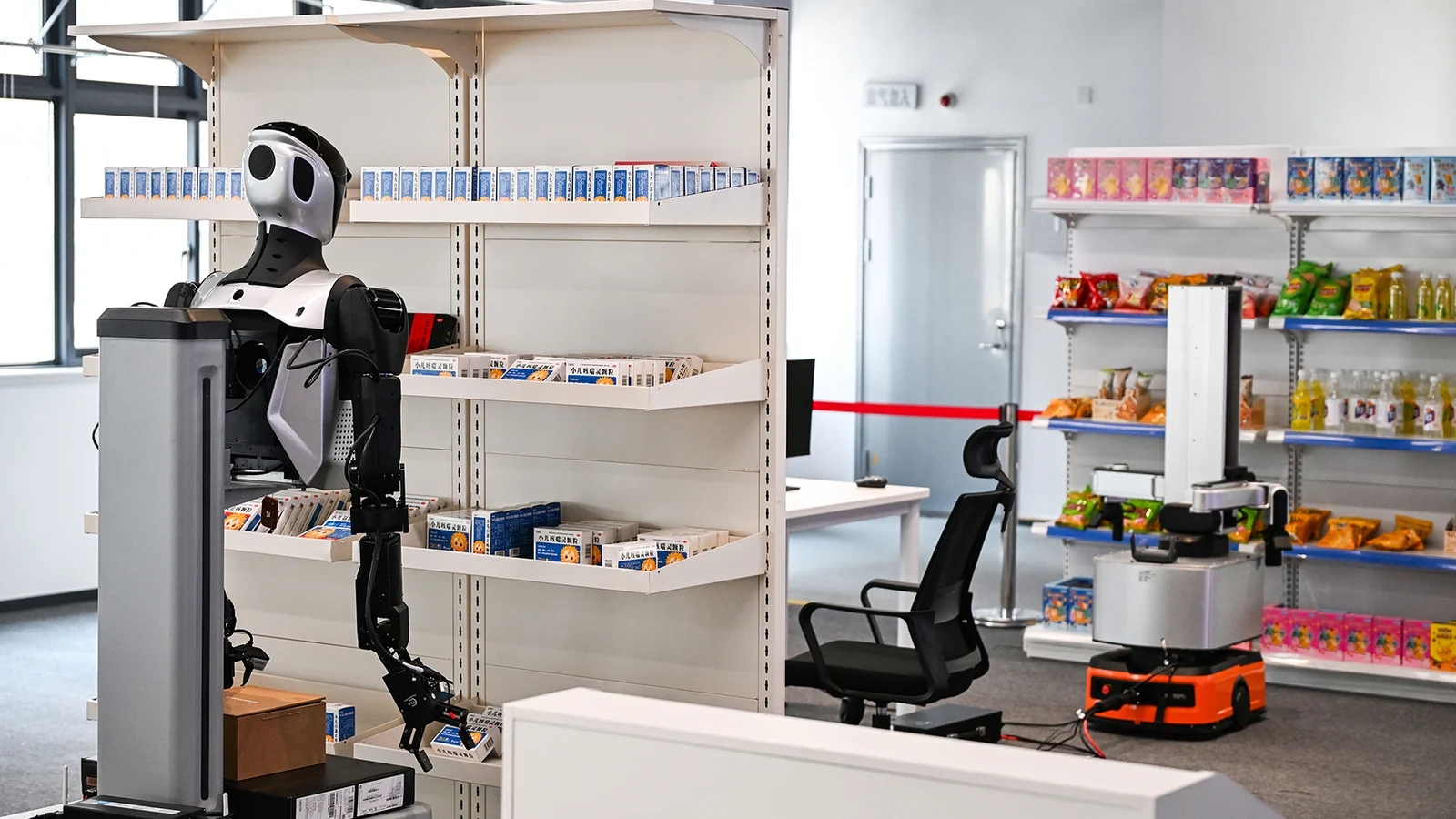


Inside brightly lit offices across China, young workers are performing an unusual job: teaching robots how to move like humans. Wearing virtual reality headsets and motion-tracking exoskeletons, they repeatedly act out simple tasks such as opening doors, folding clothes, or stacking blocks—sometimes hundreds of times a day.
Humans powering China’s robot push
One such worker, a 20-year-old computer science student using the pseudonym Kim, works as a robot trainer at a Shanghai-based startup. His movements are recorded and used to train humanoid robots, which Beijing sees as crucial to boosting productivity, tackling labour shortages, and strengthening its position in the global tech race.
“We call ourselves cyber-labourers,” Kim told Rest of World. “It’s a fine gig, though a bit boring.”
Government-backed training centres expand
To overcome a shortage of high-quality training data, Chinese local governments have set up state-funded robot training centres. These facilities, often operated in partnership with private robotics firms, provide shared data that can be used across the industry.
By December 2025, more than 40 such centres had been announced nationwide, with around two dozen already operational. One of the largest, in Beijing’s Shijingshan district, spans over 10,000 square metres and simulates environments such as car assembly lines, smart homes, and elder-care facilities
Why human data matters
Unlike large language models, which can be trained on internet text, robots require complex physical data—joint rotations, force, balance, and visual cues—that cannot be easily generated synthetically. This has made human demonstration a key input in developing “embodied intelligence”.
China currently has over 150 humanoid robot companies, and the global humanoid robot market could be worth $38 billion by 2035, according to Goldman Sachs.
Public sector drives early demand
The robotics boom in China has been fuelled heavily by state support. State-owned firms such as China Mobile have placed large orders for humanoid robots, while local governments are offering subsidies, AI funds, and university courses focused on robotics.
Companies like Tesla are also training humanoid robots using human workers, but on a far smaller scale.
Bubble fears and unanswered questions
Despite rapid growth, concerns about overcapacity are rising. China’s National Development and Reform Commission has warned of a possible bubble in the humanoid robotics sector. Experts also question whether large-scale human data collection is the most efficient way to build intelligent robots.
“It’s a noble effort, but it’s slow,” said a University of California robotics researcher. “Even with hundreds of people, it will take a long time to gather enough data.”