







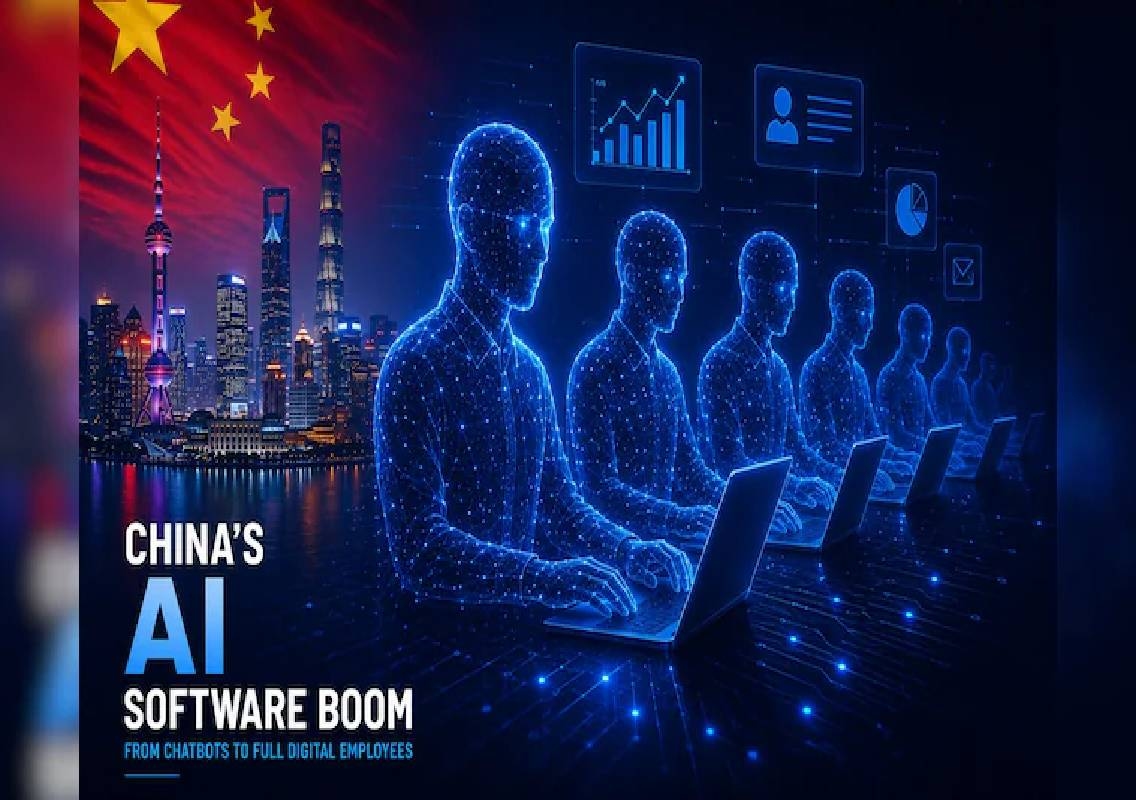


Beijing: China’s artificial intelligence industry is rapidly moving beyond chatbots, with software companies now developing autonomous “digital employees” capable of handling complete business workflows instead of simply answering questions. The shift marks a new phase in the country’s AI race as enterprises increasingly adopt AI agents that can independently perform tasks across finance, customer service, human resources and enterprise operations.
According to a recent Goldman Sachs product tracker, Chinese software firms are accelerating investments in AI agents that function like virtual employees rather than conventional chatbots. These systems are designed to execute end-to-end tasks with minimal human intervention, signalling a major transformation in enterprise software and workplace automation.
From assistants to autonomous workers
Unlike traditional AI chatbots that primarily respond to user queries, the latest generation of AI software is built to complete entire workflows.
These digital employees can process documents, prepare reports, manage approvals, coordinate internal communication, update databases and perform repetitive administrative functions without requiring constant human prompts.
The transition reflects a broader global trend towards “agentic AI”, where artificial intelligence moves beyond conversation and begins acting independently to complete assigned objectives.
Goldman Sachs noted that Chinese software companies are increasingly positioning these AI agents as virtual co-workers capable of boosting productivity across multiple industries.
Software business models are evolving
The emergence of AI employees is also changing how software companies generate revenue.
Traditionally, enterprise software relied on subscription-based pricing, where businesses paid recurring fees to access applications.
However, AI agents are encouraging vendors to adopt usage-based pricing models, charging customers based on the number of tasks completed or the computing resources consumed instead of fixed subscriptions.
This approach aligns software costs more closely with business outcomes and reflects the growing commercial value of autonomous AI systems.
China intensifies enterprise AI push
Chinese technology firms have aggressively expanded their AI offerings over the past year, supported by rapid advances in large language models and increasing enterprise demand.
Rather than focusing solely on consumer-facing chatbots, many companies are now prioritising business applications that can automate back-office operations, improve efficiency and reduce manual workloads.
The strategy is expected to strengthen China’s competitiveness in enterprise AI while helping businesses lower operating costs and improve productivity.
Businesses seek measurable productivity gains
Analysts believe organisations are becoming less interested in AI systems that simply generate text and more focused on tools capable of delivering measurable operational improvements.
Digital employees can work continuously, execute repetitive tasks consistently and integrate with existing enterprise software platforms, making them attractive for businesses facing labour shortages or rising operating expenses.
As AI agents become more reliable, companies are expected to expand their use into procurement, finance, customer support, legal documentation and supply chain management.
Challenges remain
Despite rapid progress, experts caution that fully autonomous AI systems still face significant challenges.
Businesses must address concerns around data security, regulatory compliance, decision accuracy and human oversight before deploying AI employees for critical operations.
There are also broader questions surrounding workforce transformation, with organisations needing to redefine employee roles as AI increasingly handles routine administrative work.
Industry observers expect human workers and AI agents to operate together rather than AI completely replacing employees in the near future.
A new phase in the AI race
China’s software sector appears to be entering a new stage of AI development where success is measured not by conversational ability but by the capacity to automate entire business processes.
The evolution from chatbots to autonomous digital employees reflects how artificial intelligence is becoming deeply integrated into enterprise operations rather than remaining a standalone productivity tool.
As investment in AI infrastructure and enterprise software continues to grow, digital employees are expected to play an increasingly important role in shaping the future workplace, both in China and globally.