







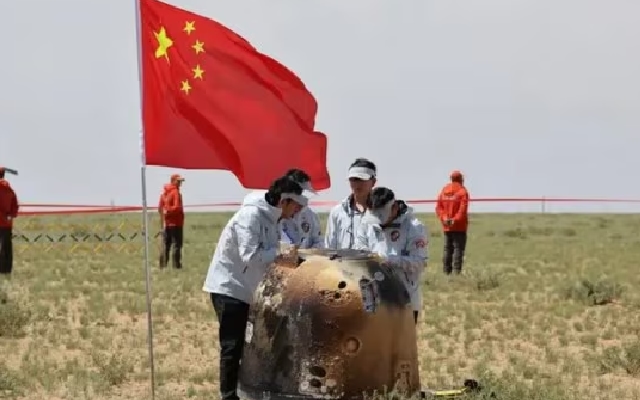


On June 25, at 2:07 PM local time, China’s Chang’e-6 lunar module successfully returned to Earth in Inner Mongolia, marking a significant achievement in lunar exploration. The capsule’s safe reentry with samples collected from the moon’s far side concludes the mission’s objectives.
This milestone represents humanity’s first-ever collection of samples from the moon’s less explored region, often referred to as the dark side. The retrieved rock and soil samples, gathered from the South Pole-Aitken Basin, a vast lunar crater, have been transported to Beijing for thorough analysis. Scientists anticipate these samples will provide valuable insights into the moon’s geological history.
The Chang’e-6 mission commenced on May 3 from the Wenchang Space Launch Center in Hainan, China. Following a successful landing on the moon on June 2, the mission spent 13 days in lunar orbit before its return journey culminated on June 25, after 53 days of exploration.
Wang Qiong, deputy chief designer of the Chang’e-6 mission, outlined the next steps: “Upon delivery of the lunar samples to the laboratory, our first task will be to carefully unseal the sample container, extract and categorize surface and subsurface samples. A portion will be stored permanently, with another stored at a separate location as a precaution. The remainder will be prepared and distributed to scientists in China and abroad in accordance with lunar sample management protocols.”
Additionally, the Chang’e-6 mission included payloads from international partners such as the European Space Agency (ESA), France, Italy, and Pakistan, enhancing collaborative efforts in lunar exploration.