







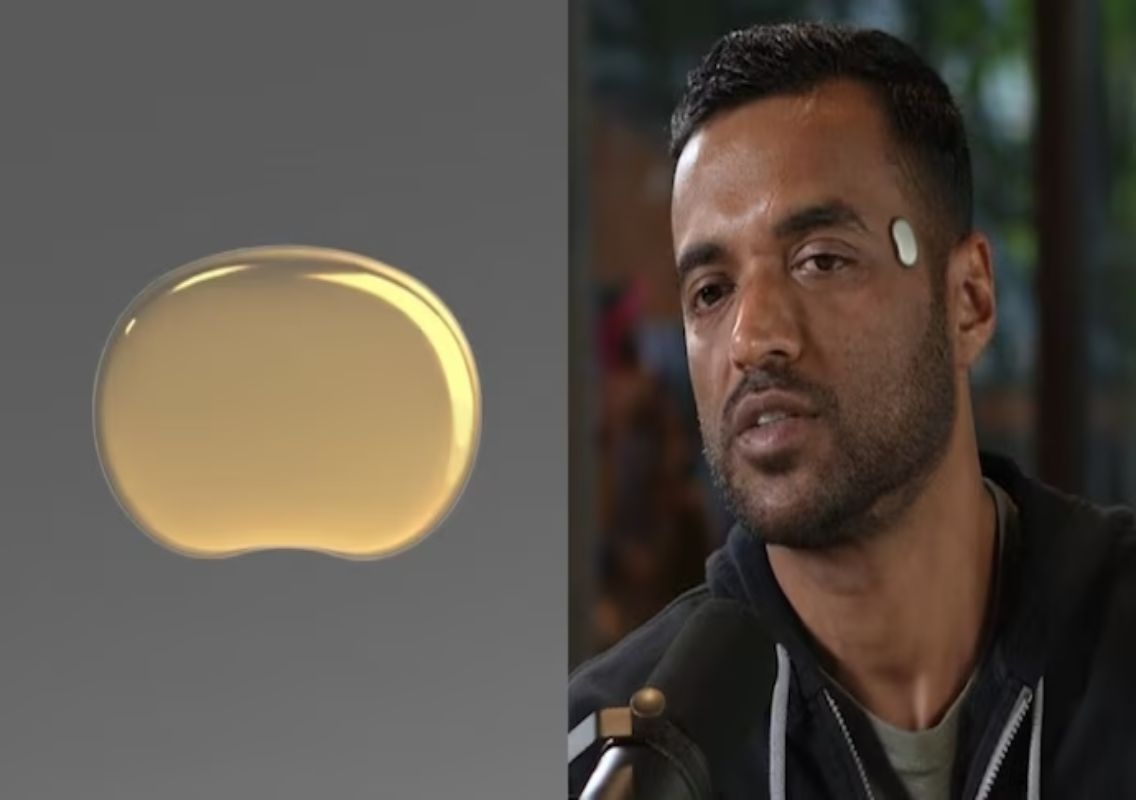


New Delhi: Zomato co-founder and Eternal CEO Deepinder Goyal has revealed that his next hardware project, Temple, is expected to launch by the end of 2026. Goyal described Temple as the “smallest wearable” being developed by his team, adding another unusual product to his growing portfolio of technology experiments.
The announcement comes as Goyal continues to expand his interests beyond food delivery and quick commerce. His latest project is being developed through a technology-focused initiative and appears to be aimed at creating a compact wearable device that could offer a new way of interacting with technology.
According to Goyal’s comments, Temple is still under development, with a launch planned before the end of 2026. The company has not yet revealed complete specifications, pricing or details about the markets where the device will initially be available.
Deepinder Goyal says Temple is the smallest wearable
Goyal shared details about Temple while discussing his interest in developing new technology products.
The description of Temple as the “smallest wearable” has immediately attracted attention because the product appears to be designed around extreme compactness.
Wearable technology has traditionally focused on products such as smartwatches, fitness trackers, wireless earbuds and smart glasses. These devices have become increasingly capable, but they also require users to wear or carry relatively visible hardware.
Temple appears to explore a different direction.
Rather than adding another large screen to the user’s wrist, the project seems to focus on creating a much smaller form factor.
However, Goyal has not yet disclosed exactly where the device will be worn or what functions it will perform.
Launch expected before the end of 2026
The biggest piece of information revealed by Goyal is the expected launch timeline.
Temple is planned for release by the end of 2026, although an exact launch date has not been announced.
The timeline suggests that development has progressed sufficiently for the team to target a commercial release within the year.
There is still considerable uncertainty around the product because hardware launches can face delays related to manufacturing, software integration, testing and regulatory requirements.
Until the company announces the final specifications and launch date, the end-of-2026 target should therefore be treated as the current plan rather than a guaranteed release date.
What is Temple?
At present, Temple remains a relatively mysterious project.
Goyal’s description provides very little information about the product’s capabilities. There has been no detailed announcement covering its processor, sensors, battery, connectivity, operating system or compatibility with smartphones.
The lack of technical details means it is too early to determine whether Temple will compete directly with existing wearable categories.
It could potentially be positioned as a health, communication, productivity or artificial intelligence device, but there is currently no confirmed information establishing its exact purpose.
The product’s name and extremely small size have nevertheless fuelled curiosity about what Goyal’s team is attempting to build.
Why smaller wearables are attracting attention
The wearable market has increasingly moved towards devices that can perform more functions without requiring larger screens.
Smartwatches have evolved into miniature computers, while earbuds have added microphones, sensors and increasingly sophisticated software features.
At the same time, technology companies are exploring devices that can reduce users’ dependence on smartphones.
AI has accelerated this trend.
Companies are experimenting with hardware that can understand voice commands, process information and provide assistance without requiring users to constantly look at a phone screen.
A compact wearable such as Temple could potentially fit into this broader movement, although Goyal has not confirmed whether artificial intelligence will be central to the device.
Deepinder Goyal’s growing interest in technology
Temple is another example of Goyal’s interest in technology and hardware.
The Zomato co-founder has increasingly spoken about areas outside Eternal’s core food-delivery and quick-commerce businesses.
His public comments and projects have frequently attracted attention because of their unconventional nature.
The development of Temple could signal a broader ambition to experiment with consumer technology products rather than limiting his entrepreneurial activities to internet platforms.
For Goyal, the wearable category also offers an opportunity to explore how technology can become less intrusive.
Instead of asking consumers to carry another large device, an extremely small wearable could potentially blend into everyday life.
Wearable technology is entering a new phase
The global wearable market has already evolved considerably over the past decade.
Fitness bands initially focused primarily on tracking steps, sleep and exercise. Smartwatches later expanded the category by adding notifications, calls, payments, navigation and health-monitoring capabilities.
More recently, smart glasses and AI-powered wearable devices have begun attracting greater attention.
The common theme is that technology is gradually moving away from traditional screens.
This creates opportunities for smaller devices that can collect information, communicate with smartphones or cloud services and provide contextual assistance.
If Temple succeeds in combining useful functionality with a very small physical footprint, it could offer a different proposition from conventional smartwatches and fitness trackers.
Questions around battery life and usability
One of the biggest challenges for an extremely small wearable will be battery capacity.
Smaller hardware generally leaves less physical space for a battery. At the same time, modern wearable devices increasingly require processors, wireless connectivity, sensors and microphones.
Balancing those requirements could be a significant engineering challenge.
If Temple uses AI-related features or continuous sensing, power consumption could become even more important.
The product will also need to be comfortable enough for long-term use.
A wearable that is technically small but inconvenient to wear may struggle to find a mass audience.
The final design, therefore, could be just as important as the technology inside it.
Privacy could also become an important issue
If Temple includes microphones, cameras, health sensors or other continuously active components, privacy will be another important consideration.
Consumers are becoming increasingly aware of the amount of personal information collected by connected devices.
Any wearable capable of recording audio, monitoring activity or interacting with AI services would need clear privacy controls.
The company could also face questions about how data is stored, processed and shared.
At this stage, however, there is no confirmation that Temple will include any particular sensor or recording capability.
Pricing will determine mass-market appeal
Another unanswered question is pricing.
The cost of a wearable can significantly influence its adoption, particularly in India’s price-sensitive consumer electronics market.
A very small wearable could potentially be positioned as an affordable accessory, but advanced components and specialised manufacturing could push the price higher.
Goyal and his team will therefore need to find a balance between design, technology and affordability.
A competitive price could help Temple stand out in a market increasingly crowded with smartwatches, earbuds and AI-enabled gadgets.
What consumers can expect next
More details about Temple are likely to emerge as the proposed launch approaches.
The company will eventually need to reveal the product’s design, functionality, compatibility, pricing and availability.
It will also need to explain what problem Temple is designed to solve.
That could be particularly important because consumers already have several categories of wearable devices available.
For Temple to create a new category, it will need to offer a clear advantage rather than simply being smaller than existing products.
Temple could become an interesting technology experiment
Goyal’s decision to describe Temple primarily through its size rather than its specifications may be deliberate.
The phrase “smallest wearable” creates curiosity while leaving room for the company to reveal the product gradually.
The approach is also consistent with the way several emerging hardware companies build anticipation before unveiling new products.
For now, however, Temple should be viewed as an upcoming technology project rather than a confirmed competitor to established wearable brands.
The end-of-2026 launch target gives the team several months to complete development and prepare the product for consumers.
Conclusion
Deepinder Goyal has confirmed that Temple, described by him as the “smallest wearable”, is expected to launch by the end of 2026.
The project remains largely under wraps, with key details such as its design, functionality, battery capacity, connectivity, pricing and availability yet to be announced.
Temple arrives at a time when the wearable industry is moving beyond traditional smartwatches and fitness trackers towards smaller, more specialised and increasingly AI-enabled devices.
Its success will ultimately depend on more than size. The device will need to offer a compelling use case, reliable battery life, comfortable design and a price that consumers are willing to pay.
For now, Goyal’s announcement places Temple among the more intriguing Indian consumer technology projects to watch in 2026. If the company can turn the idea of an extremely small wearable into a genuinely useful product, Temple could provide a fresh take on how people interact with technology in their everyday lives.