







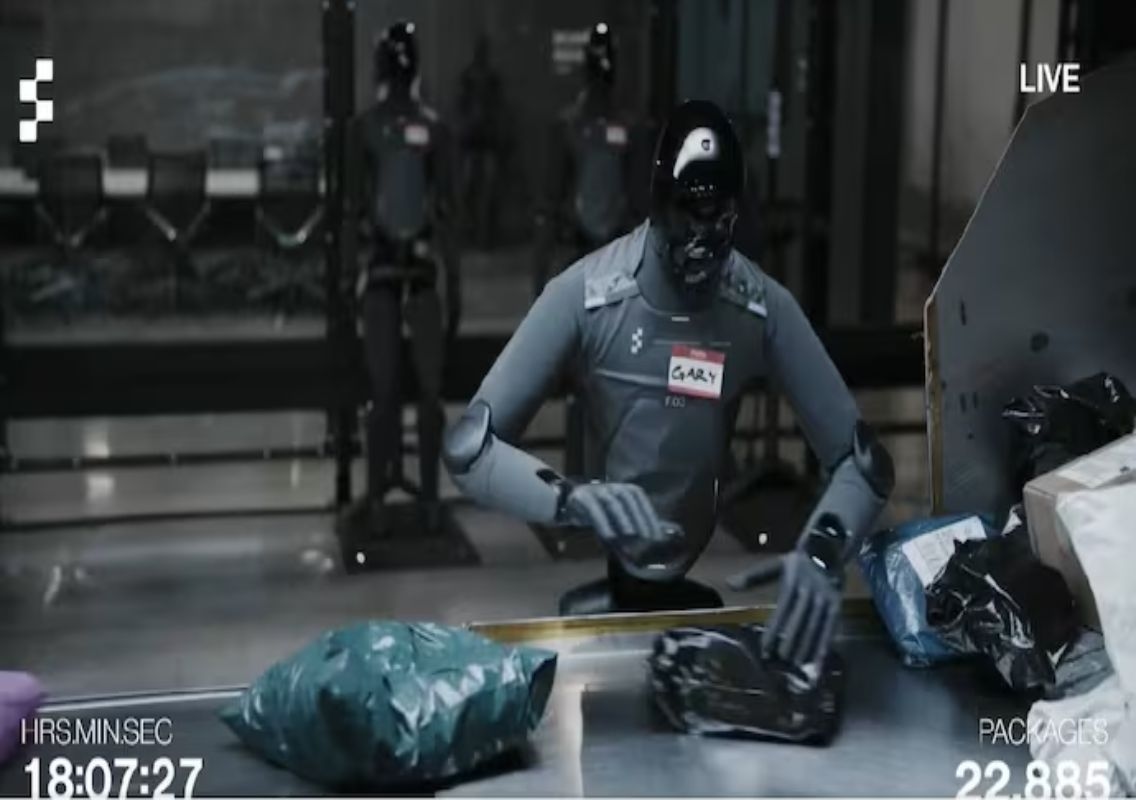


San Francisco: Figure AI has showcased a major step toward fully autonomous industrial labour by livestreaming humanoid robots working continuously for an eight-hour shift without human intervention.
The demonstration, streamed on X, featured robots powered by the company’s Helix-02, autonomously handling warehouse tasks such as picking up delivery packages and placing them onto conveyor belts.
According to CEO Brett Adcock, the test marks a significant leap from earlier trials, where the system had only operated continuously for about an hour.
“Watch a team of humanoid robots running a full 8-hr shift at human performance levels. This is fully autonomous running Helix-02,” Adcock wrote on X.
Pushing robots toward real-world work
The livestream highlights a key challenge in robotics: sustaining long-duration, uninterrupted performance in real-world environments.
To address this, Figure AI deployed a multi-robot coordination system designed to ensure continuous workflow even if one unit fails. If a robot encounters an issue, it can:
- Diagnose itself
- Exit the work area independently
- Walk to a maintenance zone
- Request a replacement robot from the fleet
All of this occurs without human involvement, marking a shift toward fully autonomous industrial systems.
Battery limits and self-replacement
While the robots demonstrated extended operation, battery constraints remain a limiting factor.
Adcock noted that each robot can function for around three to four hours per charge. Instead of halting operations, the system allows robots to:
- Signal low battery
- Request another robot to take over
- Seamlessly hand off tasks
This “autonomous failover” approach ensures that workflows continue without disruption, mimicking shift-based human labour.
How close are robots to human performance?
Figure AI claims its robots are approaching human efficiency in repetitive warehouse tasks.
- Humans: ~3 seconds per package
- Robots: Near comparable speeds (per company claims)
However, the livestream revealed that robots still lag slightly behind in real-world execution.
Limitations seen during the livestream
Despite completing the full shift, the robots showed visible limitations:
- Movements appeared slower than human workers
- Occasional pauses or idle moments during tasks
- Less fluid handling compared to experienced workers
These gaps highlight the difference between controlled demonstrations and consistent real-world productivity.
What this means for the future of work
The demonstration signals a broader shift in the robotics industry. Companies are moving beyond short, viral demos toward long-duration, reliable automation — a critical requirement for industries like logistics and manufacturing.
Rather than focusing solely on movement or intelligence, the emphasis is now on:
- Endurance
- Reliability
- Minimal human oversight
Figure AI’s experiment suggests that humanoid robots are getting closer to being viable for real industrial roles, though they are not yet ready to fully replace human workers.
Conclusion
Figure AI’s eight-hour robot shift marks an important milestone in humanoid robotics, showing that continuous autonomous work is becoming increasingly feasible. However, the test also underscores current limitations in speed, fluidity, and battery life.
While the technology is advancing rapidly, human workers still maintain an edge in efficiency and adaptability. For now, humanoid robots appear more likely to augment human labour rather than replace it entirely.