







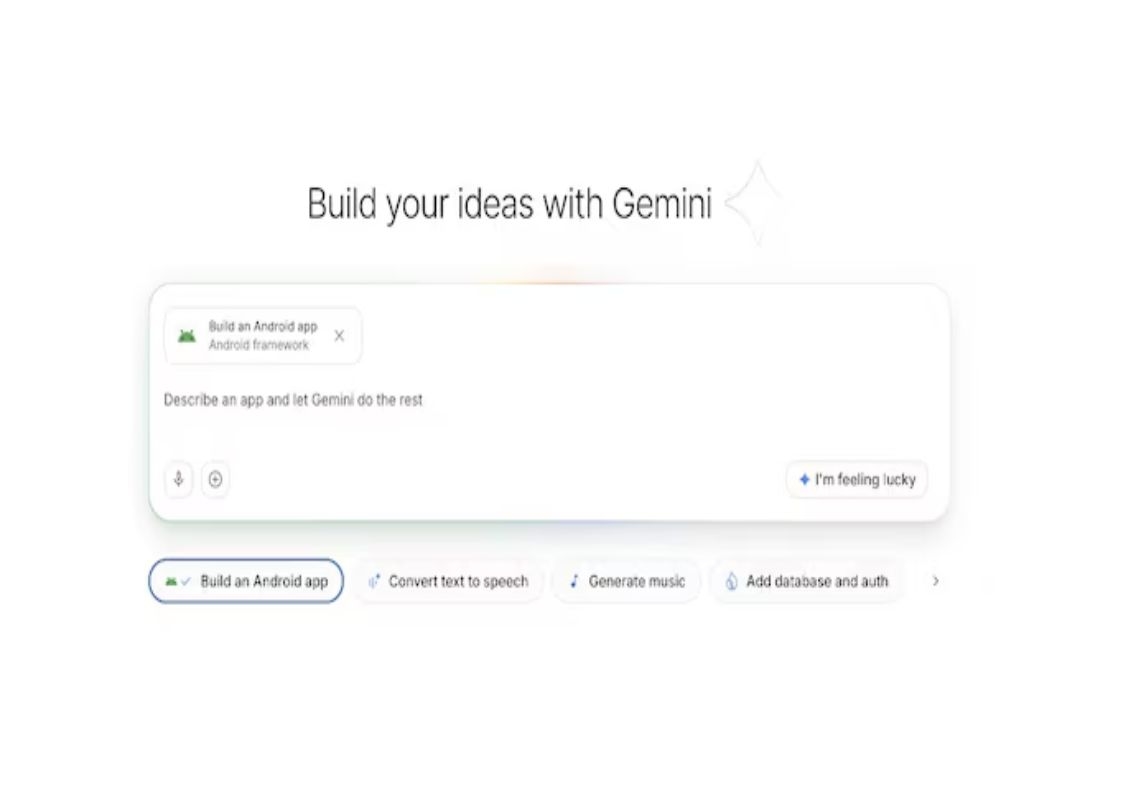


New Delhi: Google has revealed that more than 2.5 lakh Android applications were created within just one week using its free AI-powered feature in Google AI Studio. The announcement highlights how artificial intelligence is rapidly transforming app development by enabling even non-coders to build functional applications.
The update was shared by Logan Kilpatrick, who works on the company’s Gemini AI initiatives. In a post on social media platform X, he noted that the feature allowing users to build native Android apps directly within AI Studio has now been rolled out, significantly lowering the barrier to entry.
AI simplifies app development
Traditionally, building Android applications required knowledge of programming languages, frameworks and development tools. However, Google’s new approach leverages its Gemini AI system to simplify the process.
Instead of writing code manually, users can now generate apps using prompts and guided AI assistance. This means students, small business owners, hobbyists and first-time developers can create applications without prior coding experience.
According to Kilpatrick, over 99 per cent of users who built apps using the tool had never developed an Android app before. This marks a major shift in how software creation is evolving, opening up opportunities for a much wider audience.
He also highlighted the scale of the Android ecosystem, noting that it has more than 3 billion active users globally. The new feature, therefore, allows anyone to potentially build apps for a massive audience — something that would have seemed unrealistic just a few years ago.
Play Store publishing may get easier
While app creation has been simplified, publishing remains a more complex process. Currently, developers can deploy their apps to the Play test track directly from AI Studio, but full public release still requires additional steps.
Google may soon streamline this as well. Kilpatrick indicated that direct publishing to the Google Play Store from AI Studio could be introduced later this summer.
At present, developers must create a Play Console account, complete identity verification in some cases and provide essential details such as app descriptions, screenshots, icons and privacy policies. They must also comply with strict guidelines related to user data, advertising practices and content ratings.
Apps requesting sensitive permissions — such as access to location, contacts or messages — are subject to additional scrutiny. Google reviews each submission for policy violations, malware risks and misleading behaviour, with approvals sometimes taking up to seven days or longer.
Concerns over quality and discoverability
Despite the excitement around AI-driven app creation, the development has sparked debate within the tech community. Some users have raised concerns about whether such a large number of AI-generated apps can maintain quality standards.
There are also questions about discoverability — whether newly created apps will be able to stand out in an already crowded marketplace. With thousands of apps being generated rapidly, ensuring visibility and user adoption could become a major challenge.
Kilpatrick acknowledged these concerns, stating that Google is aware of the issue and may focus on solutions to improve app discovery in the future. At the same time, he emphasised that quality standards for app stores should remain high.
He also pointed out that not all apps are intended for public distribution. Many users may create applications for personal use, experimentation or learning, rather than publishing them on the Play Store.
A shift in the future of development
Interestingly, Kilpatrick revealed that he himself had never built an Android app before trying the tool internally just a few weeks ago. This underscores how accessible app development has become with the help of AI.
The rapid adoption of AI Studio reflects a broader trend in the technology industry, where generative AI tools are increasingly being used to automate complex tasks and empower non-experts.
Conclusion
Google’s latest AI feature marks a significant milestone in democratising app development. By enabling users without coding knowledge to create Android applications, the company is reshaping how software is built and who can build it.
However, challenges around quality control, app discovery and platform regulation remain. As the ecosystem evolves, balancing accessibility with reliability will be crucial.
For now, the surge in AI-generated apps signals a new era where creating software is no longer limited to trained developers, but open to anyone with an idea.