


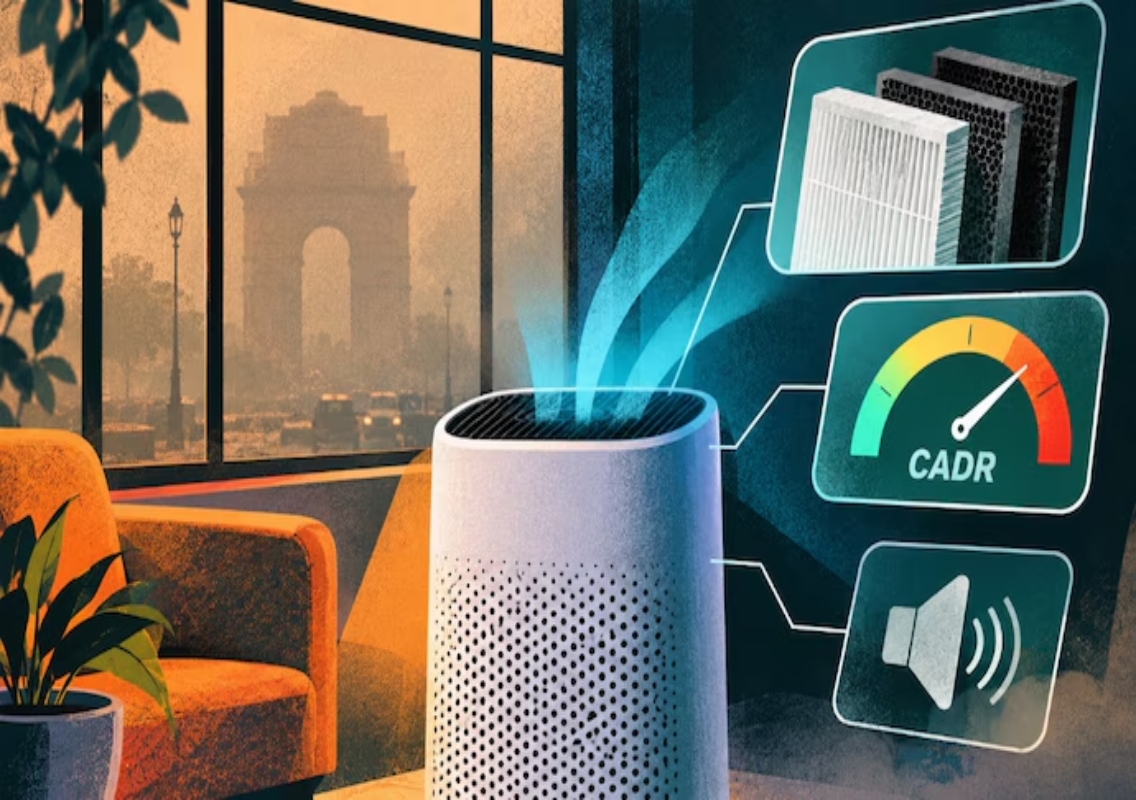


New Delhi: As air pollution levels rise across Delhi-NCR with the arrival of winter, choosing an effective air purifier has become an important consideration for households. With several models available in the market, consumers may find it difficult to identify which devices can actually reduce indoor pollution and which mainly offer attractive features.
An air purifier can help reduce exposure to airborne pollutants inside homes, but its effectiveness depends on several factors, including filter quality, room size, Clean Air Delivery Rate (CADR), maintenance costs and operating noise.
According to a report published by India Today on November 3, 2026, consumers should prioritise filtration performance and room coverage rather than simply buying the most expensive model or choosing a device based on smart features.
The report highlights the importance of True HEPA filters, activated carbon filtration and suitable CADR ratings. It also advises buyers to consider replacement-filter availability, electricity consumption and the potential risks associated with certain technologies such as ionisers and ozonators.
Why indoor air pollution is also a concern
Many people assume that staying indoors automatically protects them from outdoor air pollution. However, indoor air quality can also deteriorate when pollutants enter homes through doors, windows and ventilation systems.
Outdoor pollution, particularly fine particulate matter, can move indoors and remain suspended in the air. Everyday household activities can add to the problem.
Cooking fumes, dust, cleaning products, smoke and other indoor sources may contribute to poor air quality. In some circumstances, indoor pollution levels can become comparable to or even higher than those outdoors.
This makes indoor air management important during periods of severe pollution, especially in cities experiencing high concentrations of particulate matter.
An air purifier can help filter certain pollutants from indoor air. However, it should not be considered a complete solution to air pollution. Reducing the entry of polluted outdoor air, controlling indoor sources and maintaining adequate ventilation when outdoor conditions permit remain important.
Choose a genuine True HEPA filter
The quality of the filtration system should be the first consideration when purchasing an air purifier.
The report recommends looking for a properly specified True HEPA filter, preferably H13 or H14 grade. Under specified testing conditions, these filters can capture at least 99.97 per cent of particles measuring 0.3 microns.
Such filtration can help remove fine airborne pollutants, including PM2.5, dust, pollen and mould spores.
However, consumers should carefully examine product specifications instead of relying only on marketing descriptions.
Labels such as ‘HEPA-type’, ‘HEPA-like’ and ‘washable HEPA’ do not necessarily indicate that a filter meets the same performance standards as a certified HEPA filter.
Buyers should check the manufacturer’s technical documentation and independent test information, wherever available, before making a purchase.
A good filtration system is particularly important in areas where fine particulate pollution is a major concern.
Why activated carbon filtration matters
A HEPA filter is designed primarily to capture particles. It does not remove every gaseous pollutant or unpleasant smell.
This is where an activated carbon filter becomes useful.
Activated carbon can trap certain gases, volatile organic compounds (VOCs) and odours. It can therefore complement a HEPA filter by addressing pollutants that particle filtration alone may not effectively remove.
A well-designed air purifier generally combines multiple filtration layers.
- Pre-filter: Captures larger particles such as dust, hair and other visible debris.
- True HEPA filter: Captures fine airborne particles, including PM2.5.
- Activated carbon filter: Helps reduce certain gases, fumes and unpleasant odours.
The report advises consumers to examine the thickness and quantity of activated carbon used in a purifier. A substantial carbon layer may offer better filtration capacity than a thin carbon sheet.
This is an important consideration in polluted urban environments, where indoor air may contain a combination of particulate matter, smoke and gaseous pollutants.
Check the CADR rating before buying
Another important specification is the Clean Air Delivery Rate, commonly known as CADR.
CADR indicates how much filtered air an air purifier can deliver over a period of time. It helps buyers understand how quickly a device can clean the air in a particular room.
A higher CADR generally means that the purifier can deliver clean air more quickly, provided the device is suitable for the room and operated at the required speed.
According to the India Today report, the following figures can serve as a starting point:
| Room size | Suggested CADR |
|---|---|
| 150–200 sq. ft. | At least 250 m³/hour |
| Larger living rooms | Around 400 m³/hour or more |
These are indicative recommendations rather than universal requirements. The appropriate rating also depends on ceiling height, pollution levels, room layout and the number of people using the space.
A purifier designed for a small bedroom may not be sufficient for a large living room. Similarly, one device may not adequately clean an entire multi-room home.
Consumers should therefore match the purifier’s rated coverage with the actual size of the room where it will be used.
Understand Air Changes Per Hour
Along with CADR, buyers should examine Air Changes Per Hour (ACH).
ACH measures how many times an air purifier can process the equivalent volume of air in a room every hour.
For areas experiencing high pollution, the report recommends aiming for at least four to five air changes per hour. People with allergies or respiratory sensitivities may consider devices capable of delivering six to eight air changes per hour, depending on their requirements.
A higher ACH can help maintain cleaner indoor air, particularly when pollution levels outside are elevated.
However, the actual performance depends on the purifier’s operating speed, room dimensions and whether the device is being used in an enclosed space.
Consumers should check the manufacturer’s coverage claims and understand the conditions under which those figures were measured.
Noise levels matter, especially in bedrooms
An air purifier may offer strong filtration performance, but excessive noise can make it uncomfortable to operate for long periods.
This is particularly relevant for people planning to use the device while sleeping or working.
The report advises buyers to check noise levels at different fan speeds rather than looking only at the lowest figure advertised by manufacturers.
For bedroom use, a sleep mode producing noise below 30–35 decibels may be worth considering. Some models also dim display lights during night-time operation.
However, buyers should understand that sleep mode may reduce fan speed and consequently affect the amount of air filtered.
A device should be quiet enough for regular use while still providing sufficient air-cleaning performance for the room.
Calculate replacement-filter and electricity costs
The purchase price of an air purifier is only one part of its overall cost.
Filters need periodic replacement, and their lifespan depends on usage, pollution levels and the manufacturer’s recommendations.
In heavily polluted environments, filters may become clogged within three to six months, according to the report. This can increase the long-term cost of operating the device.
Before buying, consumers should check:
- Replacement-filter prices: Genuine filters should be reasonably priced and readily available.
- After-sales support: The company should provide warranty assistance and service in the buyer’s city.
- Electricity consumption: A purifier may operate for several hours daily, making power efficiency important.
- Filter-change indicators: These help users identify when maintenance or replacement is required.
A low-cost purifier may become expensive if replacement filters are difficult to obtain or cost a significant amount.
Buyers should also check whether the manufacturer’s stated filter lifespan is based on normal conditions or specific laboratory testing.
Be cautious about ionisers and ozonators
Many air purifiers come with additional technologies such as ionisers and ozonators. While manufacturers may promote these features as ways to improve air cleaning, consumers should understand their potential risks.
Certain ionisers and ozonators can produce ozone, which may irritate the lungs. Ozone exposure is a particular concern for people who already experience respiratory discomfort.
The report advises buyers to check whether a purifier equipped with an ioniser is certified to produce zero or negligible ozone.
Smart features such as live PM2.5 displays, automatic operating modes, timers and mobile application controls can make an air purifier more convenient. However, these features should not take priority over filtration quality and room coverage.
A device with several connected features may still be ineffective if its filter system is unsuitable for the room.
How to use an air purifier effectively
Even a high-quality air purifier may not deliver the expected results if it is incorrectly positioned or operated.
The report recommends keeping doors and windows closed while the purifier is running, particularly when outdoor pollution is high. The device should be placed away from curtains, furniture and tight corners so that air can circulate freely.
Running the purifier at a higher speed before bedtime and whenever the Air Quality Index (AQI) rises can also help improve indoor air quality.
Consumers should avoid waiting until the air smells polluted or feels uncomfortable before switching on the device.
Regular cleaning of the pre-filter, timely replacement of filters and following the manufacturer’s maintenance instructions are equally important.
It is also necessary to remember that an air purifier does not eliminate every indoor pollutant. Controlling cooking emissions, avoiding indoor smoking and reducing unnecessary sources of fumes can complement filtration.
What buyers should prioritise
The rising pollution levels in Delhi-NCR have increased interest in air purifiers, but selecting a suitable model requires more than comparing prices and brand names.
A genuine HEPA filtration system, adequate activated carbon, a suitable CADR rating and sufficient room coverage should form the basis of the purchase decision.
Noise levels, electricity consumption, replacement-filter costs and after-sales service should also be considered before selecting a model.
The most expensive air purifier is not necessarily the most suitable one. A device that matches the room size, provides effective filtration and can be maintained regularly may offer more practical value over time.
As winter pollution continues to affect urban areas, consumers should focus on understanding indoor air quality and using air purifiers correctly rather than treating them as a complete substitute for wider pollution-control measures.