







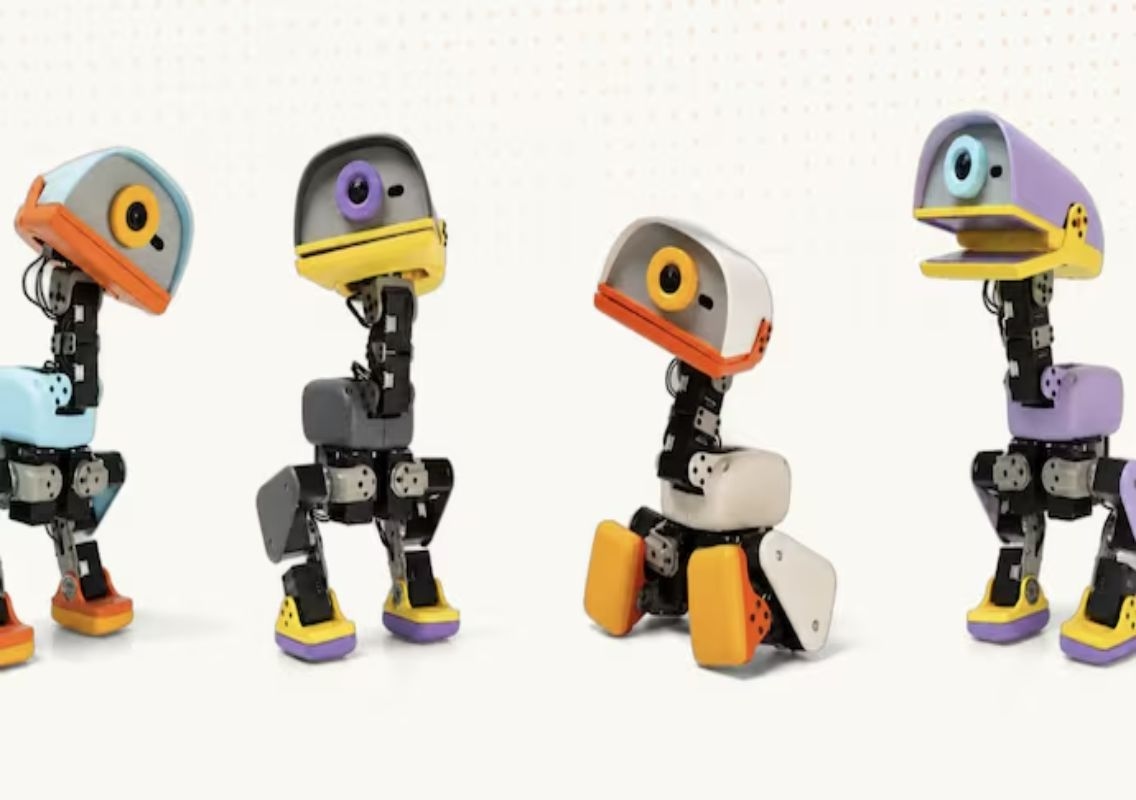


New Delhi: Artificial intelligence company Hugging Face has launched Microduck, a small open-source robot designed to let developers and enthusiasts experiment with physical AI and teach machines new behaviours.
Priced at $399, Microduck is a roughly 25-centimetre-tall, duck-shaped robot developed with French robotics company Pollen Robotics. The compact machine is designed less as a conventional household assistant and more as an accessible platform for people who want to experiment with robotics, reinforcement learning and AI systems that can interact with the physical world.
Hugging Face says Microduck can be taught new tricks using reinforcement learning, allowing users to train behaviours in simulation and then deploy them on the physical robot. The approach is intended to make physical AI experimentation more accessible to developers who may not have access to expensive industrial robots or sophisticated research laboratories.
The launch comes as the AI industry increasingly moves beyond chatbots and software agents towards systems capable of perceiving and acting in the real world. Hugging Face, which is widely known for its open-source AI model ecosystem, has been expanding into robotics through its partnership and acquisition of Pollen Robotics.
What is Microduck?
Microduck is a small bipedal robot designed to resemble a duck. It stands about 25 centimetres tall and weighs less than 1 kilogram, making it significantly smaller than many of the humanoid robots currently being developed by major technology and robotics companies.
Despite its compact size, Microduck has several capabilities that make it useful for robotics experimentation.
The robot can walk, crouch, pick up small objects using its beak-like gripper and recover after falling. Demonstrations have also shown it moving on roller skates, following a laser pointer and interacting with objects around it.
Its beak can reportedly pick up objects weighing up to around 800 grams. This means Microduck is not intended to perform heavy household work, but its mechanical capabilities are sufficient for testing manipulation and movement behaviours.
The machine is also designed to produce its own sounds, giving individual robots a distinct audio identity.
$399 price targets robotics enthusiasts
At $399, Microduck is positioned as a relatively affordable entry point into physical AI and robotics.
The price is significantly lower than many research-oriented robots, which can cost thousands of dollars or more. Hugging Face’s objective appears to be making physical AI experimentation accessible to a wider developer community rather than targeting consumers looking for a fully autonomous household robot.
The company has opened pre-orders for the robot, with shipments expected before Christmas 2026. Microduck is being offered in multiple colour options, including cream, graphite, lavender and sky blue.
The pricing strategy could be particularly important for researchers, students, hobbyists and independent developers who want to experiment with reinforcement learning without having to build a complete robot platform themselves.
Hugging Face has built much of its business and community around making AI tools and models accessible. Microduck extends that philosophy into physical machines.
The robot can learn through reinforcement learning
The most interesting feature of Microduck is not simply its appearance or price. It is the ability to train the robot to perform new behaviours.
Hugging Face describes Microduck as an open-source robot that users can teach new tricks through reinforcement learning.
Reinforcement learning allows an AI system to improve its behaviour through repeated interaction with an environment. Instead of receiving a fixed set of instructions for every movement, the system can learn which actions produce better results.
For Microduck, this can involve training a behaviour in simulation before transferring it to the physical machine.
Pollen Robotics says behaviours can be trained in simulation and then deployed directly to the robot. Developers can subsequently fine-tune the behaviour, retrain the system and deploy the updated version again.
This creates a cycle in which developers can experiment with a robot virtually before testing the resulting behaviour in the real world.
Camera, LiDAR and motion sensors power perception
Microduck is equipped with several sensors that allow it to understand its surroundings.
The robot uses a camera, LiDAR sensors and two inertial measurement units, or IMUs. The IMUs measure movement and help the robot understand its orientation and motion.
LiDAR provides another method of sensing the environment by measuring distances, while the camera provides visual information.
Together, these components allow Microduck to perceive aspects of its surroundings and respond to changes in its environment.
The hardware is powered by a Rockchip RK3566 processor, according to reporting on the robot. The machine also includes connectivity features such as Wi-Fi and Bluetooth.
These components are designed to provide enough computing and sensing capability for experimentation without turning the robot into an expensive research platform.
Open-source software is central to the project
Open-source technology is one of the biggest differences between Microduck and many consumer robotics products.
Developers are being given access to the software development kit, simulation environment and reinforcement-learning training stack. These tools are intended to allow users to modify, train and develop new behaviours for the robot.
This means Microduck is not meant to remain limited to the behaviours provided by the manufacturer.
Instead, developers can use the platform as a starting point for their own experiments.
That could include teaching the robot to navigate different environments, manipulate objects, respond to visual cues or develop entirely new movement strategies.
The availability of the training stack could also make the robot useful as an educational platform for people learning about embodied AI.
From software AI to physical AI
Microduck arrives as the technology industry increasingly shifts its attention towards embodied or physical AI.
For years, much of the AI boom has focused on systems that operate entirely in the digital world. Large language models can generate text, write software, analyse information and interact with online services.
Robotics introduces a different challenge.
An AI system operating in the physical world must deal with gravity, friction, changing environments, imperfect sensors and unpredictable objects. A robot therefore needs to translate intelligence into physical actions.
Microduck gives developers a relatively inexpensive platform on which to explore these challenges.
The robot’s small size also makes experimentation easier because it can be used in homes, classrooms, laboratories and developer environments without requiring a large dedicated space.
Hugging Face’s robotics ambitions
Microduck is not Hugging Face’s first move into physical robotics.
The company acquired French startup Pollen Robotics in April 2025, strengthening its efforts to develop affordable open-source robotics hardware. Pollen Robotics was already known for its Reachy robot platform.
The companies subsequently launched Reachy Mini, a smaller desktop robot designed for developers and AI enthusiasts. Hugging Face’s current robotics documentation describes Reachy Mini as an open-source robot aimed at hackers and AI builders.
Reachy Mini is focused heavily on building applications and integrating AI models with a physical robot.
Microduck takes a somewhat different approach by placing greater emphasis on physical movement and reinforcement learning.
The two products therefore illustrate Hugging Face’s broader interest in creating an ecosystem where developers can experiment with AI in the real world.
Microduck is not designed to replace household workers
Despite its ability to pick up objects and perform physical actions, Microduck is not a household humanoid robot.
Its small size and limited payload mean it cannot carry out substantial domestic tasks such as cleaning rooms, carrying heavy objects or performing complex chores.
Instead, the robot is best understood as a development and experimentation platform.
That distinction is important because much of the current robotics industry is focused on creating machines capable of performing useful tasks in homes, factories and warehouses.
Microduck occupies a different part of the market.
Its value lies in giving people an affordable physical platform on which they can test AI behaviours.
Privacy and open-source development
The presence of cameras and other sensors on consumer-accessible robots naturally raises privacy questions.
Microduck is designed around open-source software, which Hugging Face argues can provide developers with greater visibility and control compared with closed systems.
The company has previously argued that open-source robotics can offer privacy advantages because users have greater insight into the software running on their machines.
However, open-source technology does not automatically eliminate privacy risks. Users still need to understand what data the robot collects, where that data is processed and which applications or models have access to sensor information.
As robots become more common in homes and personal spaces, these questions are likely to become increasingly important.
A new playground for AI developers
The biggest potential impact of Microduck may be its role as a development platform.
Affordable hardware can help expand participation in robotics in the same way that affordable computers and open-source software helped expand software development.
Students can experiment with reinforcement learning, researchers can test algorithms and hobbyists can create new behaviours without requiring access to expensive robotic laboratories.
Developers can also share their work, potentially creating a community around new skills and applications for the robot.
That community-driven approach fits closely with Hugging Face’s existing open-source model ecosystem.
Conclusion
Hugging Face’s $399 Microduck represents an unusual but significant step in the company’s expansion from AI software into physical robotics.
The small duck-shaped robot combines cameras, LiDAR, motion sensors and an onboard processor with an open-source software ecosystem designed for reinforcement learning. Developers can train behaviours in simulation, deploy them on the physical robot and continue refining them through further training.
Microduck is not intended to be a fully capable household assistant. Its real purpose is to give developers, researchers and enthusiasts an affordable platform for experimenting with embodied AI.
As the technology industry moves towards AI systems that can interact with the physical world, affordable and programmable robots such as Microduck could become important development tools. Hugging Face’s bet is that making those tools open and accessible will help a much wider community participate in the next stage of the AI revolution.