







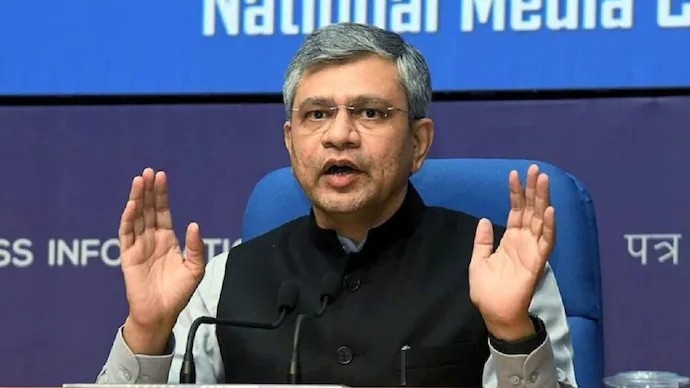


New Delhi: India is looking to deepen its smartphone manufacturing ecosystem by moving beyond assembling finished devices and producing more of the components and materials that go inside them, Union Electronics and IT Minister Ashwini Vaishnaw said as the government marked 12 years of the Make in India initiative.
Make in India was launched on September 25, 2014, with the stated objective of positioning India as a global hub for manufacturing, design and innovation. On Friday, Vaishnaw highlighted the next phase of India’s electronics manufacturing journey, saying the country is now moving towards manufacturing components used in smartphones.
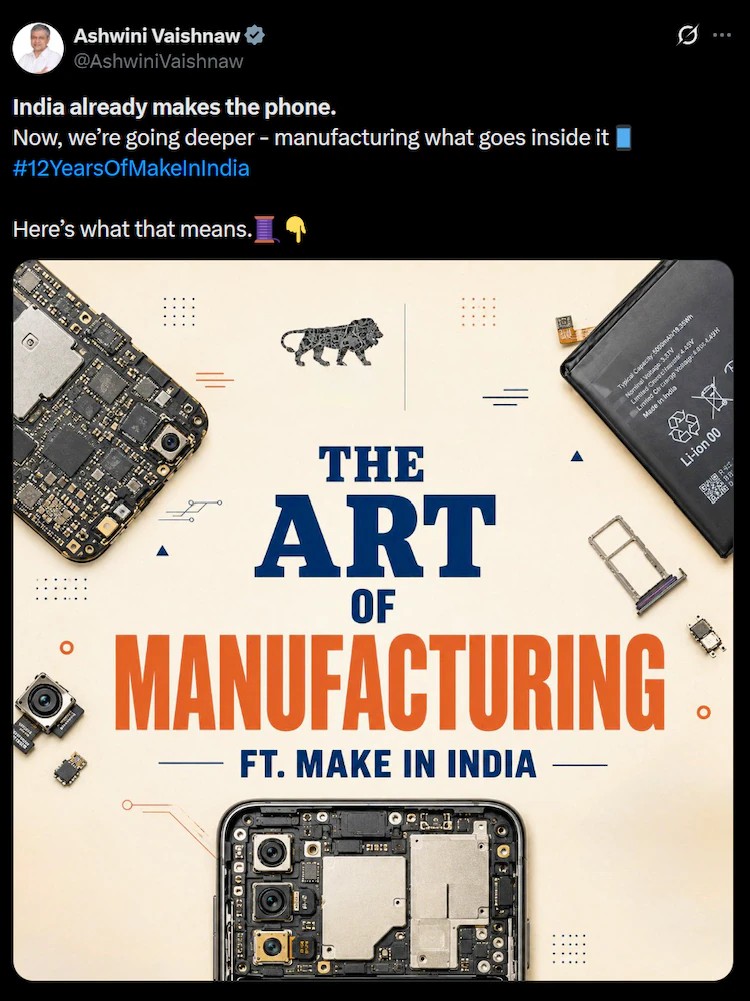
“India already makes the phone. Now, we’re going deeper – manufacturing what goes inside it,” Vaishnaw said in a post on X.
The shift is significant for India’s electronics sector, which has expanded substantially over the past 12 years. Government data shows that electronics production increased from around Rs 1.9 lakh crore in 2014-15 to an estimated Rs 13.11 lakh crore in 2025-26. Mobile phone production rose from around Rs 18,000 crore to approximately Rs 6.27 lakh crore over the same period.
India expands smartphone manufacturing base
India has emerged as the world’s second-largest mobile phone manufacturer by volume, according to government data. More than 300 mobile manufacturing units are currently operational across the country, compared with just two in 2014. Annual production has crossed 325 million mobile phones, with government figures putting the number at more than 330 million a year.
The domestic market has also undergone a major change.
In 2014-15, only 26 per cent of mobile phones sold in India were manufactured domestically. That share had increased to 99.2 per cent by FY2023-24, according to government data. The country has also moved from being a major importer of mobile phones to becoming a significant exporter.
The government’s latest manufacturing push is now focused on increasing domestic value addition rather than concentrating only on final assembly.
That means encouraging companies to manufacture more of the individual components, materials and sub-assemblies that are required to build a smartphone.
Focus shifts to components inside smartphones
A modern smartphone contains hundreds of components, ranging from batteries and displays to printed circuit boards, camera modules, speakers and other electronic parts.
Vaishnaw said India is increasingly moving into the production of these components, with the broader objective of developing a more complete electronics manufacturing ecosystem within the country.
The battery supply chain is one area where this shift is already visible.
The minister pointed to battery cells being manufactured in India and said the next stage would involve manufacturing materials used inside battery cells. This includes synthetic graphite, which is used in the anode of lithium-ion batteries.
Other materials used in batteries are also part of the emerging domestic manufacturing ecosystem. These include specialised additives used in the liquid electrolyte of lithium-ion batteries and materials such as acetylene black, which helps improve electrical conductivity.
The development of these capabilities is aimed at increasing the amount of value captured within India during the manufacturing process.
Battery manufacturing gets greater attention
Battery cells are an important part of the smartphone manufacturing supply chain, and India has been attempting to expand its domestic capacity in this area.
Vaishnaw highlighted the battery cell facility being developed by Japanese company Amperex Technology Limited (ATL) in Manesar, Haryana. The facility represents an investment of Rs 3,000 crore, according to the minister’s remarks.
The focus, however, is not limited to assembling battery cells.
The government’s stated objective is to develop capabilities further upstream, including the materials and specialised chemicals that are required in battery manufacturing.
Such localisation can potentially reduce the dependence on imported inputs while creating additional opportunities for domestic suppliers. It also forms part of the broader policy push towards increasing domestic value addition in electronics manufacturing.
More phone components being made in India
The expansion is taking place across several other parts of the smartphone ecosystem as well.
According to the government, Indian manufacturing capabilities now include components such as camera modules, display modules, speakers, coils, printed circuit boards and battery packs. Government data has also highlighted the expansion of component manufacturing alongside the growth of finished mobile phone production.
In August 2025, Vaishnaw inaugurated India’s first tempered glass manufacturing facility for mobile devices in Noida, established by Optiemus Electronics in partnership with Corning. The facility was presented as another step towards developing a wider domestic electronics supply chain.
The next challenge is to deepen this ecosystem further, including in advanced components and semiconductor-related manufacturing.
The government has separately approved Semicon 2.0 with an outlay of Rs 1.275 lakh crore to support semiconductor design, manufacturing, advanced packaging, materials, equipment, research and talent development.
Rs 62,500 crore mobile manufacturing scheme
The government’s latest policy support for the sector comes through the Mobile Phone Manufacturing Scheme (MPMS), which was approved in July 2026 with a budgetary outlay of Rs 62,500 crore.
The five-year scheme will operate from FY2026-27 to FY2030-31. Its objectives include increasing mobile phone production, deepening domestic value addition, strengthening supply-chain resilience and improving India’s global competitiveness.
The scheme provides incentives ranging from 2.25 per cent to 5 per cent for eligible mobile phone manufacturing. It also includes an additional incentive of up to 1.5 per cent linked to domestic sourcing of key components and sub-assemblies.
The scheme also has a separate focus on Indian mobile phone brands.
Under the Indian brand segment, eligible companies can receive a 5 per cent incentive, with an additional 3 per cent incentive linked to Indian design and research and development. The government has said the scheme is intended to help Indian brands capture greater economic value and develop patents in design and R&D.
The notified scheme is expected to generate around 60,000 direct jobs and drive cumulative mobile phone production of approximately Rs 39 lakh crore over its five-year duration, according to the Ministry of Electronics and Information Technology.
India strengthens its position in global smartphone supply chains
The expansion of domestic manufacturing has also coincided with a sharp increase in mobile phone exports.
Government figures show that mobile phone exports, which were negligible in 2014, crossed Rs 1.29 lakh crore in 2024. Mobile phone production value increased from Rs 18,900 crore in FY2014 to Rs 4.22 lakh crore in FY2024, according to figures released by the government in 2025.
More recently, the government said smartphones became India’s largest individual export commodity in FY2025-26.
Large global manufacturers have contributed to this expansion, while Apple’s manufacturing footprint in India has also grown significantly. The country has increasingly become part of global smartphone supply chains, particularly for devices destined for export markets.
At the same time, the government is seeking to encourage the emergence of stronger Indian brands through the new mobile phone manufacturing scheme.
From assembling phones to making what is inside
The evolution of India’s mobile manufacturing sector over the past 12 years shows a movement from importing finished phones towards domestic assembly, followed by increasing production of components and sub-assemblies.
The next stage, as outlined by Vaishnaw, is deeper component manufacturing.
That includes batteries and the materials used inside them, as well as displays, camera modules, printed circuit boards and other components. Government policy is also increasingly focused on semiconductors and other advanced technologies that could further expand the domestic electronics value chain.
As Make in India completes 12 years, the government’s current emphasis is therefore not simply on producing more smartphones but on increasing the share of the manufacturing process that takes place within India. The outcome will depend on how quickly component production, technology capabilities, supply chains and domestic brands develop in the coming years.