







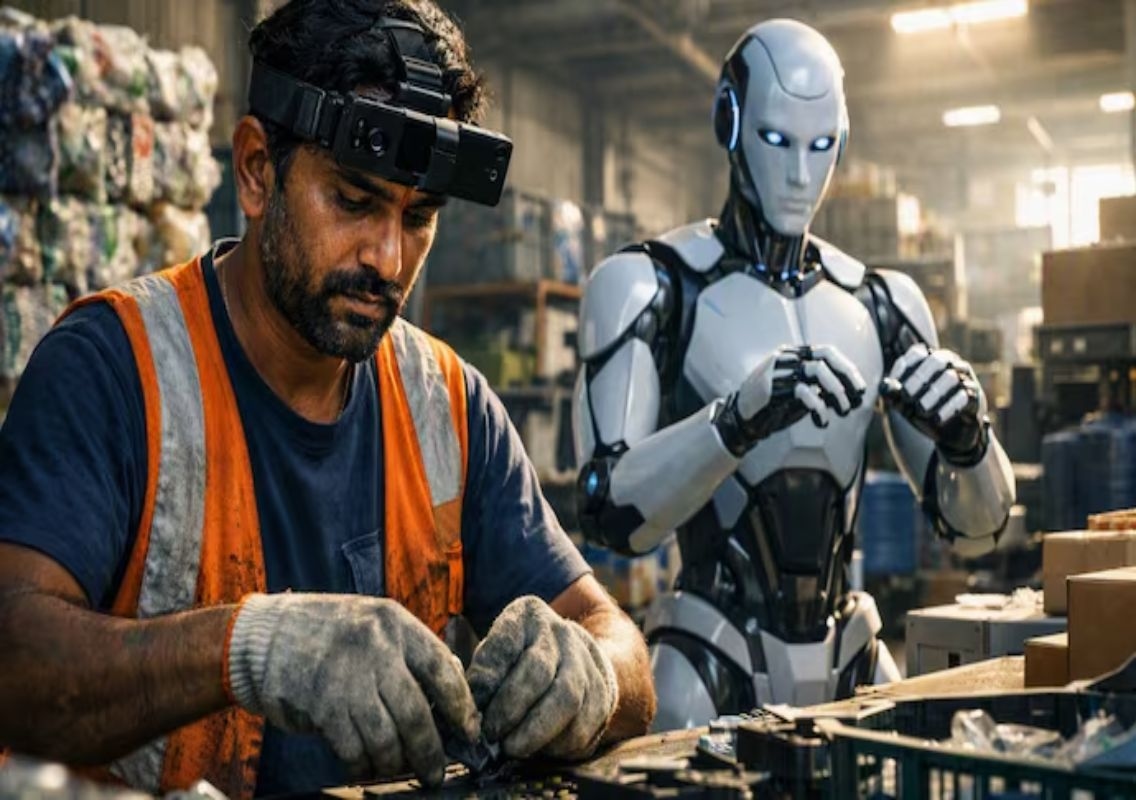


New Delhi: Indian workers are increasingly being paid to record their everyday physical tasks, unknowingly becoming part of the global race to develop humanoid robots. From recycling colonies and factories to warehouses, farms and other workplaces, people are wearing cameras and motion-tracking equipment while carrying out routine jobs. The resulting footage is used to teach robots how humans move, handle objects and perform physical tasks.
For workers, the arrangement can provide a useful additional income. But it also raises an unusual question: could the people helping robots learn today’s jobs eventually help machines take over some of those same jobs?
The issue is gaining attention as robotics companies increasingly look beyond demonstrations and attempt to build machines capable of performing practical tasks in real-world environments.
Workers are being paid to record everyday jobs
One example is 43-year-old Sunita Rathore, who works at a recycling colony on the outskirts of New Delhi. She earns around Rs 20,000 a month from her regular work sorting plastic waste.
She has now taken on an unusual additional task. An iPhone strapped to her head records her movements as she removes labels from plastic bags, sorts waste and stacks sacks. For recording this work, she receives an additional Rs 150 per hour.
Rathore reportedly does not know precisely where the footage eventually goes. For her, however, the additional income is valuable and is helping her save money for the education of her four children.
Her experience is part of a wider trend in which workers across India are being asked to record physical activities while carrying out their normal jobs.
Some use smartphones attached to caps or helmets, while others wear specialised cameras or motion-tracking gloves. The objective is to capture detailed information about how people perform tasks that robots may eventually be expected to replicate.
Why robotics companies need human movement data
Building a humanoid robot that looks impressive in a controlled demonstration is one thing. Getting that robot to reliably perform ordinary physical work is considerably more difficult.
A robot needs to understand how to approach an object, position its hands, apply the appropriate amount of force and adjust its movements when circumstances change.
Tasks such as folding, packing, welding, handling materials or picking up objects can involve thousands of subtle movements that are difficult to reproduce using conventional programming alone.
Real-world video and motion data can help robotics companies train artificial intelligence systems to understand these movements.
India is particularly valuable as a source of such data because millions of workers continue to perform manual tasks across industries ranging from manufacturing and agriculture to logistics and textiles. Some tasks that have already been automated in wealthier economies remain heavily dependent on human labour in India.
That gives robotics companies access to a huge variety of movements and working environments.
The data itself has become a valuable commodity
The recordings being collected are not necessarily treated simply as workplace videos. They can be cleaned, labelled and packaged before being supplied to robotics companies and AI laboratories.
According to the report, raw first-person video can fetch more than $7 an hour, while highly annotated footage can command between $15 and $30 an hour or even more.
This helps explain why companies are increasingly interested in collecting physical-world data.
For workers, the financial incentives can vary. At a footwear factory near Delhi, one worker reportedly receives an additional Rs 300 a day for recording his work. Elsewhere, warehouse workers have been recording themselves while packing and scanning products.
The amounts may appear relatively modest, but they can make a meaningful difference to workers whose regular incomes are limited.
The arrangement also creates a new category of work: humans performing their usual jobs while simultaneously generating training data for machines.
The unusual irony of training future replacements
The biggest question surrounding this trend is what happens if the robots eventually become capable of performing the same tasks.
Workers are effectively providing detailed examples of how jobs are done. The information can then be used to develop machines designed to perform similar physical activities.
This creates an unusual cycle. A worker may receive additional money today for recording a task, while the resulting data could contribute to technology intended to automate that task tomorrow.
That does not mean every job being recorded will inevitably disappear. Robotics adoption depends on factors such as cost, reliability, workplace safety, maintenance, regulation and whether automation is economically viable.
However, the possibility of job displacement is already part of the wider debate surrounding humanoid robots and AI-powered automation.
The technology is moving beyond purely digital tasks. While generative AI has largely focused attention on writing, coding, images and other information-based work, robotics companies are attempting to bring AI into warehouses, factories and other physical environments.
Privacy is another major concern
The growing demand for human movement data also raises questions about consent and privacy.
Workers may not always know how their recordings will be used, which company ultimately receives them or whether the footage could be combined with other information.
A camera intended to record a worker’s hands can potentially capture much more. Faces, homes, personal belongings, colleagues and other background details could appear in the footage.
This makes clear consent particularly important.
The issue becomes more complicated when workers accept the additional income because they need the money but have limited information about the eventual use of their data.
India’s Digital Personal Data Protection Act is expected to introduce stronger obligations in this area, but key provisions are not due to take effect until 2027, according to the report.
Until then, the rapid expansion of physical AI data collection is likely to keep raising questions about transparency, ownership and worker rights.
India could become a major source of robotics training data
India’s large workforce and diverse industrial base give it an important role in the development of physical AI.
Workers in footwear manufacturing, warehouses, recycling, agriculture and other sectors can provide something that simulated environments cannot always reproduce: examples of how humans actually perform tasks under real-world conditions.
For robotics companies, this data could help bridge the gap between laboratory demonstrations and machines capable of working alongside people.
For India, the development could create a new source of income and employment around data collection, annotation and robotics training. At the same time, it could accelerate automation in sectors that employ large numbers of people.
That creates a complicated economic picture. The same technology could generate new opportunities while putting pressure on existing forms of manual employment.
Workers are already thinking about a future with robots
The prospect of automation is not merely a theoretical concern for some of the workers involved.
In Bengaluru, warehouse worker Yeshwanth N has reportedly considered what he would do if robots eventually took over his job. His answer was to return to farming on his family’s land, saying that robots could not perform that work.
His response captures the uncertainty surrounding the current robotics boom.
Humanoid robots are still developing, and many demonstrations do not necessarily translate into reliable commercial deployment. But the demand for real-world training data shows that companies are investing heavily in solving the problems that currently limit these machines.
Conclusion
The growing practice of paying Indian workers to record their jobs highlights a new stage in the AI revolution. Workers are not simply using AI tools; their movements are becoming training material for machines designed to operate in the physical world.
The additional income, such as Rs 150 an hour in the case of a Delhi recycling worker, can be valuable. Yet the arrangement also raises difficult questions about consent, privacy and the future of employment.
India’s vast manual workforce could become an important source of data for the global robotics industry. Whether that ultimately creates more opportunities than it removes will depend on how quickly robots become capable, how industries adopt them and whether workers are given a meaningful role in the transition.