







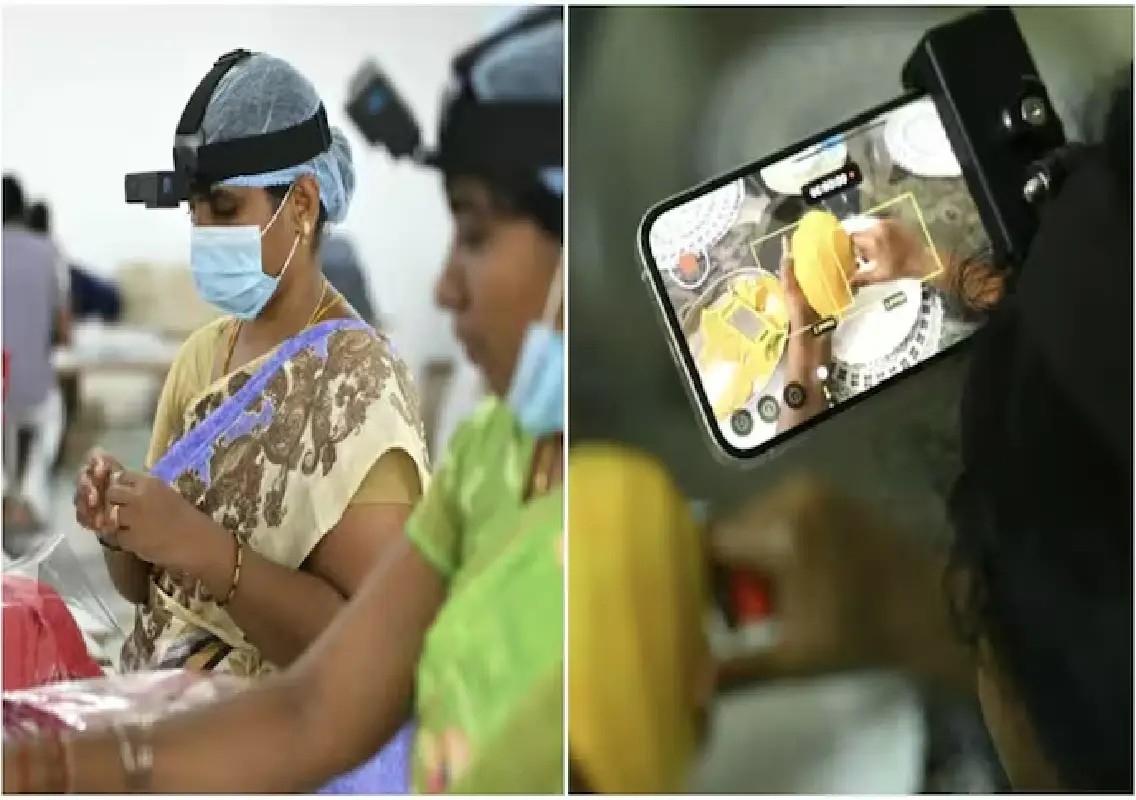


Chennai: A growing number of Indians, ranging from homemakers to factory workers, are earning extra income by recording their everyday activities to help train artificial intelligence-powered robots. The emerging trend involves participants wearing smartphones, cameras or smart devices mounted on their heads while performing routine tasks, allowing technology companies to collect valuable first-person data that can teach robots how humans interact with the physical world.
The initiative forms part of a rapidly expanding AI data industry that relies on real-world human actions to improve the capabilities of future robots. Experts believe such data could play a crucial role in developing machines capable of carrying out household, industrial and commercial tasks with greater accuracy and efficiency.
Everyday chores becoming AI training material
Among those participating in the programme is 25-year-old Nagireddy Sriramyachandra from Chennai, who spends around an hour recording herself performing household chores in exchange for Rs 250.
Using a smartphone attached to her head, she captures first-person footage of routine activities such as slicing fruits, preparing food and working in the kitchen. The recordings are later analysed and processed to help train robots to understand human movements, object handling and task execution.
According to participants, specialised applications monitor the recording process and even alert users if their hands are not clearly visible in the frame, ensuring the collected data remains useful for AI training purposes.
For many contributors, the activity offers a convenient way to earn supplementary income while carrying out tasks they would ordinarily perform at home.
Demand grows for human-centred AI data
Unlike AI chatbots and image-generation systems that primarily learn from digital content available online, robots require extensive exposure to real-world physical interactions.
Technology companies are increasingly relying on what is known as “egocentric data”—videos recorded from a person’s point of view—to bridge this gap. Such footage enables AI systems to observe how humans move, grasp objects, use tools and navigate different environments.
Workers involved in these projects often use a range of devices, including head-mounted cameras, smart glasses and motion-tracking sensors. The collected information is then labelled, analysed and integrated into machine-learning models designed to improve robotic capabilities.
The Chennai-based participant sends her recordings through a dedicated application to an AI data company operating in both India and the United States. The company reportedly serves several Fortune 500 corporations involved in advanced technology development.
India emerging as a major AI data hub
India has become an important centre for AI-related data collection, processing and annotation services, supported by its large workforce and expanding digital infrastructure.
Thousands of workers across the country are already engaged in various forms of AI data generation, including image labelling, content moderation, speech recognition and behavioural data collection.
Industry observers believe the demand for such services will continue to rise as investments in artificial intelligence and robotics accelerate globally.
The humanoid robotics industry is expected to witness substantial growth in the coming decades. Analysts project that more than one billion robots could be deployed worldwide by 2050, primarily in industrial, commercial and service-oriented sectors.
As companies race to develop machines capable of performing increasingly complex tasks, the need for high-quality human behavioural data is likely to become even more significant.
Concerns over automation and employment
While the AI data economy is creating new earning opportunities, it has also reignited concerns about the long-term impact of automation on employment.
Experts have cautioned that as robots become more capable of replicating human actions, certain categories of work may eventually face disruption.
Aditi Surie, a digital labour expert at the Indian Institute for Human Settlements in Bengaluru, observed that demand for AI-related data collection services is expected to increase substantially in the coming years. However, she also noted that discussions about artificial intelligence often focus on white-collar jobs while overlooking the challenges faced by India’s vast informal workforce.
Government policy discussions have similarly highlighted the need to understand how technological advancements may affect the country’s nearly 49 crore informal workers, many of whom rely on manual occupations for their livelihoods.
Workers express mixed feelings
Among those contributing to AI training efforts is 55-year-old Ponni, a flower garland maker from Bengaluru who has spent years working by the roadside.
Like many others, she participated in data collection by wearing a camera mounted on her forehead while carrying out her daily work. The footage was used to capture the intricate hand movements involved in crafting flower garlands.
While she welcomed the opportunity to earn additional income, Ponni expressed concern about the future impact of automation on traditional occupations.
She acknowledged that advances in robotics could create challenges for younger generations who may depend on similar forms of work for their livelihood.
A glimpse into the future of AI
The sight of people wearing cameras while carrying out ordinary daily activities may appear unusual today, but it reflects a broader transformation taking place within the global technology industry.
As artificial intelligence systems become increasingly integrated into everyday life, the actions, habits and skills of ordinary workers are becoming valuable resources for training the next generation of intelligent machines.
For now, participants continue to record routine tasks in exchange for modest payments. Yet the data they generate could help shape a future in which robots are capable of performing many of the same activities that humans undertake every day.
The trend highlights both the opportunities and challenges presented by artificial intelligence, offering new income streams for workers while simultaneously raising important questions about the future relationship between technology and employment.