







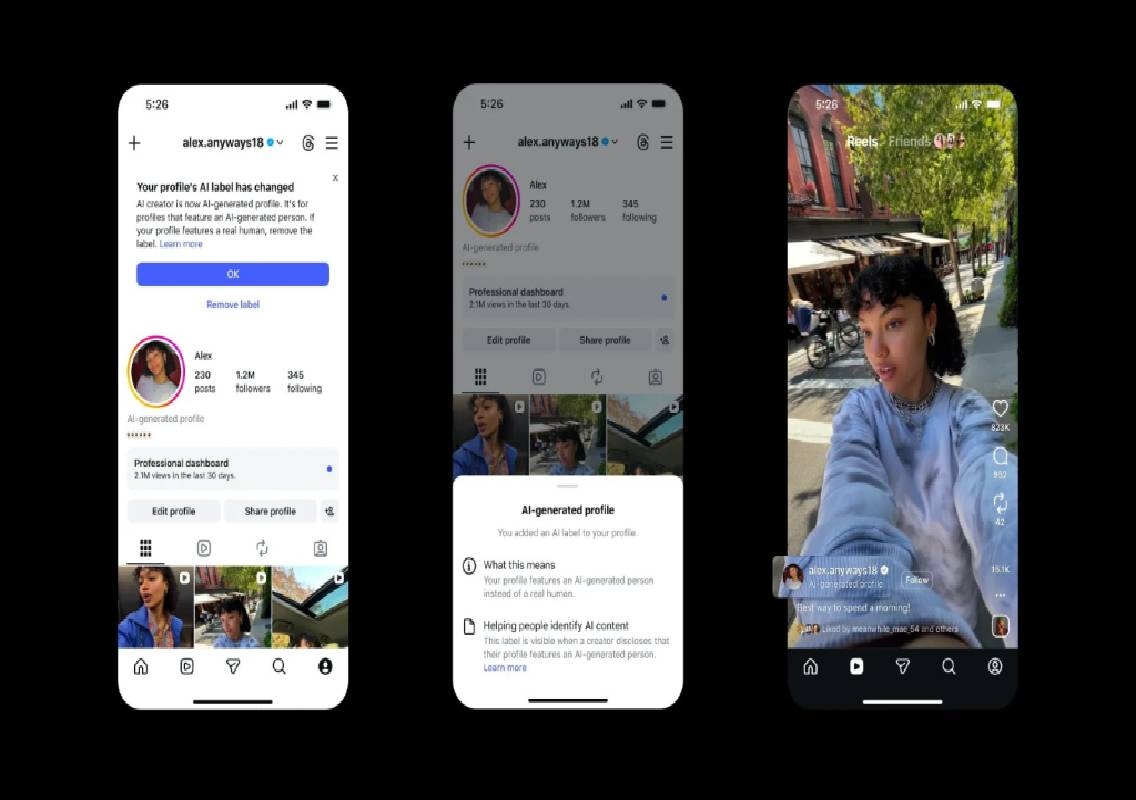


The Meta-owned platform said Tuesday that it is changing how it labels AI-generated profiles as it attempts to make it easier for users to distinguish between real people and artificially created influencers. The move comes amid the rapid growth of AI-generated personalities across social media.
The policy could have a significant impact on creators and businesses that use entirely artificial personalities to build audiences, promote products or generate advertising revenue on Instagram.
Instagram targets undisclosed AI influencers
Instagram’s latest move focuses specifically on accounts that create or present AI-generated people without making their artificial nature clear to users.
Under the updated approach, accounts that feature AI-generated people but fail to disclose the use of artificial intelligence may face reduced distribution on the platform. This means their posts may be shown to fewer people, potentially limiting their ability to build an audience through Instagram’s recommendation systems.
The change is significant because reach is one of the most important factors for influencers and creators. Accounts that rely on Instagram recommendations to reach people who do not already follow them could be particularly affected.
Instagram has increasingly used AI-generated content labels as part of its broader efforts to provide users with more information about how digital content is created.
Why AI labels matter
AI-generated images and videos can now create highly realistic people who do not exist in the real world. These artificial personalities can have photographs, videos, biographies and online identities that resemble those of conventional influencers.
Without clear disclosure, users may assume that they are interacting with a real person.
Instagram’s new approach is therefore aimed at increasing transparency around AI-generated personalities. By making the artificial nature of such accounts clearer, the platform wants users to have more context when viewing content.
The issue has become increasingly important as generative AI tools have become easier to use and capable of producing increasingly realistic images, videos and digital characters.
Reach could be reduced for accounts that do not disclose AI use
The most significant consequence of the updated policy is the potential reduction in reach.
Instagram’s recommendation systems can introduce posts and accounts to users who do not follow them. This discovery mechanism is central to the growth of many influencers and creators.
If an account’s content is given less distribution because it fails to comply with AI disclosure requirements, its ability to attract new followers could be affected.
For AI influencers that have built businesses around sponsored posts, virtual modelling, entertainment or other commercial activities, reduced reach could also have financial implications.
The policy therefore goes beyond simply adding a label to an image or video. It could affect how successfully undisclosed AI-generated personalities can grow on the platform.
Rise of virtual influencers
Virtual influencers are not entirely new. Digital personalities have existed on social media for years, with some attracting large audiences and commercial partnerships.
However, generative AI has lowered the technical barriers to creating convincing artificial people.
Creators can now produce realistic faces, fashion shoots, lifestyle images and videos without employing a conventional model or maintaining a physical production environment.
This has opened opportunities for businesses and creators but has also raised questions about transparency, authenticity and the possibility of misleading audiences.
Instagram’s latest policy reflects the growing challenge faced by social media platforms as they attempt to distinguish synthetic media from content involving real people.
Impact on creators and brands
The new approach could require creators using AI-generated personalities to review how they present their accounts and content.
Brands working with virtual influencers may also need to consider how AI-generated personalities are disclosed to audiences.
Clear labelling could become increasingly important as companies explore AI-generated models and digital characters for advertising campaigns.
For legitimate virtual influencers, the policy does not necessarily prevent them from operating on Instagram. Instead, the emphasis is on disclosure and transparency.
The distinction is important because AI-generated content itself is not necessarily prohibited. The concern is the presentation of artificial people as if they were real without adequate disclosure.
Users may find it easier to identify synthetic content
For ordinary Instagram users, clearer AI labelling could make it easier to understand the content appearing in their feeds.
Highly realistic AI-generated images can make it difficult to determine whether a photograph represents a real person, a digitally altered individual or a completely artificial character.
Labels can provide an additional signal that helps users assess the content they are viewing.
However, labels alone may not eliminate the challenges posed by synthetic media. AI-generated content is becoming increasingly sophisticated, and users may still need to rely on context and other information when evaluating what they see online.
Broader debate over AI-generated content
Instagram’s move is part of a wider debate surrounding transparency in AI-generated media.
Social media platforms are under increasing pressure to ensure that users are not misled by synthetic images, videos or accounts. This is particularly relevant when artificial content involves public figures, political subjects, commercial promotions or fabricated personal identities.
The challenge for platforms is to balance transparency with the creative possibilities offered by generative AI.
AI tools can help creators produce entertainment, artwork, advertising and other forms of digital content. At the same time, the technology can be used to create deceptive identities or misleading material.
What the policy means for AI creators
For creators operating AI influencer accounts, the latest Instagram policy means disclosure is becoming increasingly important.
Creators who clearly identify their virtual personalities as AI-generated may be able to continue building audiences while providing users with appropriate context.
Those who fail to disclose the artificial nature of their accounts could face reduced visibility.
The change could therefore encourage a shift towards greater transparency among virtual influencers and businesses using AI-generated personalities.
Instagram continues to expand AI-related safeguards
The policy comes as Instagram and its parent company Meta continue to develop approaches for identifying and labelling AI-generated content.
The platform has been working to give users more information about content created or modified using artificial intelligence. The latest move specifically focuses attention on AI-generated people and influencer accounts.
The development reflects the growing scale of synthetic media across social platforms and the need for platforms to adapt their policies as AI technology evolves.
A new challenge for the influencer economy
The influencer economy has traditionally relied on the connection between creators and audiences. Followers often engage with influencers because they perceive them as real people sharing personal experiences, opinions and lifestyles.
AI influencers challenge that traditional relationship.
A virtual personality can potentially have a consistent identity, appearance and online presence without having a real human behind the character in the conventional sense.
Instagram’s latest move indicates that the platform sees transparency as an important part of managing this emerging category.
For creators, the message is increasingly clear: using AI to build an online personality may be possible, but hiding that artificial nature could come with consequences for visibility.
Conclusion:
Instagram is moving to limit the reach of AI-generated influencer accounts that fail to disclose their artificial nature. The policy aims to give users greater transparency while placing new responsibilities on creators and brands using virtual personalities. As AI-generated content becomes more realistic, clear disclosure is likely to become an increasingly important part of social media publishing.