







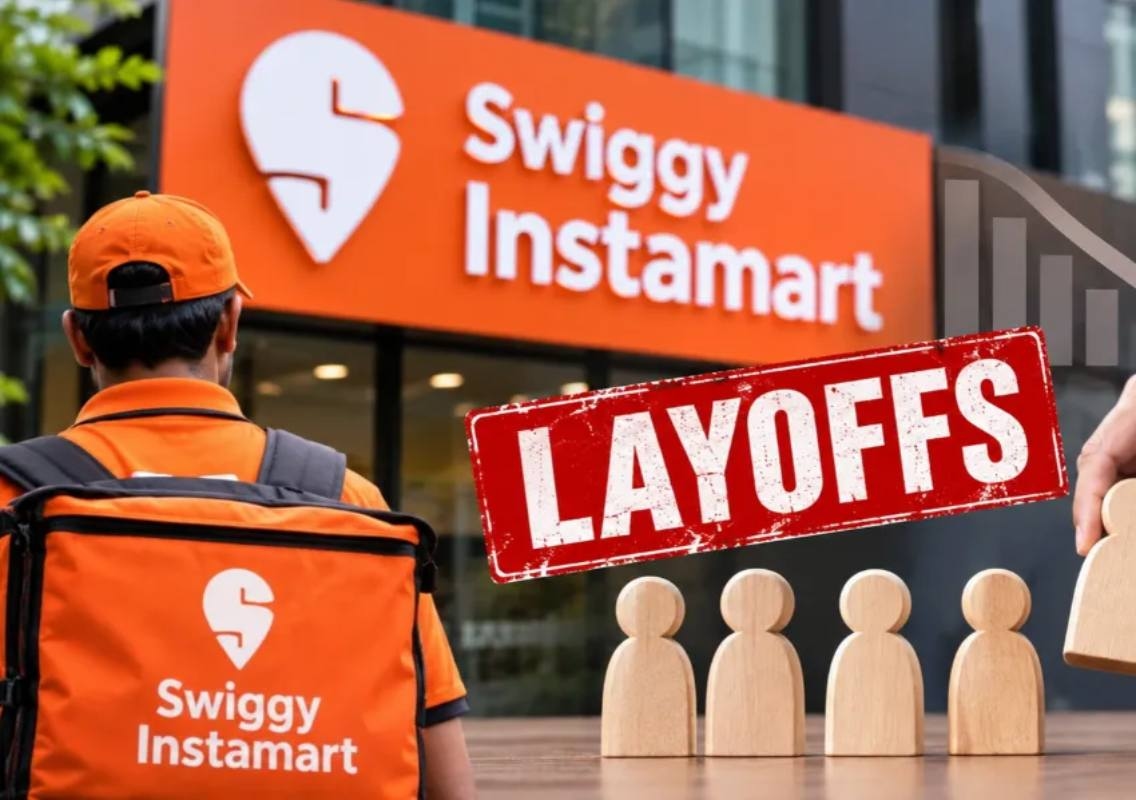


Bengaluru: Swiggy‘s quick commerce business Instamart is reportedly planning to lay off around 340 employees as part of a restructuring exercise, according to a report, people familiar with the matter. The reported job cuts come amid mounting competition in the quick commerce sector and widening losses at the business.
The proposed layoffs mark the first major restructuring move at Instamart under its new CEO, Nandita Sinha, who took charge of the business on August 3, succeeding Amitesh Jha. Sinha previously headed fashion e-commerce platform Myntra.
The restructuring comes at a time when Instamart is under increasing pressure to improve operational efficiency and strengthen its position against rivals such as Blinkit and Amazon Now.
Instamart’s losses widen in September quarter
Instamart’s financial performance has become a key concern as the quick commerce business continues to invest in growth, infrastructure and competition-driven expansion.
The business reported an adjusted EBITDA loss of Rs 895 crore in the September quarter, compared with Rs 778 crore in the preceding quarter. The loss increased by Rs 117 crore sequentially, representing a rise of approximately 15%.
The increase in losses highlights the financial pressures facing quick commerce platforms as they compete through faster deliveries, wider product selection, store expansion and customer acquisition strategies.
Despite the rise in losses, Swiggy has indicated that it believes Instamart’s losses may have peaked, suggesting that the company expects financial performance to improve as its business strategy evolves.
At the consolidated level, Swiggy reported a net loss of Rs 922 crore in the September quarter, compared with Rs 1,092 crore during the corresponding quarter of the previous year. The narrowing of the consolidated loss reflects developments across the company’s broader businesses, although Instamart continues to face challenges.
Instamart launches private labels amid competition
Alongside the reported restructuring, Instamart is continuing to expand its product offerings and strengthen its position in the quick commerce market through the introduction of private-label brands.
The company recently launched two private labels, Noice and Nectr, targeting different grocery categories.
- Noice: Focuses on snacks and beverages.
- Nectr: Focuses on fresh fruits and vegetables.
The introduction of private labels allows Instamart to expand its presence in categories where customers frequently purchase grocery and household products. Private-label offerings can also help platforms differentiate their product assortment and potentially improve margins, depending on sourcing, pricing and operating costs.
The launches come as Instamart competes with established quick commerce players, including Blinkit and Amazon Now, which are expanding their offerings and strengthening their delivery networks.
Swiggy plans transition to inventory-led model
Swiggy is also preparing for a significant change in Instamart’s business operations by transitioning towards an inventory-led model.
In its shareholder letter accompanying the September-quarter results, Swiggy said it would begin moving towards an inventory-led business model from the middle of the third quarter of FY27. The company expects the transition to take between two and three quarters.
Under an inventory-led model, the platform takes ownership of the goods it sells rather than relying primarily on arrangements in which third-party sellers hold the inventory. The approach can give the company greater control over product availability, assortment, inventory management and fulfilment operations.
The planned shift represents a significant change in Instamart’s operating structure and is expected to be implemented gradually.
However, the report on the proposed layoffs did not specify which departments or employee teams would be affected. It also did not establish whether the reported job cuts were directly connected to the planned inventory-led transition.
Swiggy’s corporate restructuring and quick commerce strategy
Swiggy transitioned to an Indian-owned and controlled company in August, marking another significant development in its corporate structure. The same month, Nandita Sinha took charge of Instamart.
The combination of leadership changes, reported workforce reductions, private-label launches and the planned inventory transition reflects the broader strategic adjustments taking place within the quick commerce business.
The sector has become increasingly competitive, with companies investing in delivery infrastructure, product assortment, technology, customer retention and operational efficiency. These investments have also intensified pressure on businesses to manage costs while maintaining growth.
Instamart’s reported restructuring comes as Swiggy attempts to balance expansion with financial discipline. Whether the planned changes will help reduce losses and strengthen the business will depend on how the company executes its operational transition and responds to competition in the months ahead.