










New Delhi: The iPhone, long seen as a premium and often out-of-reach device for many Indians, has gradually become more affordable over the past decade. While it may still appear expensive at first glance, a closer look at inflation, income growth, and Apple’s pricing strategy reveals a significant shift. Much of the credit for this transformation is attributed to Apple CEO Tim Cook, who is set to step down later this year.
The affordability argument explained
At first, the claim that iPhones are now more affordable in India may seem surprising. After all, spending Rs 70,000 to Rs 80,000 on a smartphone still feels like a major expense. However, affordability is not just about the absolute price—it is about purchasing power and relative cost over time.
To understand this, let us go back to 2016, when Apple launched the iPhone 7 in India at a starting price of around Rs 60,000. When adjusted for inflation, that price translates to approximately Rs 94,000 in today’s terms.
In comparison, the latest iPhone 17 is priced at around Rs 82,900, while the more affordable iPhone 17e starts at Rs 64,900. This means that, in real terms, the cost of owning a current-generation iPhone has decreased over time.
Income growth makes a difference
Another key factor in affordability is income growth. In 2016, India’s per capita income stood at approximately Rs 1,59,365. At that time, purchasing an iPhone 7 would have required nearly 37 per cent of an average annual income.
Fast forward to 2026, and the per capita income is estimated to be around Rs 2,62,621. With the iPhone 17 priced at Rs 82,900, it now accounts for roughly 31 per cent of the average annual income.
While this does not mean iPhones are “cheap,” it clearly shows that they have become more accessible relative to earnings.
Apple’s pricing strategy under Tim Cook
The shift in affordability did not happen through direct price cuts. Instead, Apple adopted a long-term pricing strategy under Tim Cook that focused on stability.
For instance, the iPhone 11 launched in 2019 at Rs 64,900, which would be equivalent to around Rs 88,000 today after inflation. The following year, Apple introduced the iPhone 12 at Rs 79,900, alongside a more affordable Mini variant.
What stands out is that from the iPhone 12 through to the iPhone 16, Apple kept the base price unchanged at Rs 79,900 for nearly five years. This period included global disruptions such as the COVID-19 pandemic, rising inflation, and supply chain challenges.
By holding prices steady while costs increased globally, Apple effectively made the iPhone more affordable over time.
Manufacturing in India and supply chain efficiency
One of Tim Cook’s biggest strengths has been supply chain management. Under his leadership, Apple expanded its manufacturing footprint in India, reducing reliance on imports from countries like China.
Local production helped Apple avoid high import duties and stabilise pricing in the Indian market. This strategic move played a crucial role in keeping iPhone prices competitive despite global economic pressures.
A broader product strategy for India
Apple also adapted its sales strategy specifically for India. Unlike some markets where older models are quickly discontinued, Apple continues to sell previous-generation iPhones at reduced prices.
For example, the iPhone 15 is currently available for under Rs 60,000, offering a more affordable entry point into the Apple ecosystem. This multi-tier pricing approach allows consumers to choose from a range of devices based on their budget.
Additionally, e-commerce platforms such as Flipkart and Amazon frequently offer discounts during major sales events. Combined with EMI options, these deals significantly reduce the upfront cost for buyers.

Changing consumer landscape
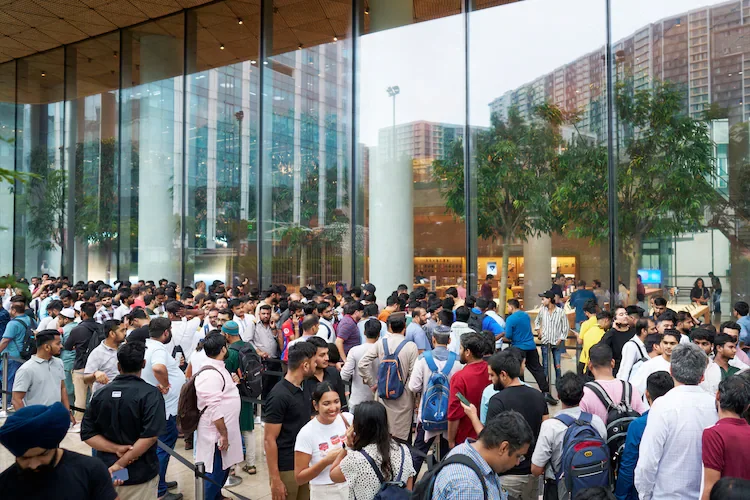
The increased affordability of iPhones is also visible in everyday life. Compared to 2016, more people in urban India now own iPhones, especially in corporate environments and among younger professionals.
This shift is not just anecdotal—it reflects Apple’s evolving strategy in India, where it has focused on long-term growth rather than short-term price cuts.
Conclusion
While iPhones remain premium devices, they are undeniably more affordable in India today than they were a decade ago. Through a combination of stable pricing, local manufacturing, and a diversified product strategy, Apple has gradually lowered the barrier to entry.
As Tim Cook prepares to transition out of his role, his legacy in India will likely include not just record revenues, but also making the iPhone more accessible to a wider audience.