







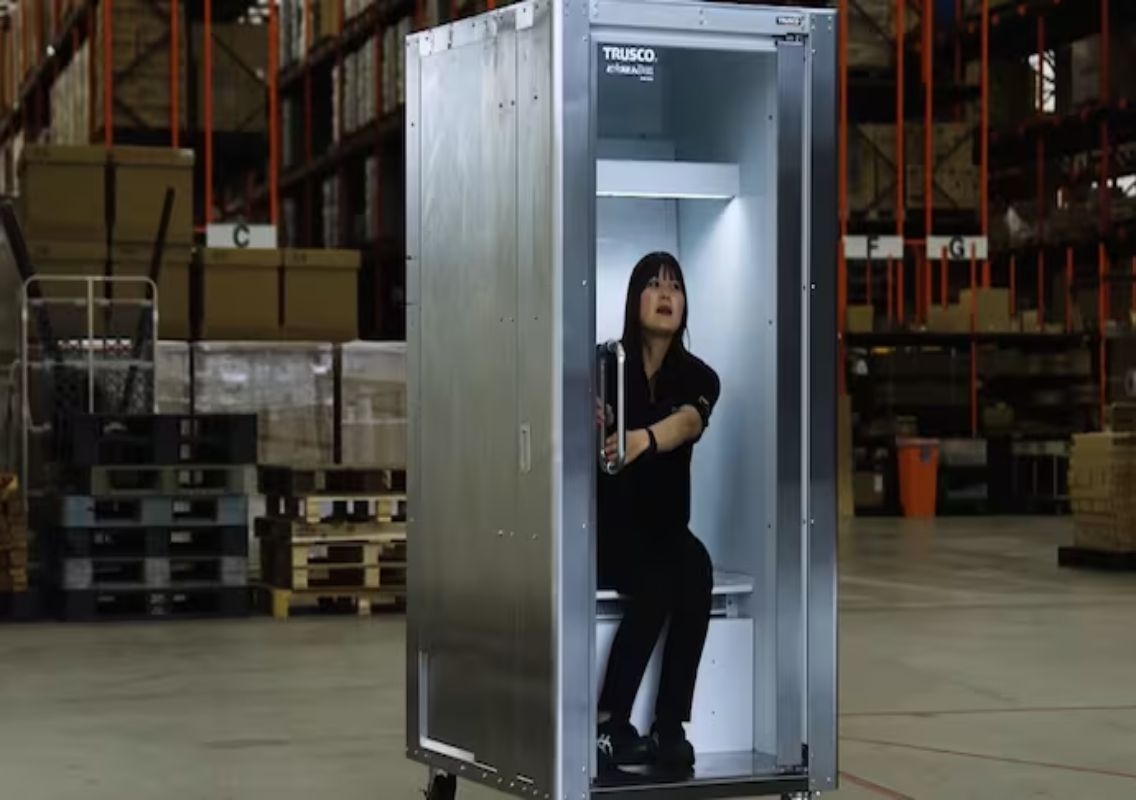


Tokyo: Japan has introduced a futuristic cooling booth called the Do Hiemon Box, a one-person “human refrigerator” designed to provide quick relief from extreme summer heat. Developed to help people working in high-temperature environments, the device can lower body temperature within minutes and reduce the risk of heat-related illnesses.
The innovative cooling cabin has been developed by Japanese refrigeration and vending machine manufacturer SDRS and is sold by industrial equipment supplier Trusco Nakayama. Designed like a compact metal cabin with a transparent door, the device allows users to step inside, sit down and cool themselves using controlled cold air.
As Japan continues to experience intense summer temperatures and increasing concerns over heatstroke, the Do Hiemon Box is being positioned as a practical solution for workers exposed to prolonged heat.
How the Do Hiemon Box works
The Do Hiemon Box resembles a small refrigerator cabin but is specially designed for human use. According to the company, users enter the booth, sit on the built-in seat and close the glass door before the cooling system begins operating.
The cabin maintains an internal temperature of around 15 degrees Celsius. Additionally, chilled air at around 5 degrees Celsius is directed towards key areas of the body, including the head, neck, shoulders and back.
The company claims that users begin feeling significantly cooler within around five minutes. A 10-minute session is designed to help reduce body temperature and provide relief from early symptoms of heat exhaustion.
The cooling booth also includes three different cooling modes, allowing users to select their preferred level of comfort. For safety, the system automatically switches off after 20 minutes to prevent excessive cooling.
Designed for workers facing extreme heat
The Do Hiemon Box is primarily aimed at people who spend long hours working outdoors or in hot industrial environments.
The company has identified several groups that could benefit from the technology, including:
- Construction workers
- Factory employees
- Warehouse staff
- Outdoor event workers
- Industrial workers exposed to high temperatures
Unlike traditional air-conditioning systems that cool large areas, the booth focuses on providing immediate personal cooling. This makes it useful in locations where installing large cooling systems may not be practical.
The device does not require permanent installation and can be used both indoors and outdoors. It is also fitted with wheels, allowing businesses to move it between different locations depending on requirements.
Energy-efficient alternative to traditional cooling
Apart from providing rapid cooling, the Do Hiemon Box is designed to consume less energy compared with conventional spot air conditioners.
The company claims that the cooling booth uses around half the electricity of a standard spot air-conditioning unit. This could make it an attractive option for workplaces looking for energy-efficient methods to manage rising temperatures.
With climate change contributing to more frequent heatwaves across several regions, companies are increasingly exploring new ways to protect workers while managing energy consumption.
Inspired by futuristic ideas but built for industries
The concept of a “human refrigerator” may appear similar to something from a futuristic cartoon, but the Do Hiemon Box has a practical purpose.
Rather than being designed for household use, the device targets commercial and industrial customers. Businesses, factories, warehouses and construction companies are expected to be the primary buyers due to the cost and intended usage.
The booth provides a dedicated cooling space where workers can take short breaks during extreme heat conditions instead of relying only on fans, water breaks or traditional cooling systems.
High price limits personal use
While the technology has attracted attention for its unique design, the Do Hiemon Box is not currently aimed at individual consumers.
The standard model is priced at 1.5 million yen (around Rs 8.8 lakh), making it more suitable for businesses and organisations rather than personal buyers.
However, as heat-related health risks increase globally, similar personal cooling technologies could become more common in workplaces and public spaces in the future.
Growing demand for heat protection solutions
Japan has been facing repeated challenges from rising summer temperatures, with authorities warning people about the dangers of heatstroke. Outdoor workers are particularly vulnerable because they often spend several hours exposed to direct sunlight and high temperatures.
Technologies like the Do Hiemon Box represent a shift towards more targeted cooling solutions that focus on individual protection rather than cooling entire buildings.
Experts believe that workplace heat management will become increasingly important as global temperatures continue to rise. Employers may need to invest in better cooling infrastructure, flexible working schedules and improved safety measures.
Conclusion
Japan’s Do Hiemon Box offers a unique approach to tackling extreme summer heat by creating a personal cooling space that can lower body temperature within minutes. While the device is currently targeted mainly at businesses due to its high cost, it highlights the growing demand for innovative solutions to protect people from heat-related illnesses in a warming world.