







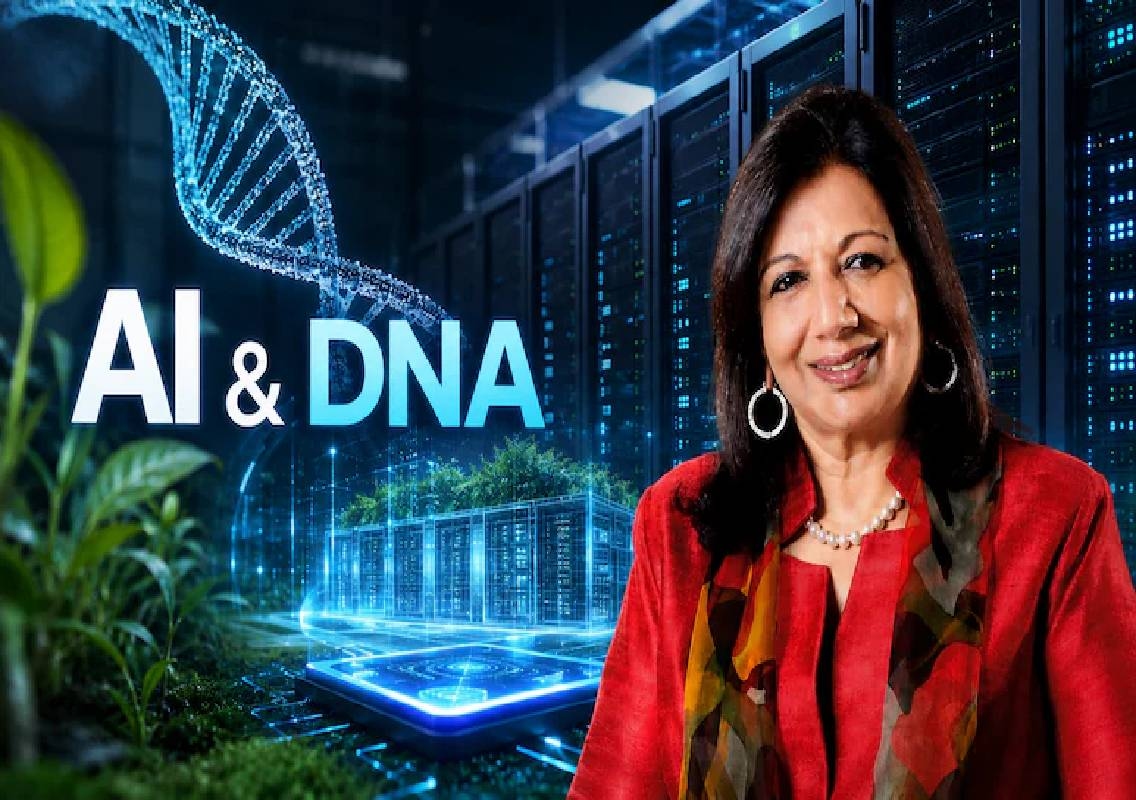


Bengaluru: Biocon founder Kiran Mazumdar-Shaw believes DNA-based data storage could become a transformative solution to the growing energy and infrastructure challenges posed by artificial intelligence (AI), although she acknowledged the technology remains in its early stages.
In an exclusive interview with NDTV Profit, Mazumdar-Shaw said the future of computing may not be driven solely by silicon chips and conventional data centres. Instead, she argued that biology could play a far greater role in powering next-generation AI systems.
Her remarks come as AI adoption accelerates globally, driving unprecedented demand for data centres that consume vast amounts of electricity, water and specialised hardware.
DNA-based data centres could address AI’s resource challenges
Responding to concerns over the environmental footprint of modern data centres, Mazumdar-Shaw suggested that DNA-based storage could provide a long-term solution.
“DNA-based data centres could solve some of these problems,” she said.
When asked how close the technology is to commercial reality, she described it as “blue skies thinking” but stressed that breakthrough innovations often evolve faster than expected.
“It’s blue skies thinking at the moment. But we should never shy away from blue skies thinking. These things can happen much faster than ever,” she said.
Her comments reflect growing interest among scientists and technology companies in exploring biological alternatives to conventional digital storage.
Biology could reshape the future of artificial intelligence
Mazumdar-Shaw also suggested that biology may eventually become central to AI itself.
Rather than viewing AI purely through the lens of machine learning and large language models, she believes computational biology could unlock more advanced forms of intelligence.
“I believe that biology is going to play a very important role in AI. It’s not going to be artificial intelligence, it’s going to be biological,” she said.
According to her, future advances in computational biology could produce more powerful and efficient computing models than today’s AI architectures.
Why scientists are exploring DNA for data storage
Mazumdar-Shaw’s views align with a growing body of scientific research investigating DNA as an alternative medium for storing digital information.
Researchers have highlighted several advantages of DNA storage:
- Extremely high storage density
- Long-term durability
- Low energy requirements
- Minimal physical storage space
According to research published in Nature Reviews Genetics, DNA offers a promising solution to the widening gap between the volume of data being generated globally and the world’s storage capacity.
Another study published in Nature found that DNA can store up to a billion times more information than traditional silicon-based storage within the same physical volume. Under suitable conditions, DNA-encoded information can remain stable for centuries.
Potential benefits over conventional data centres
The rapid expansion of AI has significantly increased demand for large-scale data centres, which require:
- Massive electricity consumption
- Continuous cooling systems
- Significant water usage
- Large quantities of semiconductors and rare-earth materials
Scientists believe DNA-based storage could substantially reduce some of these requirements because DNA molecules naturally possess exceptional information density while requiring far less physical space.
A 2025 study published in Nature Communications identified DNA’s storage density, longevity and energy efficiency as key reasons it could become an important future storage technology.
Commercial adoption still years away
Despite its promise, DNA data storage remains largely confined to research laboratories.
Experts note that several technological challenges still need to be addressed before commercial deployment becomes viable.
Among the biggest hurdles are:
- Faster data writing speeds
- Quicker data retrieval
- Lower production costs
- Scalability for enterprise applications
Until these challenges are overcome, conventional semiconductor-based storage technologies are expected to remain the dominant solution for AI infrastructure.
AI infrastructure demand continues to rise
The discussion around alternative storage technologies comes as AI adoption continues to accelerate across industries.
Technology companies worldwide are investing billions of dollars in new AI data centres to support increasingly sophisticated models and applications. This rapid expansion has intensified concerns over electricity demand, water consumption and the sustainability of existing computing infrastructure.
As governments and businesses seek greener alternatives, research into biological computing and DNA storage is gaining greater attention.
Conclusion
While DNA-based data centres are still far from widespread commercial use, Kiran Mazumdar-Shaw believes biology could eventually transform how the world stores and processes information. Her remarks highlight an emerging area of scientific research that aims to address one of AI’s biggest long-term challenges—building computing infrastructure that is both powerful and sustainable.
For now, DNA storage remains an experimental technology, but continued advances in biotechnology and computational biology could bring it closer to real-world applications in the years ahead.