







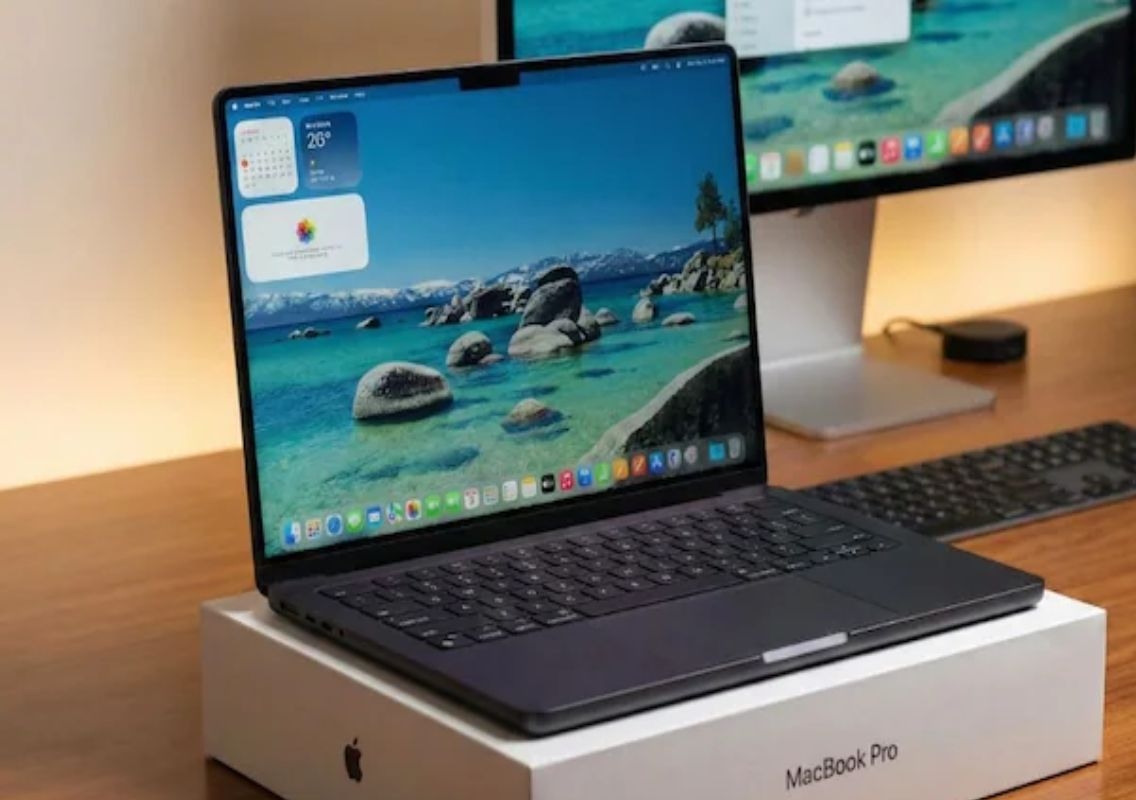


Cupertino: Apple could introduce a new high-end MacBook Ultra later this year, bringing a major design and hardware shift to the company’s laptop lineup. Rumours suggest the premium MacBook could sit above the existing MacBook Pro range and introduce features such as an OLED display, touchscreen support, a reinforced hinge, a thinner body and a Dynamic Island-style display cutout.
The upcoming machine is expected to complement rather than replace the existing MacBook Pro models powered by Apple’s M5 Pro and M5 Max chips. If the reported changes materialise, the MacBook Ultra could become Apple’s most ambitious laptop yet and mark a significant departure from the company’s current MacBook design philosophy.
Here are seven changes that could make the MacBook Ultra different from existing MacBook Pro models.
1. OLED display could replace mini-LED
One of the biggest upgrades expected on the MacBook Ultra is an OLED display.
Current high-end MacBook Pro models use mini-LED technology, which already offers excellent brightness, contrast and HDR performance. OLED could take those capabilities further by allowing individual pixels to switch off completely when displaying black.
This would result in deeper blacks, stronger contrast and potentially improved HDR performance.
Reports from Bloomberg’s Mark Gurman and analyst Ming-Chi Kuo have previously pointed towards OLED MacBook models. Samsung Display has also reportedly been preparing to supply OLED panels for Apple’s future laptops.
For professional users who work with photography, video editing, graphic design and other visually demanding applications, the display could become one of the MacBook Ultra’s biggest selling points.
The move to OLED would also bring Apple’s premium MacBook closer to the display technology already used across many high-end smartphones and tablets.
2. Apple may finally add a touchscreen
The MacBook Ultra could also introduce a feature Apple has avoided on its laptops for years: a touchscreen.
Apple has traditionally kept touch-based interfaces on the iPhone and iPad while relying on the trackpad and mouse for Mac computers. A touchscreen MacBook would therefore represent a major change in the company’s approach to laptop design.
The reported device could allow users to interact directly with applications and controls on the display while retaining the traditional trackpad and mouse experience.
The touchscreen would not necessarily replace the trackpad. Instead, Apple could give users multiple ways to interact with macOS depending on the task.
Recent reports about touch-friendly features appearing in upcoming versions of macOS have added further speculation that Apple could be preparing the software ecosystem for touch-enabled Macs.
If launched, the MacBook Ultra could therefore become the first major MacBook to combine Apple’s conventional desktop interface with direct touch interaction.
3. A stronger hinge could support touch input
Adding a touchscreen would create a new engineering challenge for Apple.
Laptop displays can move slightly when users tap them, particularly when the hinge is designed primarily for opening and closing the computer rather than supporting frequent touch interactions.
Apple is reportedly developing a reinforced hinge and display structure for the new MacBook.
The stronger mechanism could help keep the screen stable when users interact with it using their fingers. This would be particularly important for a premium laptop positioned as Apple’s most advanced MacBook.
A more rigid hinge could also improve the overall feel of the display, although it could potentially add complexity and weight to the internal structure.
Apple’s engineering challenge will be to balance stability with the thin and lightweight design reportedly planned for the MacBook Ultra.
4. The body could be significantly thinner
Another major change could come in the physical design.
Apple has increasingly focused on thinner products, particularly with recent generations of the iPad Pro and iPad Air. The MacBook Ultra could follow the same design philosophy.
A thinner laptop would give the machine a more premium appearance and make it easier to carry.
However, reducing the thickness of a MacBook Pro-class machine is not straightforward.
Apple’s 2021 MacBook Pro redesign restored several ports and connectivity options that had previously been removed from the company’s thinner laptops. Maintaining those connections while making the machine substantially slimmer could therefore be a major engineering challenge.
The company would also need to manage heat generated by the processor and other components.
A thinner chassis typically provides less physical space for cooling systems, although Apple’s custom silicon has helped the company deliver strong performance with relatively efficient power consumption.
5. Dynamic Island-style cutout could replace the notch
The familiar MacBook display notch could also receive a significant redesign.
According to reports, Apple is considering a display cutout inspired by the Dynamic Island on recent iPhone models.
The current MacBook notch houses the camera and related components while occupying a small section of the top of the display. A Dynamic Island-style system could make the cutout more interactive.
Rather than remaining a fixed visual interruption, the area could potentially expand or change depending on what is happening on the computer.
This could allow Apple to integrate system information and alerts into the cutout while making it feel more purposeful.
Whether Apple will actually adopt such a design remains uncertain, but it would give the MacBook Ultra a visual identity distinct from the current MacBook Pro lineup.
6. Expect a significantly higher price
The MacBook Ultra is expected to sit at the top of Apple’s laptop range, which means it could carry a substantial premium.
The current MacBook Pro lineup is already expensive, particularly in India.
The 14-inch MacBook Pro with the M5 Pro chip starts at around $2,499 in the US, while the 16-inch version starts at around $2,999.
In India, the 14-inch M5 Pro MacBook Pro is priced at around Rs 2,99,900, while the 16-inch version costs around Rs 3,59,900.
The MacBook Ultra could therefore move into a considerably higher price bracket.
Apple has also increased MacBook Pro pricing in some markets in 2026, adding further uncertainty around the eventual cost of the new premium model.
The company could justify the higher price through the OLED display, touchscreen hardware, new chassis, upgraded components and other features that are not available on current MacBooks.
For Indian buyers, however, taxes, currency movements and Apple’s regional pricing strategy could make the Ultra considerably more expensive than its US equivalent.
7. The chip could be unusual for an Ultra model
Despite the “Ultra” branding, the first MacBook Ultra may not necessarily launch with a new Ultra-series processor.
Reports suggest that Apple could initially use existing M5 Pro and M5 Max chips in the premium laptop.
That would make the machine different from what consumers might normally expect from an Apple product carrying the Ultra name.
The company is reportedly considering an unusual chip roadmap, with future Pro and Max processors potentially moving to the M7 generation instead of an M6 Pro and M6 Max.
A second-generation MacBook Ultra could eventually move to the M7 architecture.
This would suggest that Apple may be using the Ultra branding primarily to identify the laptop’s premium design and feature set rather than tying it directly to a specific processor generation.
The strategy could also allow Apple to launch the hardware sooner without waiting for an entirely new chip platform.
Launch could happen between October and December
Apple has not announced an official launch date for the MacBook Ultra.
However, reports suggest that the laptop could arrive sometime between October and December 2026.
That would place the potential launch within Apple’s traditional end-of-year product cycle.
There are still several factors that could influence the timing.
One of them is the global shortage of memory chips, which could affect production schedules and component availability. If supply constraints become more severe, Apple could potentially adjust the launch timeline or limit initial availability.
The absence of a confirmed date means buyers should treat the current launch window as a rumour rather than an official schedule.
MacBook Ultra could create a new premium category
If the reported features are accurate, Apple may be attempting to create a completely new category within its laptop portfolio.
The MacBook Pro already serves professional users who want high performance, strong displays and extensive connectivity. A MacBook Ultra could instead target consumers willing to pay significantly more for cutting-edge display technology and a redesigned form factor.
The introduction of touch could be particularly important.
For years, Apple has maintained a clear distinction between MacBooks and iPads. A touchscreen MacBook would blur that boundary and potentially change how users interact with macOS.
Apple could also use the premium model to experiment with technologies that could eventually reach more affordable MacBook models.
A potential turning point for Apple’s laptops
The MacBook Ultra would represent a notable shift if Apple goes ahead with the reported features.
OLED would improve display quality, touchscreen support would change how users interact with macOS, and a reinforced hinge could address the physical challenges created by touch input.
A thinner body would continue Apple’s push towards slimmer hardware, while a Dynamic Island-style cutout could provide a new visual identity.
The premium pricing would also clearly separate the machine from the mainstream MacBook Air and existing MacBook Pro models.
However, many of these details remain based on reports and rumours. Apple has not confirmed the product, its specifications, pricing or launch date.
What to expect from the MacBook Ultra
The reported MacBook Ultra could ultimately become Apple’s most expensive and feature-rich laptop.
The combination of OLED, touchscreen support and a redesigned chassis would make it significantly different from today’s MacBook Pro. The device could also serve as a testing ground for technologies Apple may eventually introduce across its broader Mac lineup.
The most important questions will be whether Apple can maintain strong performance and battery life in a thinner chassis and how much the new technologies will add to the price.
For consumers considering a MacBook Pro in late 2026, the possible launch could therefore be worth watching.
Conclusion
Apple’s rumoured MacBook Ultra could bring some of the biggest changes to the company’s laptop lineup in years. The premium machine is reportedly being developed with an OLED display, touchscreen support, a reinforced hinge, a thinner body and a Dynamic Island-style cutout.
The laptop could also carry a significantly higher price than current MacBook Pro models, potentially making it Apple’s most expensive MacBook. Despite its Ultra branding, the first-generation model may use existing M5 Pro and M5 Max chips, while a future version could move to a newer chip architecture.
Apple has not officially confirmed the MacBook Ultra, and the launch timeline remains uncertain. Reports currently point to a possible release between October and December 2026, although global memory chip shortages could affect Apple’s plans.
If Apple delivers most of these changes, the MacBook Ultra could become more than simply a faster MacBook Pro. It could represent a new direction for Apple’s laptops, particularly if the company finally embraces touchscreen computing on macOS.