










New Delhi: Meta has launched Muse Wonder, its latest and most advanced artificial intelligence model, with CEO Mark Zuckerberg claiming that the company has reached the frontier of AI development alongside competitors such as OpenAI and Anthropic.
The launch marks a significant step in Meta’s efforts to strengthen its position in the increasingly competitive AI industry. According to Zuckerberg, Muse Wonder is a larger and more advanced model family than its predecessor, Muse Spark, and is designed to support more sophisticated AI capabilities.
In an announcement on X, Zuckerberg described Muse Wonder as a new class of models that brings Meta to the AI frontier. He also told the Financial Times that the model would enable more sophisticated behaviour in line with the latest developments in the field.
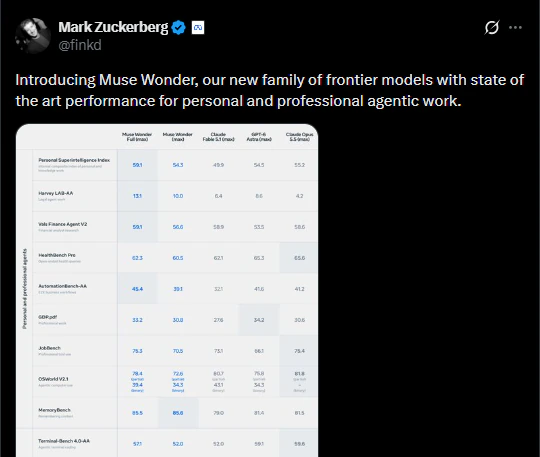
Meta positions Muse Wonder among leading AI models
Meta has developed two versions of the new model: Muse Wonder and the more powerful Muse Wonder Full. The company says Muse Wonder performs better than comparable models, including Anthropic’s Opus 5.5 and OpenAI’s GPT-6 Astra, on certain tasks.
These performance claims are based on company benchmarks and data cited from Artificial Analysis. The comparisons reflect results for specific tasks rather than establishing that one model is superior across every possible use case.
Zuckerberg said reaching this stage required substantial computing resources, financial investment and rigorous scientific work over an extended period.
Meta has invested billions of dollars in AI development over the past year as it attempts to close the gap with competitors. The launch of Muse Wonder is part of that broader push to develop more advanced models and strengthen the company’s AI capabilities.
Muse Wonder to power Meta’s personal AI assistant
One of the main applications for Muse Wonder will be Meta’s Muse personal AI assistant. The company said the model would power the paid version of the assistant, which was launched last month.
Muse is designed to use autonomous AI agents to carry out tasks such as ordering groceries and booking travel. According to Meta, the app became and remains the most downloaded application on both Apple and Android app stores in the United States.
Meta AI chief Alexandr Wang said the company had deliberately taken a different approach from competitors. While OpenAI and Anthropic have focused significantly on coding agents, Meta has concentrated on building models suited to broader consumer needs and personal AI assistance.
Wang described the focus on personal-agent applications as a key point of differentiation for Meta.
The strategy suggests that Meta wants its AI tools to do more than answer questions or generate content. Through its personal assistant, the company is seeking to offer systems that can help users complete practical tasks.
Active memory is a key feature
Meta says Muse Wonder includes an active memory capability that allows it to retain relevant information across days, weeks and months.
According to Wang, the feature is intended to help the model remember information over longer periods and continue working when it encounters obstacles. Rather than stopping when one approach fails, the model can try alternative tactics to complete a task.
These capabilities could be particularly relevant to personal AI agents, which may need to retain context and manage multi-step activities rather than respond to isolated prompts.
The company has presented Muse Wonder as a model capable of supporting more sophisticated personal and professional agent-based work. However, its broader performance will depend on how the system operates across different tasks and real-world applications.
Pricing, API access and launch issues
Meta has made Muse Wonder available through the Meta Model API and Muse Code.
The pricing ranges from $0.20, approximately Rs 19, per million tokens for basic use to $200, approximately Rs 19,000, per month for Muse Wonder Full.
The launch was affected by a bug involving how usage was counted against the limits of Meta’s Code subscription. Wang acknowledged the issue in a post on X, saying the company was investigating several bugs.
The pricing structure offers different levels of access, from basic API usage to the more powerful version available through a monthly subscription. The launch issues, however, indicate that some technical problems remained to be addressed as the new model became available.
Meta moves towards closed AI models
Muse Wonder also represents a shift in Meta’s approach to AI development. The company has previously placed considerable emphasis on open-source AI, but the new model will be closed, with its most capable versions sold directly to businesses.
This approach gives Meta another way to commercialise its AI research while making advanced capabilities available through paid access.
Zuckerberg has indicated that the company is already working on the next stage of model development and expects progress to accelerate.
Wang, who leads Meta’s Superintelligence Labs, described the launch as a major moment for the company and said Meta believes its models are competitive with leading systems, particularly for personal and professional agent-based tasks.
AI investment continues amid company-wide changes
Meta’s renewed AI push comes alongside wider organisational and financial developments. The company laid off 10 per cent of its workforce, amounting to 8,000 jobs, in May, according to the report.
Meta also faced employee backlash over plans for software that would track mouse movements and keystrokes to help train AI models. The company subsequently withdrew the plan.
The report also noted that Meta agreed in August to pay $18 billion to settle a legal dispute with US states over alleged failures relating to child protection and social media addiction.
Against this backdrop, the launch of Muse Wonder highlights Meta’s continued commitment to AI investment despite changes and challenges elsewhere in the business.
With its new model family, personal AI assistant and paid access options, Meta is seeking to establish itself among the leading developers of advanced AI systems. Whether Muse Wonder can sustain its claimed performance advantages across a wider range of applications will be an important measure of the company’s progress in the AI race.