







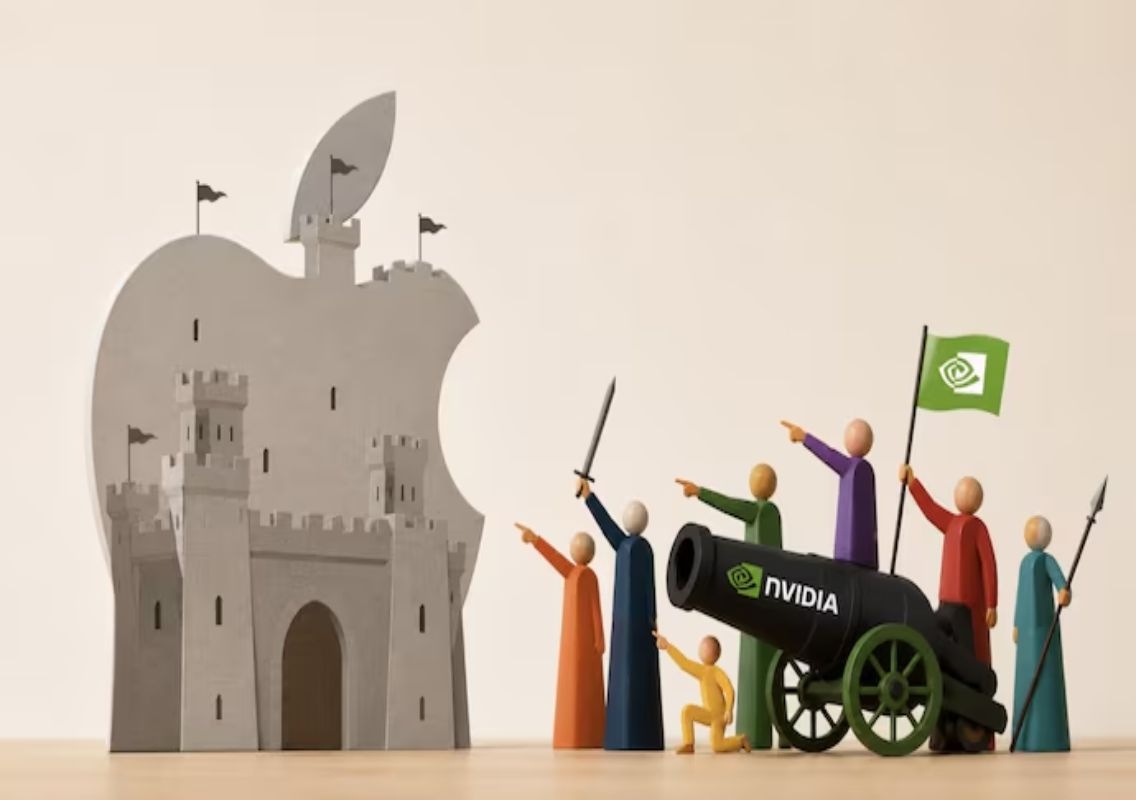


San Francisco: Global PC manufacturers and software giant Microsoft are making a renewed attempt to challenge Apple’s dominance in personal computing, this time leveraging artificial intelligence (AI) hardware from NVIDIA. The move signals a broader shift in the industry as companies look to redefine laptops and desktops in the era of AI-powered computing.
Over the past few years, Apple’s MacBook lineup has steadily outperformed Windows-based laptops in several key areas, including performance, battery life, and design. This success has largely been driven by Apple’s transition to its in-house M-series chips, which combine CPU, GPU and AI processing capabilities into a tightly integrated system. As a result, traditional PC makers such as HP and Lenovo have struggled to keep pace.
Apple’s quiet advantage in the AI era
Despite not being seen as a frontrunner in large-scale AI models like those developed by companies such as OpenAI or Google, Apple has quietly gained an advantage through its hardware. Mac computers, including compact systems like the Mac Mini, have become popular for running AI tools locally, especially those that combine cloud and on-device processing.
This trend became particularly evident earlier this year when new AI applications drove a surge in demand for Mac systems in technology hubs. Users found that Apple’s machines, powered by M-series chips with dedicated neural engines, offered a reliable and efficient platform for AI workloads.
Apple’s vertical integration — controlling both hardware and software — has enabled it to optimise performance in ways that fragmented Windows ecosystems have struggled to replicate. In contrast, Windows laptops rely on components from multiple vendors, often leading to inconsistencies in performance and user experience.
Nvidia enters the personal computing space
In response, the Windows ecosystem is now betting on Nvidia’s latest innovation, the RTX Spark chip. Unlike Nvidia’s high-end AI processors designed for data centres, RTX Spark is aimed at personal computers, bringing advanced AI capabilities directly to laptops and desktops.
The chip is expected to support complex AI tasks, including running large language models locally. Nvidia has indicated that RTX Spark could handle models with up to 120 billion parameters, marking a significant leap in consumer-level computing power.
Nvidia’s strength lies not only in its hardware but also in its software ecosystem, particularly CUDA, which enables developers to fully utilise GPU capabilities. This combination has made Nvidia a dominant force in the AI industry.
A coordinated push from the Windows ecosystem
The introduction of RTX Spark has seen strong backing from across the Windows ecosystem, including Microsoft and major laptop manufacturers. Companies such as Dell, HP and Lenovo are expected to incorporate the new chip into upcoming devices.
Microsoft CEO Satya Nadella recently highlighted the industry’s shift towards AI-driven computing, emphasising that future devices will be built around intelligent agents rather than traditional applications. This aligns with Nvidia’s vision of creating “personal AI computers” capable of handling advanced tasks locally.
For these companies, RTX Spark represents an opportunity to close the gap with Apple by offering unique AI capabilities that Mac systems may not currently match, particularly in terms of compatibility with Nvidia’s CUDA platform.
Challenges remain for Windows manufacturers
While the strategy appears promising, several challenges remain. Previous attempts by Windows PC makers to rival Apple’s MacBook — such as the Ultrabook initiative — have fallen short due to execution issues.
Key uncertainties include how RTX Spark will perform within the thermal and power constraints of laptops, how well it integrates with Windows software, and whether manufacturers can deliver devices that match Apple’s standards in design, battery life and overall user experience.
Pricing will also play a crucial role. Apple’s recent introduction of more affordable Mac models has reduced the price advantage that Windows laptops traditionally held, intensifying competition in the mid-range segment.
Apple’s potential response
Apple is unlikely to remain passive in the face of this renewed competition. The company continues to refine its M-series chips and could further enhance their AI capabilities in future iterations.
Although Apple currently does not use Nvidia’s CUDA platform, it has the resources to develop alternative solutions or optimise its existing frameworks to remain competitive in AI workloads.
Conclusion
The collaboration between Microsoft, PC manufacturers and Nvidia marks a significant moment in the evolution of personal computing. As AI becomes central to how users interact with devices, the battle between Apple and the Windows ecosystem is entering a new phase.
While Nvidia’s RTX Spark offers a compelling vision for AI-powered PCs, its success will ultimately depend on execution. Apple’s strong ecosystem and proven track record present a formidable challenge, and it remains to be seen whether this latest effort will finally shift the balance in the PC market.