







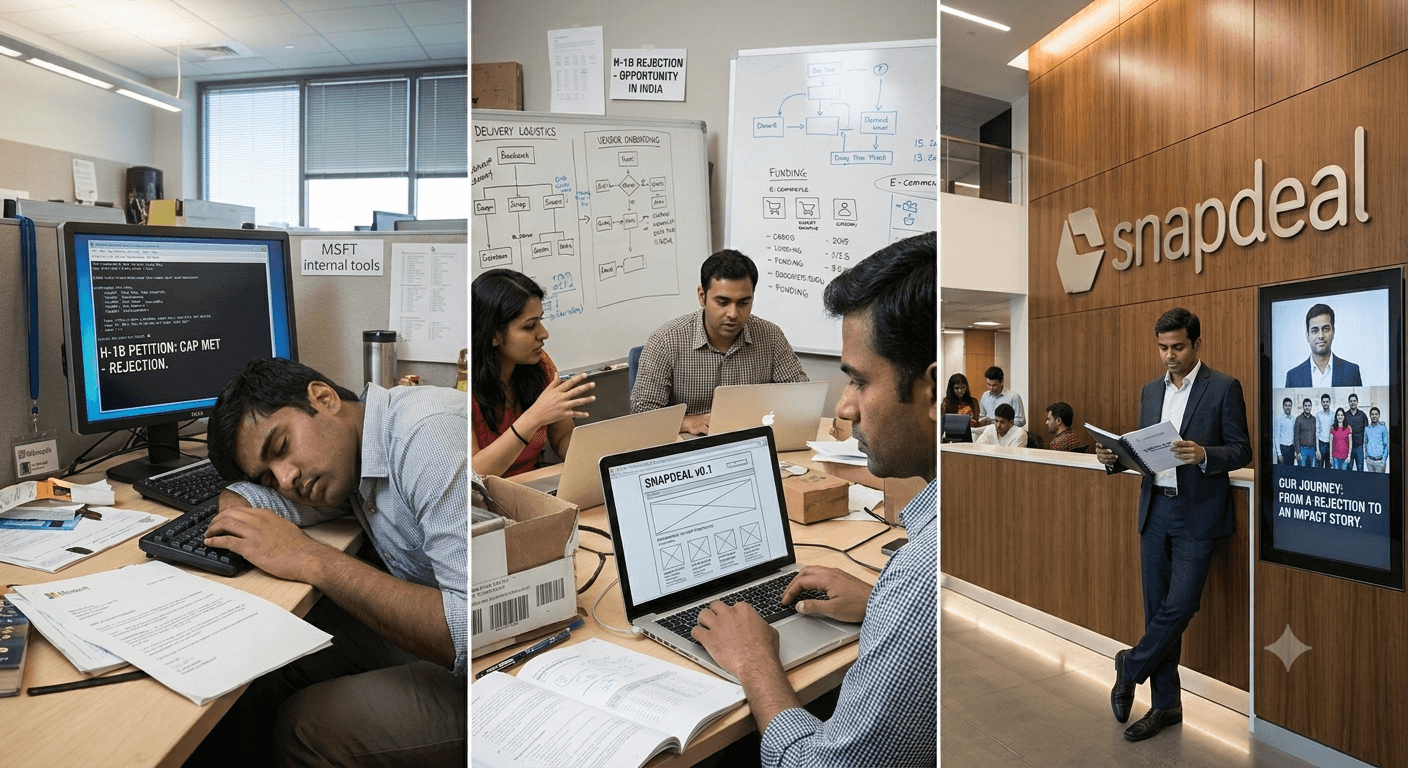


New Delhi: An Indian professional working at Microsoft in the United States was once forced to reconsider his career plans after his H-1B visa petition was rejected. Rather than relocate to India and continue his corporate career while waiting to reapply, he chose to pursue entrepreneurship, eventually co-founding e-commerce platform Snapdeal.
Kunal Bahl, who later established Snapdeal with his school friend Rohit Bansal and went on to co-found investment firm Titan Capital, has recalled the experience in an interview with Business Insider. The rejection came in 2007, when he was employed by Microsoft and approaching the end of his temporary work authorisation in the US.
Microsoft offered Bahl the option of relocating to its India office and attempting to secure an H-1B visa again after 12 months. However, he decided to use the unexpected setback as an opportunity to start a business.
His experience has resurfaced amid wider discussions about employment-based immigration in the US, particularly as major technology and consulting companies reassess their visa sponsorship policies. IBM, meanwhile, has reportedly decided to stop sponsoring H-1B visas and green cards for most positions in its US consulting division.
Microsoft employee’s H-1B application rejected in 2007
Bahl joined Microsoft as a full-time employee in October 2006 after completing an internship at the company. He had graduated from the University of Pennsylvania and was beginning his professional career at one of the world’s largest technology companies.
However, his employment did not guarantee approval of his work visa.
According to his account to Business Insider, the H-1B petition was rejected around June or July 2007. At the time, he was waiting for the outcome of his application and nearing the end of his temporary authorisation to work in the US.
The decision came as a surprise. Bahl said he initially found it difficult to understand why his application had been turned down despite working for a major technology company.
He subsequently spoke to Microsoft’s team and understood that the rejection was final. The company suggested that he move to India, continue working from its Indian office and make another attempt to obtain an H-1B visa after 12 months.
For many foreign professionals, such a relocation could offer a way to maintain employment while waiting for another opportunity to secure US work authorisation. Bahl, however, had a different plan.
Visa rejection became a turning point for Snapdeal
Instead of returning to India to continue his corporate career, Bahl decided to pursue an entrepreneurial idea he had been considering for some time.
He contacted his school friend Rohit Bansal, and the two began working towards setting up a business. They established the company in September 2007, shortly before Bahl arrived in India.
Their initial venture was a coupon-book business. The idea later evolved into Snapdeal, which became one of India’s recognised e-commerce platforms.
The journey marked a major shift from Bahl’s plans of building a career in the US technology industry. What began as a response to an unexpected visa setback eventually became the starting point of his entrepreneurial career.
Bahl later co-founded Titan Capital, an investment firm that backs startups. His experience illustrates how an immigration-related career disruption can sometimes lead professionals towards opportunities outside their original plans.
However, his decision was a personal choice rather than a standard route for employees facing visa difficulties. For many foreign workers, particularly those with families and established careers in the US, relocating or changing employers can involve significant professional and personal challenges.
IBM reportedly ends sponsorship for most US consulting roles
Bahl’s experience comes against the backdrop of changing immigration sponsorship policies among major American companies.
IBM has decided to discontinue H-1B visa and green card sponsorship for most positions within its US consulting business.
The reported policy change gives affected employees two options: continue working for the company from outside the US or leave the organisation by the end of 2026.
The company has linked the decision to changing hiring requirements and the availability of skilled professionals in the US.
An IBM spokesperson told that the company’s participation in high-skilled immigration programmes had been declining over several years.
IBM said it had previously relied on such programmes to address skill shortages but would no longer sponsor visas and green cards for the majority of positions within IBM Consulting.
The decision could affect foreign professionals who depend on employer sponsorship to maintain their employment status in the US. Employees whose roles fall within the affected categories may have to consider relocating outside the country or seeking other employment arrangements.
The reported change also highlights how companies are reviewing their reliance on employment-based immigration programmes as hiring strategies and workforce requirements evolve.
What H-1B and green card sponsorship mean for foreign workers
The H-1B programme allows US employers to hire foreign professionals for speciality occupations that generally require specialised knowledge and at least a bachelor’s degree or its equivalent in a relevant field.
Technology companies have historically used the programme to recruit skilled workers in areas such as software development, engineering, data science and other specialised roles.
Unlike a general employment arrangement, H-1B status is linked to an approved employer and petition. Workers who face a visa rejection, job loss or changes in their employment circumstances may have to make decisions about their legal status and future work arrangements.
Green card sponsorship follows a separate process for employees seeking permanent residency. One important stage is the Permanent Labour Certification programme, commonly known as PERM.
Under the PERM process, an employer generally has to demonstrate that there are no qualified and available US workers for the position and that hiring a foreign worker will not adversely affect the wages and working conditions of similarly employed US workers.
The process is an important step for many employment-based green card applications, although not every category of permanent residency requires PERM certification.
For foreign professionals, employer sponsorship can therefore play a significant role in long-term career planning and the possibility of settling permanently in the US.
Immigration scrutiny adds to uncertainty for Indian professionals
The changes at IBM come amid increased scrutiny of employment-based immigration under US President Donald Trump’s administration.
In October, Microsoft and Adobe were among the companies whose access to the green card labour certification process was suspended over alleged violations. Such action can create additional uncertainty for employers and foreign employees who depend on the process for permanent residency applications.
The developments also underline the distinction between temporary work authorisation and permanent residency sponsorship. An employee may have a job with a major company but still face uncertainty over the immigration approvals needed to continue working in the country.
For Indian professionals employed in the US technology and consulting sectors, employer policies can have a direct bearing on career decisions. A company changing its sponsorship approach may leave workers considering relocation, a change of employer or a move into a different professional path.
Bahl’s experience at Microsoft dates back to 2007, but his decision to build a business after his visa rejection offers a personal example of how such setbacks can alter career trajectories. IBM’s reported policy change, meanwhile, points to a more recent shift in how a major US technology company is approaching immigration sponsorship for its consulting workforce.