







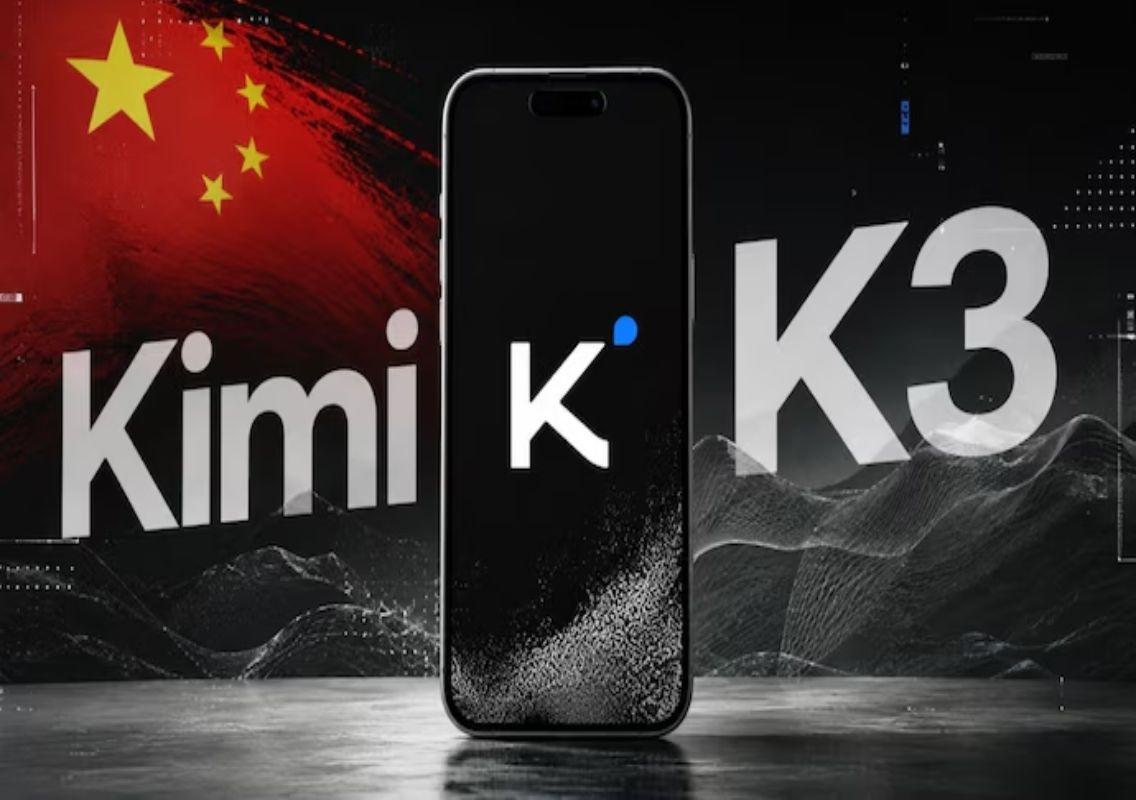


Beijing: Moonshot AI has released its latest flagship artificial intelligence model, Kimi K3, making the model weights and technical resources available for free to developers. The release is being seen as one of the major open-source AI launches of the year, allowing researchers, businesses and developers to download, customise and run the model on their own systems.
Moonshot AI said Kimi K3 is its most advanced AI model so far, featuring a 2.8-trillion-parameter Mixture-of-Experts (MoE) architecture, native visual understanding capabilities and a one-million-token context window. The company claims that the model delivers strong performance across coding, mathematics, reasoning and agent-based tasks.
The Beijing-based AI company has also open-sourced several technologies behind Kimi K3, including FlashKDA, MoonEP and AgentEnv, which are designed to improve model training, efficiency and large-scale AI deployment.
Kimi K3 becomes one of the largest open-weight AI models
Unlike leading AI companies such as OpenAI and Anthropic, which keep their most advanced models closed, Moonshot AI is providing developers with access to Kimi K3’s actual model weights.
The availability of model weights means developers can study how the AI works, modify it for specific requirements and deploy it on their own infrastructure without relying entirely on external APIs.
At around 1.4TB in size, Kimi K3 is among the largest open-weight artificial intelligence models released so far. Moonshot AI believes that open access will encourage innovation and allow more organisations to experiment with advanced AI technologies.
The company’s founder, Yang Zhilin, has previously highlighted openness as a key part of Moonshot AI’s strategy to attract developers and businesses.
Advanced architecture aims to improve AI efficiency
Moonshot AI said Kimi K3 is nearly three times larger than its previous Kimi K2.5 model. However, the company stated that improvements are not only due to the increase in parameters but also because of changes in the underlying architecture.
The company introduced technologies such as Kimi Delta Attention, Attention Residuals and MoonEP, which it claims improve scaling efficiency by around 2.5 times compared with the previous generation.
According to Moonshot AI, these improvements help Kimi K3 handle complex tasks more efficiently while reducing some of the challenges associated with training and operating extremely large AI models.
The company has also published a detailed technical report explaining the training process, architecture improvements and performance evaluation of the model.
Kimi K3 focuses on coding, reasoning and visual understanding
Moonshot AI said Kimi K3 has been designed to perform a wide range of advanced AI tasks. The model includes native visual understanding, allowing it to process image-based information along with text.
The company claims improvements in areas such as:
- Complex reasoning tasks
- Software coding
- Mathematical problem-solving
- Long conversations
- AI agent operations
- Image understanding
The one-million-token context window allows Kimi K3 to process large amounts of information in a single interaction, which could benefit applications involving long documents, research material and complex workflows.
Moonshot AI said the model combines multiple AI capabilities into a single system through a new training approach, allowing it to perform better across different domains.
Open-source technologies behind Kimi K3
Alongside the model release, Moonshot AI has made several supporting technologies available to developers.
FlashKDA focuses on improving attention-related operations, while MoonEP is designed to support efficient communication in Mixture-of-Experts models. AgentEnv provides infrastructure for running AI agents at scale.
The company said these technologies can help developers build faster AI applications and make large-scale AI deployment more accessible.
By releasing these tools publicly, Moonshot AI aims to encourage wider adoption of advanced AI systems and support research towards Artificial General Intelligence (AGI).
Kimi K3 reportedly outperforms Fable 5 in some benchmarks
Moonshot AI has claimed that Kimi K3 performs strongly against competing AI models in several benchmark tests. According to the company’s technical report, Kimi K3 outperformed Anthropic’s Fable 5 in coding-focused benchmarks, including Terminal-Bench 2.1, SWE-Bench and SWE-Marathon.
These benchmarks are commonly used to evaluate AI models’ ability to solve programming problems, understand software environments and complete complex coding tasks.
However, Moonshot AI also acknowledged that Anthropic’s Fable 5 continues to rank ahead of Kimi K3 in overall evaluations. The company said the benchmark results demonstrate Kimi K3’s competitiveness while recognising that different models perform better across different categories.
Open-source AI race intensifies globally
The release of Kimi K3 comes amid increasing competition in the global artificial intelligence sector. While companies such as OpenAI, Anthropic and Google continue developing powerful closed models, several organisations are focusing on open-weight alternatives.
Open-source models allow researchers and developers to experiment more freely, create customised applications and reduce dependence on individual AI providers.
However, large AI models also require significant computing resources, technical expertise and infrastructure investment, meaning access to model weights does not automatically guarantee easy deployment for all users.
Conclusion
Moonshot AI’s release of Kimi K3 marks a significant development in the open-source artificial intelligence landscape. By providing free access to model weights and supporting technologies, the company is giving developers greater control over advanced AI systems. While Kimi K3’s claimed benchmark advantages will continue to be tested independently, its release highlights the growing competition to create more capable and accessible AI models worldwide.