







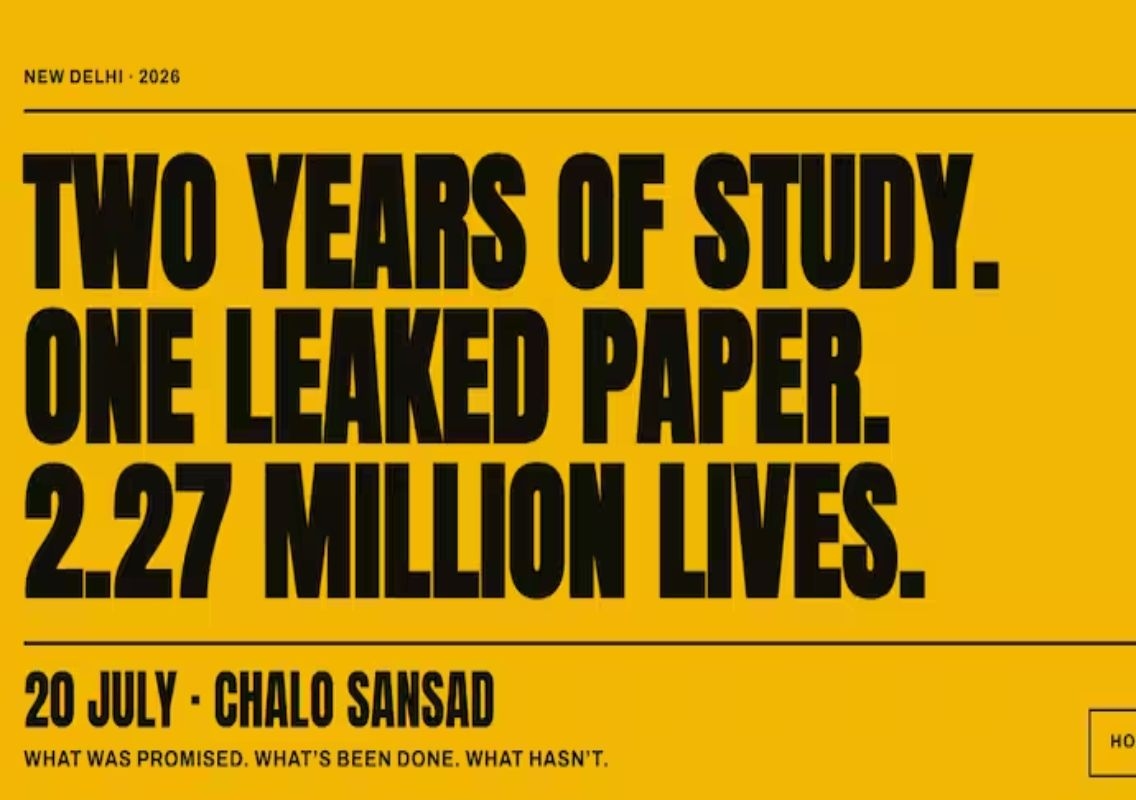


New Delhi: An Indian techie’s newly registered chalosansad.in domain was suspended by the National Internet Exchange of India (NIXI) just three days after registration, triggering questions about how India’s .IN domain registry can suspend websites and whether users are given adequate reasons or an opportunity to respond.
The domain was created by techie Sriram Vishawanathan ahead of the July 20 Chalo Sansad march organised by the Cockroach Janta Party (CJP). The website was intended to serve as a public record of the 2026 NEET paper leak protests. However, the website went offline within days after NIXI placed the domain on serverHold.
The incident has now drawn the attention of the Internet Freedom Foundation (IFF), which says it is representing Vishawanathan after he sent a legal notice to NIXI. According to IFF, the suspension was carried out without prior notice or a hearing, while the explanation provided by NIXI later changed from an alleged WHOIS problem to the domain containing a “critical keyword”.
The lack of clarity around the decision has raised broader concerns because NIXI operates the .IN domain registry, meaning thousands of Indian websites ultimately depend on its policies and decisions.
Why was chalosansad.in suspended?
According to the account documented by the IFF and reported by India Today Tech, NIXI placed the domain on serverHold on July 22, 2026, shortly after it was registered.
In practical terms, serverHold prevents the domain from functioning normally, leaving the associated website inaccessible. Vishawanathan reportedly discovered the suspension only when he could no longer access the website.
Initially, his GoDaddy control panel reportedly displayed the reason as “Suspended – Invalid WHOIS”. The message suggested that the domain’s contact information did not satisfy the requirements for a .IN domain.
Vishawanathan then contacted GoDaddy support. He was reportedly told that the domain could be restored after his Aadhaar details were matched. He updated the information and also contacted NIXI seeking clarification about whether a pre-suspension notice had been issued and what rule or legal provision had been used.
The domain, however, remained suspended.
NIXI later cited a “critical keyword”
NIXI’s subsequent response introduced a different explanation.
In an email reportedly received by Vishawanathan on July 24, the registry said the domain contained a “critical keyword” and requested additional information about why the name had been selected and how the website would be used.
The email reportedly did not identify the alleged keyword. It also did not cite a specific law, policy or provision that had been breached, nor did it mention a complaint, court order or government direction.
Vishawanathan sent another email on July 28 seeking clarification but reportedly received no response. Calls to NIXI’s published telephone number also went unanswered, according to the report.
The situation is particularly notable because the website itself reportedly had no advertising, did not collect user data and did not seek donations or funds. It also carried a disclaimer stating that it was not affiliated with the government or any protest organisation.
What does NIXI’s domain policy say?
NIXI, or the National Internet Exchange of India, is a not-for-profit organisation authorised by the Ministry of Electronics and Information Technology to operate India’s .IN country-code domain registry.
When a person registers a .IN domain through a registrar such as GoDaddy, the registrar handles the customer-facing registration process, but the underlying .IN registry is operated by NIXI.
NIXI does have rules allowing domains to be suspended in certain circumstances. It also maintains a list of reserved or restricted names.
However, the IFF says “chalosansad” was not listed as a reserved or restricted name and had not been notified as one. The organisation also argues that none of the other conditions available to NIXI for placing a domain on hold were invoked in this case.
That distinction is central to the dispute.
The question is not simply whether a registry has the power to suspend a domain. Rather, it is whether that power was exercised according to clearly defined rules and whether the domain owner was given sufficient information to understand the reason for the action.
Internet Freedom Foundation raises censorship concerns
The IFF has criticised the suspension as a potential example of excessive control over internet infrastructure.
According to the organisation, a domain suspension without a clear legal basis, judicial process or reasoned decision could effectively become a form of censorship.
The organisation has also questioned the reported use of Aadhaar-related verification during the dispute.
The issue matters beyond the individual website because .IN domains are widely used by Indian businesses, organisations, individuals and public-interest projects. If a domain can be suspended without a transparent explanation, website operators may have limited ability to challenge the decision or understand what they need to change.
At the same time, it is important to distinguish the allegations and concerns raised by IFF from established findings. NIXI’s complete reasoning has not been publicly clarified in the report, and India Today Tech said it had contacted NIXI for comment. The story noted that it would be updated if the organisation responded.
The website remains inaccessible
At the time of the report, chalosansad.in remained inaccessible.
The website’s mirror, chalosansad.com, continued to operate because it uses the .COM extension and a global registrar rather than the .IN registry.
The difference demonstrates the practical consequence of the dispute: the content itself was not necessarily removed from the internet, but access to the .IN domain was disrupted.
For website owners, domain registration is a crucial part of maintaining an online presence. A suspension can make an otherwise functioning website difficult or impossible for users to reach, even if the underlying hosting and content remain intact.
Why the case matters for .IN domain users
The controversy comes down to transparency and due process.
NIXI has an important role in maintaining India’s country-code domain infrastructure, and some level of enforcement is necessary to prevent abuse, fraud and other prohibited activities. However, domain owners also need predictable rules so that they can understand what is permitted and challenge decisions when they believe a domain has been incorrectly suspended.
In this case, the reported change in the explanation—from “Invalid WHOIS” to a “critical keyword”—has made the issue more difficult to understand. The absence of a publicly identified keyword or cited rule has further fuelled questions from digital-rights advocates.
The case could therefore become an important test of how transparent India’s domain-registry processes are and what safeguards are available to domain owners when a .IN address is suspended.
What happens next?
The immediate issue is whether NIXI will provide a clearer explanation for the suspension or restore the domain.
Vishawanathan has reportedly pursued the matter through a legal notice, while the IFF is challenging the basis for the action. NIXI’s response will be significant in establishing whether the suspension was connected to a specific violation, registration requirement or other regulatory concern.
Until the registry provides a fuller explanation, the controversy remains centred on unanswered questions rather than a definitive finding of wrongdoing.
The chalosansad.in episode nevertheless highlights an important issue for India’s digital ecosystem: operating a website is not only about hosting content. The domain name itself is controlled through a registry framework, and the transparency of that framework can directly affect whether an online platform remains accessible.