







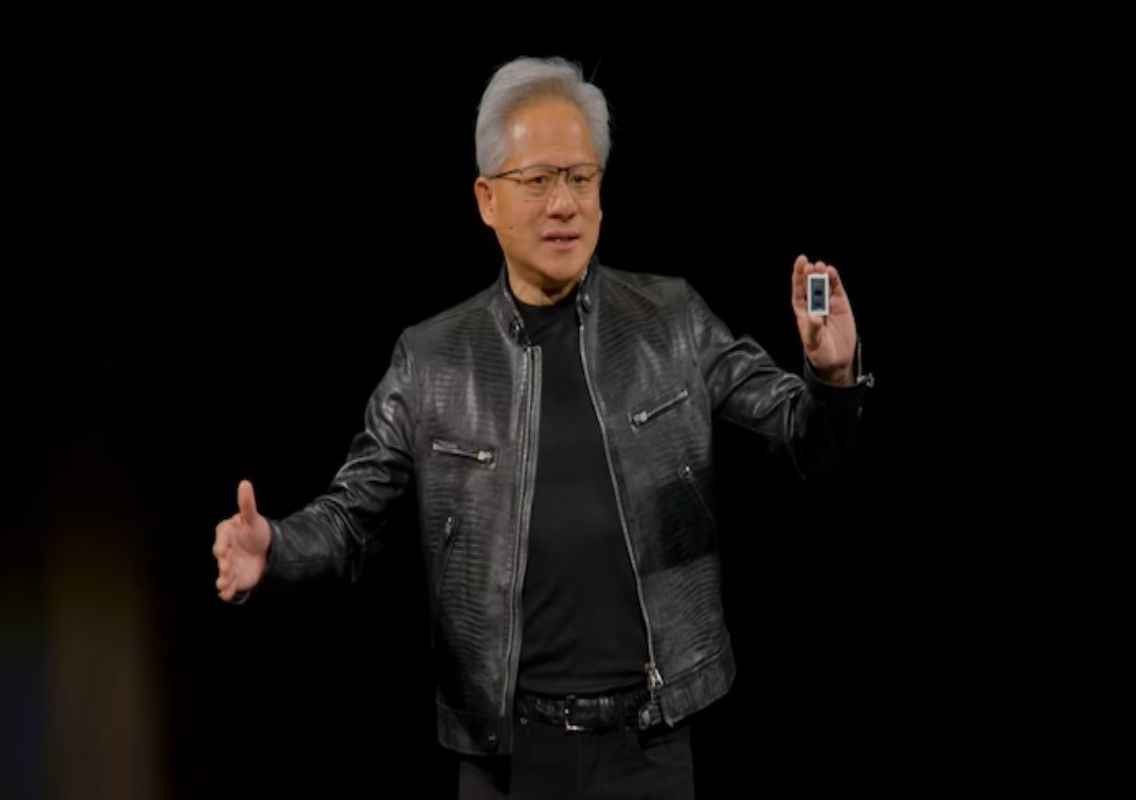


Taipei: Nvidia has announced a major push into the next generation of artificial intelligence (AI)-powered personal computing with the launch of its new RTX Spark chip. The unveiling took place during the company’s GTC keynote at Computex in Taipei, where CEO Jensen Huang outlined a vision for “agentic AI” that could redefine how users interact with Windows PCs.
The RTX Spark is an ARM-based processor designed to enable AI agents to run locally on personal computers, marking a shift from cloud-dependent AI services to on-device intelligence. Nvidia’s announcement signals a broader transformation in the PC ecosystem, with the company positioning AI agents as the next major computing paradigm.
RTX Spark built for agentic AI era
At the core of Nvidia’s announcement is the RTX Spark chip, which the company claims can deliver up to 1 petaflop of AI compute performance. The chip integrates up to 6,144 GPU cores alongside 20 CPU cores and supports up to 128GB of LPDDR5X unified memory.
The architecture is designed to handle complex AI workloads locally, enabling users to run AI agents directly on their devices. These agents can automate routine tasks, assist in workflows and perform actions independently, reducing the need for constant user input.
Nvidia also confirmed that lower-end configurations of the RTX Spark will be available, with memory options starting at 16GB, making the platform accessible across a range of devices.
The company emphasised that the chip combines its core technologies—including CUDA, RTX, DLSS, TensorRT, OptiX, Reflex and G-SYNC—into a single platform optimised for slim laptops and compact desktops with all-day battery life.
Local AI agents and creative workflows
A key highlight of the RTX Spark platform is its ability to run AI agents locally using Nvidia’s OpenShell runtime on Windows systems. This allows users to deploy personal AI assistants for tasks such as automation, coding and content creation without relying on external servers.
According to Nvidia, the chip can handle demanding creative workloads, including rendering 90GB-plus 3D scenes, editing 12K video and generating AI-powered 4K video content. The company also revealed collaborations with software makers, including Adobe, which is optimising applications like Photoshop and Premiere Pro for RTX Spark with AI-powered features such as Generative Fill and Generative Extend.
In addition to creative applications, RTX Spark is also aimed at gamers. Nvidia claims the chip can support AAA gaming at 1440p resolution with over 100 frames per second, along with ray tracing and DLSS technologies.
New wave of RTX Spark-powered devices
Nvidia confirmed that RTX Spark-powered devices will be available later this year from major manufacturers, including Asus, Dell, HP, Lenovo, Microsoft and MSI.
These laptops are expected to feature slim designs ranging from 14-inch to 16-inch displays, with thickness as low as 14mm and weight around 1.3kg. Premium features such as aluminium chassis and tandem OLED displays with G-SYNC support are also anticipated.
Microsoft has already announced a new Surface Laptop Ultra powered by RTX Spark, which will include up to 128GB of LPDDR5X RAM and a 15-inch mini-LED display capable of reaching 2,000 nits of peak brightness.
Nvidia expands AI infrastructure with Vera platform
Beyond personal computing, Nvidia also introduced its next-generation AI infrastructure platform, Vera Rubin. The company described it as its most ambitious project to date, designed to support large-scale AI workloads across enterprises.
Vera Rubin integrates new Vera CPUs built specifically for AI agents, addressing the need for faster response times and efficient task execution. According to Jensen Huang, traditional CPU architectures are not optimised for agent-based computing, prompting Nvidia to develop a new approach.
The platform is already in production and is reportedly twice the size of Nvidia’s previous Grace Blackwell system. Early adopters include major organisations such as OpenAI, Anthropic and SpaceX.
Nvidia also highlighted improvements in deployment efficiency, stating that assembling AI computing stacks has become significantly faster and more resource-efficient, addressing concerns about energy and water usage in data centres.
New AI models and developer tools
The company further expanded its AI ecosystem with the introduction of new tools and models. Among them is the Nemotron 3 Ultra open AI model, which Nvidia claims is five times faster and 30 per cent more cost-efficient than competing models.
Other announcements included Cosmos 3, an open multimodal platform for physical AI, and Isaac Groot, aimed at humanoid robotics. Nvidia also introduced Alpamayo, a reasoning model for autonomous vehicles capable of explaining its decisions in real time.
Additionally, the company launched a new enterprise AI toolkit featuring models, agents, secure runtime environments and developer tools based on its CUDA-X libraries.
Conclusion
Nvidia’s RTX Spark launch marks a significant step in the evolution of personal computing, as AI agents move from cloud-based systems to local devices. By combining powerful hardware with an expanding AI ecosystem, the company is positioning itself at the centre of the next computing shift.
As RTX Spark-powered devices arrive later this year, the success of Nvidia’s vision will depend on how effectively developers and users adopt agentic AI workflows. If widely embraced, this approach could redefine the role of PCs in an increasingly AI-driven world.