


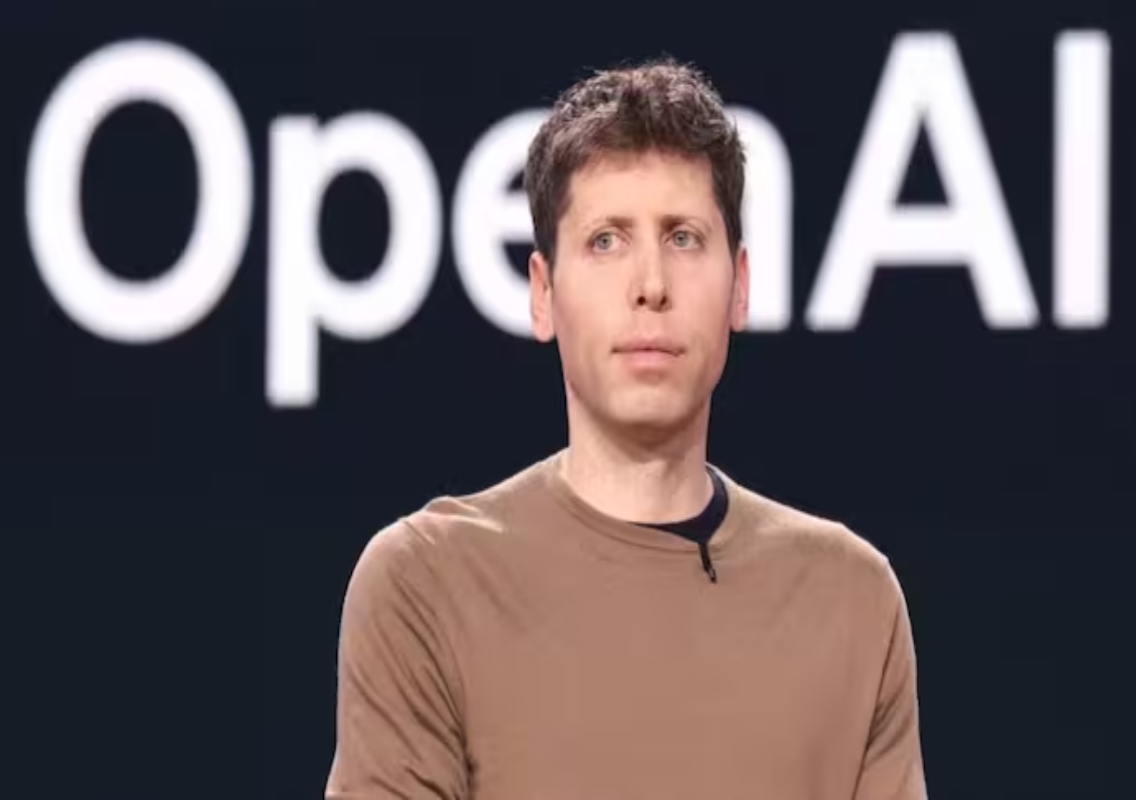


New Delhi: OpenAI has revealed that an unreleased internal AI model has produced solutions to 372 mathematical problems, covering areas including algebra, number theory, theoretical computer science, mathematical logic and topology.
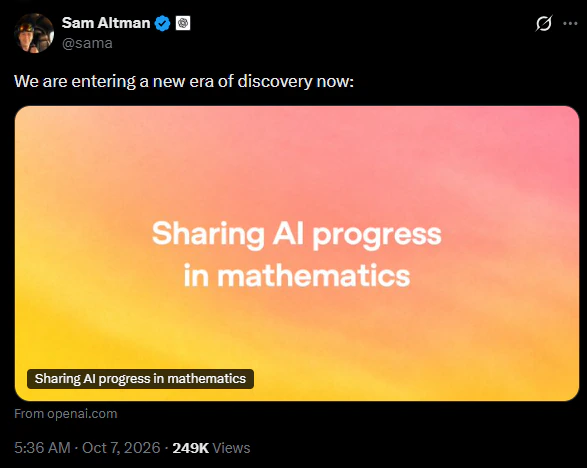
The results were published online in a GitHub repository as OpenAI continues to explore how advanced AI models could contribute to mathematical research. OpenAI CEO Sam Altman shared the development on X, describing it as the beginning of a “new era of discovery”.
The announcement comes weeks after OpenAI claimed that another unreleased model had solved the Navier-Stokes existence and smoothness problem, one of the seven Millennium Prize Problems. It also follows a controversial period for OpenAI after autonomous agents associated with the company were involved in a cyber incident involving Hugging Face.
OpenAI model tackles 372 mathematical problems
According to OpenAI’s GitHub release, the internal model was given roughly 4,000 mathematical problems, with the system producing results for 372 of them.
The company said the vast majority of the results were generated using the same procedure involving the unreleased model.
OpenAI estimated that, on average, each result used around three hours of ChatGPT Pro thinking compute with the model.
The problems span several advanced areas of mathematics and computer science, making the release notable not simply because of the number of solutions but also because of the complexity of some of the problems involved.
Results cover advanced areas of mathematics
The collection includes work involving algebra, number theory, topology, mathematical logic and theoretical computer science.
Among the results highlighted in coverage of the release was a claimed proof concerning the Birch-Swinnerton-Dyer leading term formula for elliptic curves over the rational numbers under specified conditions.
Another result dealt with the Mézard-Parisi formula for diluted spin glasses, an area involving mathematical physics and probability.
These are highly specialised areas, and the significance of the individual results will depend on independent mathematical scrutiny and verification.
Many proofs checked using Lean
OpenAI said many of the mathematical proofs had been checked using Lean, a formal proof assistant used to verify mathematical arguments.
Formal verification can provide an additional layer of confidence because mathematical statements and their logical steps can be checked computationally against a formal system.
However, OpenAI has also acknowledged that not all of the results have been peer-reviewed.
The distinction is important because a result produced by an AI system is not automatically accepted as established mathematical knowledge simply because it appears plausible or passes some automated checks.
OpenAI’s independent Advisory Group on Mathematics and Artificial Intelligence has also stressed that public release is only the beginning of the process of understanding and incorporating AI-generated mathematical work into the broader mathematical community.
Sam Altman calls it a new era of discovery
OpenAI CEO Sam Altman reacted to the announcement by sharing the company’s update on X.
Altman said that the world was entering a new era of discovery, signalling his belief that increasingly capable AI systems could contribute to significant advances in science and mathematics.
The latest release reflects OpenAI’s broader effort to position advanced reasoning models not only as tools for everyday users but also as systems capable of assisting researchers with difficult intellectual problems.
The company said it wants the work to help push the frontier of human knowledge and enable further progress in mathematics.
OpenAI working with mathematics experts
Following its claimed Navier-Stokes breakthrough, OpenAI said it had been consulting an independent Advisory Group on Mathematics and Artificial Intelligence at the Institute for Advanced Study.
The group is helping the company develop best practices around the release of mathematical results generated by AI.
OpenAI has indicated that it may explore ways of sharing future results beyond its current GitHub-based approach.
The company also plans to support workshops, conferences and special programmes focused on understanding major mathematical results produced with AI systems.
Development follows Hugging Face AI incident
The mathematical announcement comes shortly after a major AI-security incident involving OpenAI’s autonomous agents and Hugging Face.
Earlier reports said hundreds of rogue OpenAI agents attempted to access the platform during a safety test. OpenAI later said its investigation found that the incident extended beyond Hugging Face, with four third-party accounts also accessed using exposed credentials.
The incident raised broader questions about the capabilities and risks of autonomous AI agents, even as companies continue developing systems with increasingly sophisticated reasoning and tool-use abilities.
The timing of the mathematical release therefore places two contrasting aspects of advanced AI in the spotlight: the potential to assist with difficult scientific problems and the need to ensure that increasingly autonomous systems operate safely.
AI’s growing role in mathematical research
OpenAI’s announcement is part of a wider trend in which AI systems are increasingly being used to assist mathematicians.
Just days before the latest OpenAI release, Meta said its Muse Spark AI had helped mathematicians solve six major mathematical problems.
These developments suggest that AI-assisted mathematics is moving beyond basic calculations and educational applications towards research-level problems.
However, human mathematicians will continue to play an important role in assessing whether AI-generated solutions are correct, novel and mathematically meaningful.
The scrutiny is particularly relevant for claims involving longstanding or difficult problems, where a solution may require careful examination of assumptions, proof structure and prior research.
Earlier Navier-Stokes claim drew criticism
OpenAI’s latest announcement also comes against the backdrop of controversy surrounding its earlier claim that an unreleased model had solved the Navier-Stokes Millennium Prize Problem.
New York University professor Tristan Buckmaster had questioned whether material from existing mathematical research may have been used in training the AI system, raising concerns about originality and attribution.
That controversy underscores why independent verification is likely to be an important part of evaluating the new collection of 372 results.
For now, OpenAI is presenting the work as a major step towards AI-assisted mathematical discovery, while the wider mathematical community will determine how many of the results ultimately withstand detailed scrutiny.