









London: Seventeen-year-old Indian-origin chess player Shreyas Royal has made history by becoming the youngest-ever winner of the British Chess Championship, adding another major achievement to a remarkable rise that has received support from Google DeepMind co-founder Demis Hassabis.
Royal secured the British title on Sunday, finishing half a point ahead of Grandmasters Luke McShane and nine-time champion Michael Adams. His victory came at just 17, making him the youngest player to win the prestigious championship.
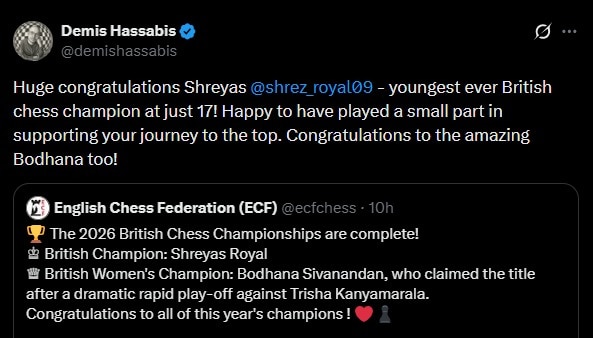
Following the triumph, Hassabis publicly congratulated the teenager and acknowledged the role he has played in supporting Royal’s career.
On X, Hassabis wrote that he was happy to have played “a small part” in Royal’s journey to the top. The message underlined a relationship that goes back several years and reflects Hassabis’ continued interest in supporting young chess talent.
Royal’s latest achievement is another milestone in a career that has already seen him become Britain’s youngest-ever grandmaster.
Shreyas Royal makes British chess history
Royal won the British Chess Championship after producing a strong performance against a field featuring some of the country’s most accomplished players.
The 17-year-old finished ahead of experienced Grandmasters McShane and Adams, with the final standings separated by narrow margins.
The result is particularly significant because of Royal’s age. Winning a national championship at 17 places him among the most promising young players in British chess history.
His victory also comes at a time when interest in the next generation of chess talent continues to grow internationally. Young players are increasingly gaining access to advanced training tools, online competitions and sophisticated chess engines, allowing promising talent to develop at an earlier age.
Royal’s career has benefited from a combination of his own ability, family support and backing from prominent figures in the technology and chess communities.
Another historic result came in the women’s championship, where 11-year-old Bodhana Sivanandan became the youngest British Women’s Chess Champion.
The achievements of Royal and Sivanandan highlight the emergence of a new generation of British chess players.
Demis Hassabis congratulates Royal
After Royal secured the title, Hassabis shared a message celebrating the teenager’s achievement.
The Google DeepMind co-founder and chair described Royal as the youngest-ever British chess champion at 17 and said he was pleased to have supported his journey.
The message was significant because Hassabis has been associated with Royal’s development for several years.
Royal publicly revealed in March 2023 that Hassabis had agreed to sponsor his chess journey as he pursued the ambition of becoming the UK’s youngest grandmaster.
The sponsorship came at an important stage in Royal’s development, with his family facing the financial pressures associated with supporting a young chess player competing at an increasingly high level.
Royal’s father, Jitendra Singh, had reportedly managed to establish contact with Hassabis and seek support for his son’s career.
That relationship ultimately became part of Royal’s journey towards becoming a grandmaster and, now, a British champion.
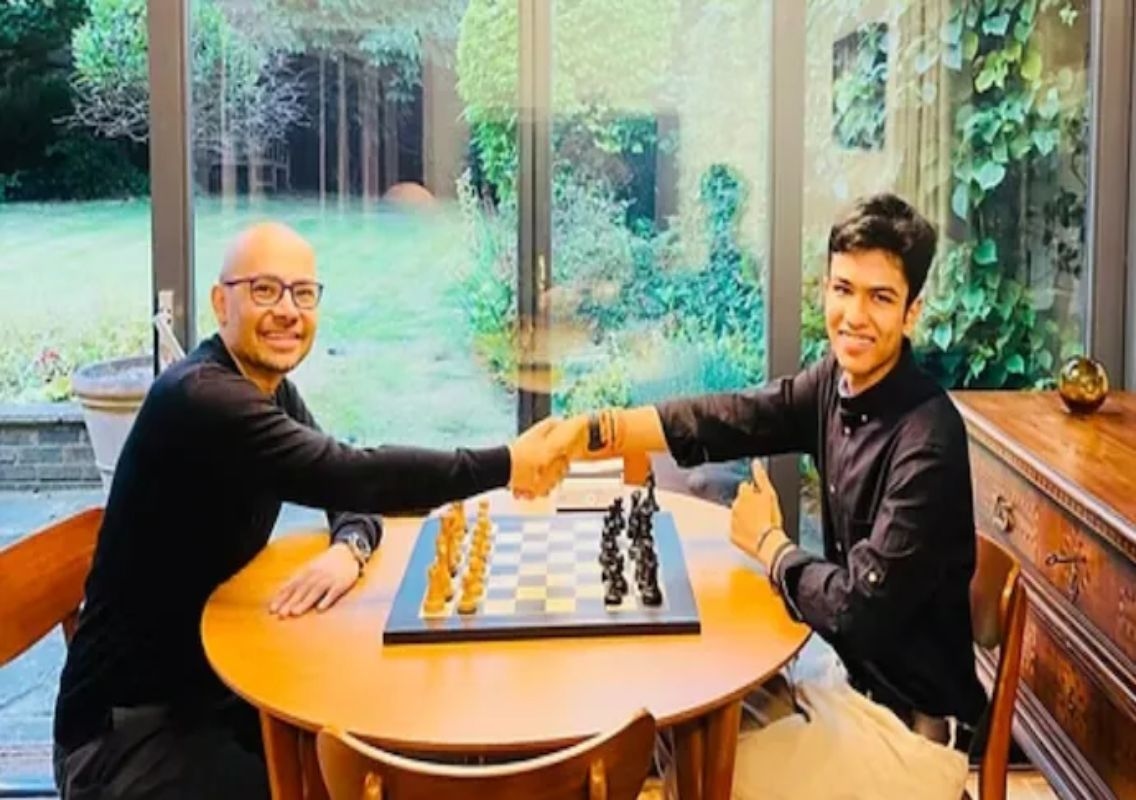
Royal and Hassabis first met in 2018
The connection between Royal and Hassabis goes back further than the sponsorship arrangement.
The two were paired in the Pro-Biz Cup, an event associated with the London Chess Classic, in 2018.
Royal was only nine years old at the time.
The meeting brought together a young chess prodigy and one of Britain’s best-known technology entrepreneurs, who himself had an exceptional background in chess.
The encounter took place years before Royal’s grandmaster achievement and his British Championship victory.
For Royal, the relationship eventually developed from an early chess connection into a long-term source of financial and professional support.
Hassabis’ interest in the teenager is also understandable given his own history with the game.
Hassabis was a chess prodigy
Before becoming one of the world’s most prominent artificial intelligence researchers, Hassabis was a highly accomplished chess player.
He was once ranked as the world’s second-highest-rated under-14 player, behind legendary Hungarian chess player Judit Polgar.
Hassabis eventually moved away from competitive chess and pursued computer science and neuroscience. His career in technology eventually led him to co-found DeepMind, the artificial intelligence company that was later acquired by Google.
His chess background has remained an important part of his interest in artificial intelligence.
Hassabis has often discussed the importance of games such as chess in developing systems capable of planning, reasoning and learning.
His connection with Royal therefore brings together two areas that have played major roles in his own career: chess and artificial intelligence.
From chessboard to artificial intelligence
Hassabis’ involvement in chess extends beyond his playing career.
DeepMind became internationally recognised in the chess world following the development of AlphaZero, an artificial intelligence system that demonstrated a radically different approach to learning games.
In 2017, DeepMind published research on AlphaZero, which learned to play chess through self-play rather than relying primarily on human-created chess knowledge.
The system reportedly reached an extraordinary level of performance after only a few hours of self-training.
In a widely reported test, AlphaZero defeated Stockfish, one of the world’s leading conventional chess engines, in a series of games.
The achievement was considered an important demonstration of the potential of reinforcement learning and self-play.
While Royal’s progress is based on human training, competition and experience, the technological environment surrounding modern chess has changed dramatically because of systems such as AlphaZero.
Today’s elite players can use powerful engines to analyse positions, identify weaknesses and prepare against opponents.
Royal became Britain’s youngest grandmaster
The British Championship is not Royal’s first major record.
In 2024, he became Britain’s youngest-ever Grandmaster at the age of 15 years and seven months.
The achievement marked another major step in a career that had been attracting attention since he was a child.
Becoming a Grandmaster is one of the most difficult achievements in competitive chess. Players must meet demanding performance requirements and achieve the necessary ratings and norms in high-level tournaments.
Royal reached that milestone at an exceptionally young age.
His progress since then has continued to demonstrate his ability to compete against experienced players.
Winning the British Championship at 17 now adds a national title to his list of achievements and strengthens his reputation as one of Britain’s leading young chess talents.
Family support remains central to Royal’s journey
Behind Royal’s achievements has been significant commitment from his family.
Young chess players competing internationally can face considerable costs, including tournament entry fees, travel, coaching, training and accommodation.
Royal’s family had publicly discussed the financial pressure involved in supporting his ambitions.
Hassabis’ sponsorship therefore provided important assistance at a stage when Royal was attempting to establish himself at the highest level.
The support also illustrates the role that private sponsorship can play in developing young sporting talent.
For many promising chess players, financial backing can determine how frequently they compete and whether they can access high-quality coaching and international tournaments.
In Royal’s case, the support coincided with a period of rapid progress.
A new chapter for British chess
Royal’s British Championship victory could mark the beginning of another phase in his career.
At 17, he has already achieved milestones that many players spend decades pursuing. Yet his age also means that he has significant time to develop further.
The next challenge will be maintaining his progress against increasingly strong international competition.
His success also gives British chess a high-profile young champion at a time when the game is experiencing renewed global popularity.
The combination of traditional competition, online platforms and artificial intelligence has made chess more accessible while also raising the standard of preparation available to players.
Royal’s story sits at the intersection of those developments.
Conclusion
Shreyas Royal’s victory in the British Chess Championship is a landmark achievement for the 17-year-old Indian-origin player, but his success also reflects a longer journey supported by family and Demis Hassabis.
From their first meeting at the 2018 Pro-Biz Cup to Hassabis sponsoring Royal’s grandmaster ambitions, the relationship has followed the teenager through several important milestones. Royal’s record as Britain’s youngest-ever grandmaster at 15 years and seven months has now been followed by another historic achievement at 17.
For Hassabis, who moved from being a chess prodigy to becoming a pioneer in artificial intelligence, supporting Royal represents a continuation of his long-standing connection with the game.
Royal’s latest title suggests that his journey is far from over, with the young champion now facing the challenge of establishing himself among the world’s strongest players.