





Chennai: Zoho co-founder Sridhar Vembu has highlighted how the software company built its own cloud infrastructure instead of depending on major cloud providers such as Amazon Web Services (AWS) and Google Cloud. The company is now opening parts of that infrastructure to developers through Catalyst, its serverless development platform, and plans to make the platform free for students.
Vembu said Zoho began developing its own infrastructure during the company’s early years to support the applications it was building. The infrastructure includes core components required to run cloud software, including databases, identity management, messaging, search, storage and computing.
The move reflects Zoho’s long-standing approach of maintaining greater control over the technology stack supporting its products, while also giving developers access to infrastructure that can be used to build and deploy applications.
Zoho built its own cloud infrastructure
According to Vembu, building its own cloud was an early decision at Zoho as the company needed infrastructure to operate its growing portfolio of applications.
“One of the early things we did at Zoho was build our own cloud infrastructure to run our applications,” Vembu said in a recent post.
Rather than building its services primarily on infrastructure provided by companies such as AWS or Google Cloud, Zoho developed many of the underlying systems itself.
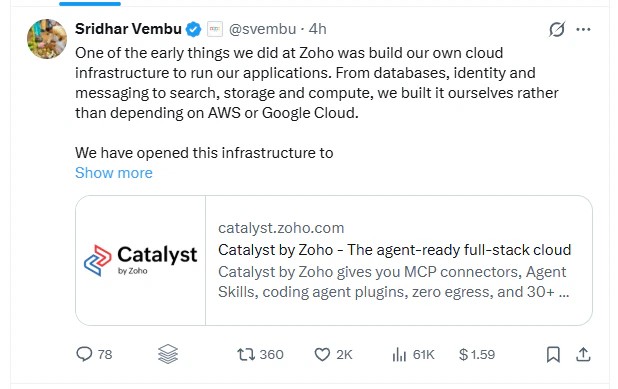
These include databases, identity systems, messaging, search, storage and computing infrastructure. Vembu said Zoho’s services run on hardware owned by the company and software frameworks developed internally, while also making use of open-source technologies such as Linux and PostgreSQL.
The approach gives Zoho direct control over significant parts of the infrastructure on which its cloud applications operate.
Zoho opens infrastructure through Catalyst
Zoho has gradually made some of this infrastructure available outside its own product ecosystem through Catalyst.
Catalyst was initially developed to allow developers to extend Zoho applications and build additional functionality around the company’s software. Vembu said the platform is now also being used by developers who are not part of the wider Zoho ecosystem.
The company is increasing its investment in Catalyst as it seeks to position the platform as a broader environment for application development and deployment.
This means developers can use Zoho’s infrastructure without necessarily building applications specifically for Zoho’s existing products.
Catalyst to be free for students
Zoho is also planning to make Catalyst free for students.
The company wants students to be able to develop and deploy applications without having to worry about infrastructure costs while working on projects.
“Our goal is to give developers the infrastructure to turn their ideas into real products,” Vembu said.
For students, the move could provide access to cloud development infrastructure without the initial costs that can come with commercial cloud services. It also gives Zoho an opportunity to introduce its infrastructure and development tools to a new generation of developers.
The company has not indicated that its broader cloud infrastructure will be made free for all users. The student initiative is specifically tied to access to Catalyst.
Vembu explains Zoho’s infrastructure strategy
Vembu has previously discussed Zoho’s approach to infrastructure, data storage and software development.
In a September 2025 post, he addressed questions about where Zoho develops its software, where customer information is stored and which infrastructure providers are used to operate the company’s services.
Vembu said Zoho’s products are developed in India and that its global headquarters is in Chennai. The company has offices in more than 80 countries, including a significant presence in the United States.
He has also said that Indian customer data is hosted within India. At the time of his earlier post, Zoho had data centres in Mumbai, Delhi and Chennai, with another facility planned in Odisha.
Zoho operates more than 18 data centres globally and says customer data is hosted according to the requirements of the relevant country or region.
Zoho says it does not rely on AWS or Azure
Vembu has also drawn a distinction between Zoho’s own infrastructure and the use of third-party cloud services.
“All our services run on hardware we own and software frameworks we developed, on top of open source like Linux OS and Postgres database,” he said.
He also said Zoho does not host its products on AWS or Microsoft Azure.
However, Vembu has acknowledged that some services from major cloud companies can be used for regional switching nodes. These can help route traffic and improve connection speeds in different locations, while he said customer data is not stored on those services.
Zoho is also expanding its points of presence in different regions as part of its infrastructure strategy.
The company’s model therefore combines infrastructure owned and operated by Zoho with open-source software and selected third-party networking services where required.
Vembu warns developers about over-reliance on AI
Vembu’s comments on Zoho’s infrastructure come alongside his broader views on the changing software development industry, particularly the growing use of artificial intelligence tools to write code.
He recently responded to a developer describing a workplace where specifications, code, tests and other engineering tasks were increasingly being generated with Anthropic’s Claude Code.
Vembu said developers should use AI tools but should not allow them to replace their understanding of the software they build.
“This is sad. I tell our engineers to use AI but never cede our understanding to AI,” he said.
His argument is that AI-assisted development should remain under the control of engineers who understand the underlying systems, rather than becoming a process where developers simply accept machine-generated code without fully understanding it.
Zoho’s approach to AI and software development
Vembu compared the industry’s rapid adoption of AI development tools to “driving too fast in a fancy new car we barely understand how to drive”.
His comments reflect concerns about what could happen if companies increasingly rely on AI-generated software without maintaining sufficient technical understanding internally.
For Zoho, the approach is consistent with Vembu’s broader emphasis on developing and controlling core technology rather than becoming dependent on external infrastructure or software providers.
The decision to open Catalyst to developers and make it available free to students also represents an expansion of that infrastructure strategy beyond Zoho’s own products.
By offering students access without infrastructure costs, Zoho is seeking to lower the barrier to building and deploying applications, while Catalyst provides the company with a platform through which developers can access its cloud capabilities.
For developers, the initiative adds another option to an increasingly competitive cloud and serverless market. For Zoho, it extends an infrastructure model that the company says it has built over many years to support its own software business.