










Chennai: Sridhar Vembu, founder of Zoho Corporation, has raised concerns over a significant slowdown in job creation in India’s IT sector, attributing the shift to the rapid rise of artificial intelligence (AI) and increasing infrastructure costs. His remarks come at a time when the technology industry is undergoing structural changes, with companies prioritising automation and AI investments over workforce expansion.
In a recent post on X, Vembu acknowledged that even his own company has not been adding many new jobs. He described the situation as a pressing challenge for India, especially given the country’s large and growing youth population. According to him, the key issue lies in generating sustainable employment opportunities in an uncertain global economic environment.
IT sector faces hiring stagnation
India’s IT industry has long been a major driver of employment and economic growth. However, Vembu noted that the sector is no longer creating jobs at the same pace as before. While companies are not necessarily laying off workers across the board, hiring has slowed considerably.
He stated that Zoho has managed to avoid layoffs but has also refrained from significant hiring in recent years. This trend, he suggested, reflects a broader shift across the industry, where companies are becoming cautious about expanding their workforce.
The slowdown coincides with a wave of layoffs globally, affecting major technology firms such as Infosys, Oracle, Microsoft and Meta. These firms have been restructuring operations to manage costs and adapt to evolving technological demands.
According to recent industry data, active IT job openings in India have declined by around 6 per cent year-on-year to approximately 44,000 roles. However, the broader technology job market still shows some resilience, with total openings across sectors standing at about 1,09,000—an increase of 6 per cent compared to the previous year.
AI investments replacing hiring budgets
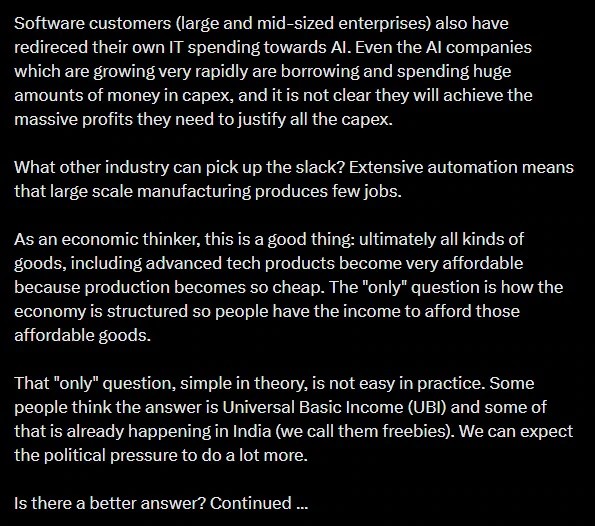
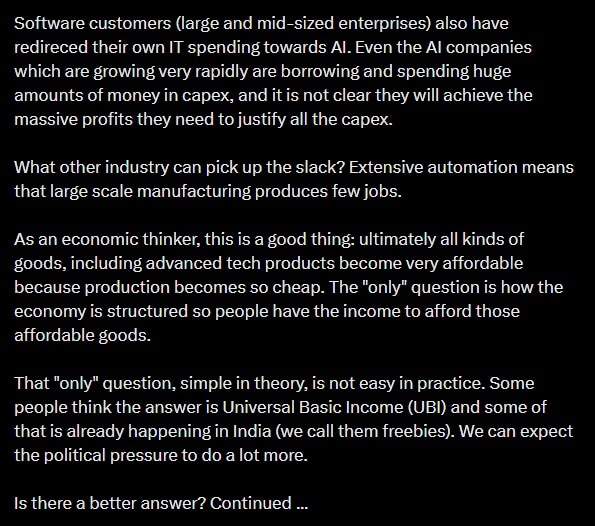
Vembu highlighted that funds traditionally allocated for hiring are now being redirected towards AI-related investments. Companies are increasingly spending on advanced tools, data centres and computing infrastructure to stay competitive in the AI-driven landscape.
He pointed out that the rising cost of servers and memory has significantly increased operational expenses. These costs, often beyond the control of individual companies, are forcing businesses to prioritise capital expenditure over human resources.
Global technology giants are expected to invest hundreds of billions of dollars in AI infrastructure this year. Indian firms such as HCLTech and Tata Consultancy Services are also expanding their data centre capabilities, signalling a long-term commitment to AI-driven growth.
Concerns over software saturation
Another issue raised by Vembu is the growing saturation of the global software market. With AI tools enabling faster and cheaper software development, the supply of digital products is increasing rapidly.
He questioned whether there is sufficient demand for the volume of software being produced. According to him, software is gradually becoming a commodity, where differentiation is based more on quality, reliability and brand value rather than innovation alone.
This shift could lead to slower growth in the sector, as companies compete in an increasingly crowded market. Additionally, enterprises are reallocating their IT budgets towards AI adoption, further reducing demand for traditional software services.
Automation and employment challenges
Vembu also expressed concerns about the broader impact of automation on employment across industries. He noted that even sectors like manufacturing, which have historically generated large-scale jobs, are becoming increasingly automated and less labour-intensive.
This trend raises questions about whether alternative sectors can absorb the workforce displaced by technological advancements. The challenge is particularly significant for countries like India, where job creation is critical to economic stability.
Debate on Universal Basic Income
In exploring potential solutions, Vembu referred to the concept of Universal Basic Income (UBI), which proposes providing citizens with a fixed income regardless of employment status. He noted that similar ideas are already being discussed and partially implemented in India in the form of welfare schemes.
While he acknowledged that increased automation could make goods and services more affordable, he stressed that the key question is how people will earn the income needed to access these benefits.
The idea of a universal income has also been supported by global figures such as Elon Musk, who has previously suggested that AI-driven productivity could lead to a future of widespread financial support systems.
Conclusion
Sridhar Vembu’s observations underline a critical transition in India’s IT sector, where technological advancement is reshaping traditional employment patterns. While AI offers significant opportunities for efficiency and innovation, it also poses challenges for job creation and economic inclusion.
As companies continue to invest heavily in AI infrastructure, policymakers and industry leaders may need to explore new models of employment and income distribution. The coming years will be crucial in determining how India balances technological progress with the need to generate meaningful opportunities for its workforce.