


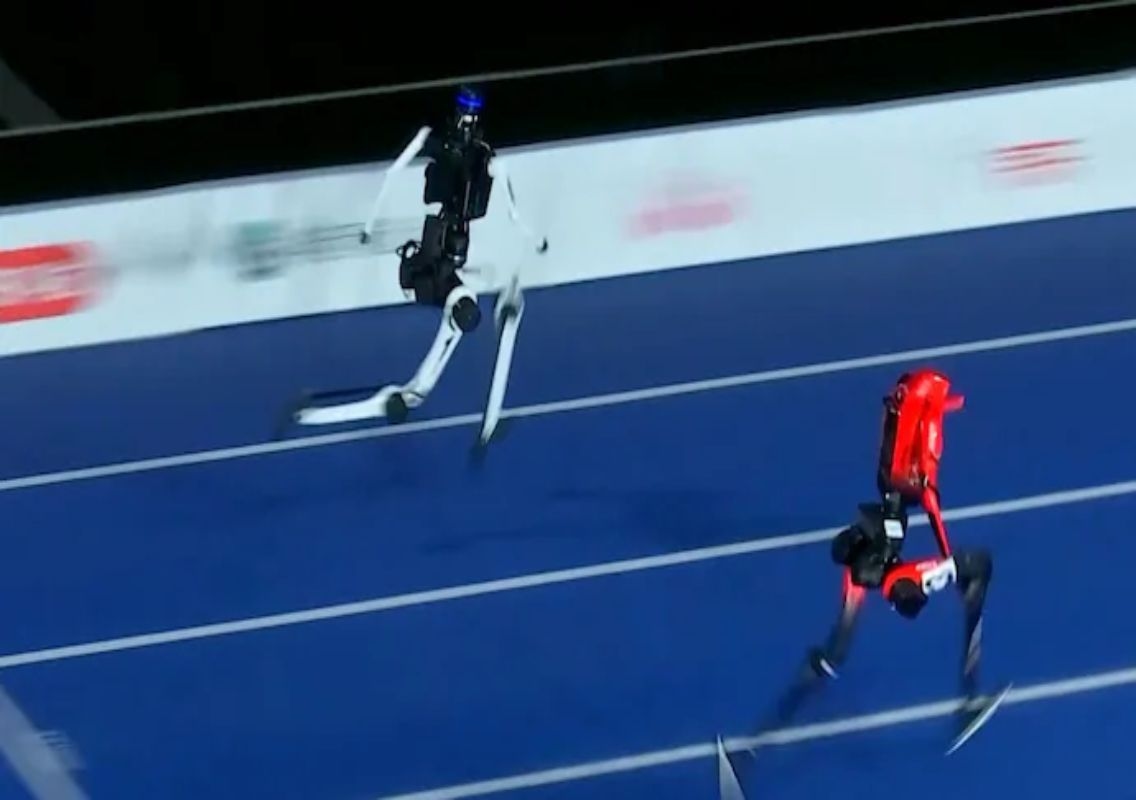


Beijing: China’s Tiangong Ultra humanoid robot has made headlines after completing a 100-metre run in a record time, with the machine’s performance being compared with the speed of elite human sprinters including Usain Bolt.
The achievement highlights the rapid progress being made in humanoid robotics in China, where companies and research institutions are increasingly developing robots capable of walking, running and performing tasks that were previously associated primarily with humans.
According to India Today, Tiangong Ultra completed the 100-metre distance in 9.62 seconds at a robotics event in Beijing. The reported performance is faster than the official men’s world record of 9.58 seconds set by Bolt in 2009.
However, the comparison needs an important qualification. Tiangong Ultra’s reported run was achieved under controlled conditions and involved a robot specifically engineered for high-speed movement. It should therefore not be interpreted as evidence that humanoid robots have broadly surpassed human athletic performance.
Tiangong Ultra’s record-breaking run
The Tiangong Ultra humanoid robot reportedly completed the 100-metre run in 9.62 seconds.
The result is particularly notable because running on two legs is considerably more complicated for a robot than simply moving forward on wheels or tracks.
A bipedal robot needs to maintain balance while repeatedly shifting its weight between its legs. It must also coordinate motors, joints, sensors and control systems quickly enough to prevent a fall.
At high speeds, even a small error in balance can cause the robot to lose stability.
The reported performance therefore represents a significant engineering achievement.
Faster than Bolt’s world record — but not the same comparison
The headline comparison with Usain Bolt has attracted considerable attention.
Bolt’s official 100-metre world record stands at 9.58 seconds, set in Berlin in 2009. Tiangong Ultra’s reported 9.62-second run is only 0.04 seconds slower.
However, the two performances should not be treated as directly equivalent sporting records.
Bolt’s record was achieved under the rules and conditions of competitive athletics, while Tiangong Ultra’s run was a demonstration of robotic capability.
Human sprinting also involves a much broader range of physiological and biomechanical factors, including muscle power, energy efficiency, reaction time and endurance.
The significance of Tiangong Ultra’s performance lies primarily in robotics rather than athletics.
Why running is difficult for humanoid robots
Walking is already a complex challenge for humanoid robots.
Running increases that challenge considerably.
During running, there are moments when both feet are off the ground. The robot must calculate how and where to land while maintaining its centre of mass and controlling its joints.
A high-speed humanoid robot therefore needs extremely responsive control systems.
Its motors must generate sufficient force while remaining light enough to allow rapid movement.
The machine also needs sensors capable of detecting its position and motion in real time.
This combination of hardware and software is what makes high-speed robotic running difficult.
China’s growing humanoid robotics sector
Tiangong Ultra’s performance comes amid rapid growth in China’s humanoid robotics industry.
Chinese companies and research teams have been investing heavily in robots designed for factories, logistics, healthcare, domestic environments and other applications.
The Chinese government has also identified humanoid robotics as an important emerging technology.
The sector has attracted significant investment as manufacturers seek to develop machines that can operate in environments designed for humans.
Humanoid robots could potentially perform repetitive or physically demanding jobs, although widespread commercial deployment remains a major technical and economic challenge.
From demonstrations to practical applications
High-speed running demonstrations can generate significant public attention, but the long-term value of humanoid robots will depend on their practical capabilities.
For a robot to become commercially useful, it needs to do much more than run quickly.
It may need to carry objects, manipulate tools, navigate stairs, recognise its surroundings and safely interact with people.
Reliability is equally important.
A robot used in a factory or warehouse must be able to perform the same task repeatedly without frequent failures or expensive maintenance.
Energy consumption is another challenge.
Running at high speed requires substantial power, and a robot’s battery capacity can limit how long it can operate.
The engineering behind Tiangong Ultra
A humanoid robot such as Tiangong Ultra combines several technological systems.
Electric motors provide movement at the joints, while sensors monitor the robot’s position and motion.
Control software then uses this information to make rapid adjustments.
The robot’s computing system must continuously coordinate the movement of its legs, arms and body.
At high speed, the margin for error becomes extremely small.
A successful sprint therefore demonstrates not just mechanical power but also the ability of the control system to maintain stability during rapid movement.
Humanoid robots are becoming faster
The development of faster humanoid robots has accelerated in recent years.
Researchers have moved beyond basic walking demonstrations towards running, jumping, climbing and more dynamic movements.
This progress is partly driven by improvements in electric motors, batteries, sensors, artificial intelligence and control algorithms.
Better actuators allow robots to generate more power while reducing weight.
Advances in computing allow robots to process sensor information more quickly.
Together, these technologies are helping humanoid machines perform movements that increasingly resemble those of humans.
Why speed matters for future robots
A robot’s ability to run may have applications beyond entertainment or demonstrations.
Fast movement could become useful for robots operating in large industrial facilities, warehouses or emergency environments.
A machine capable of moving quickly could potentially reach a location faster, transport objects more efficiently or navigate environments where wheeled robots are less effective.
However, speed will always need to be balanced against stability, energy efficiency and safety.
A robot that can run quickly but cannot safely stop or change direction may have limited practical value.
The safety challenge
As humanoid robots become more powerful and faster, safety becomes increasingly important.
A machine weighing dozens of kilograms and moving at high speed could cause serious injury if it loses control.
Developers therefore need to ensure that robots can detect obstacles, respond to unexpected situations and stop safely.
Demonstrations in controlled environments provide useful evidence of capability, but real-world environments are far less predictable.
People, furniture, uneven surfaces and unexpected obstacles can all complicate movement.
What the Tiangong Ultra achievement means
The reported 9.62-second run should be viewed as an engineering milestone rather than a direct challenge to human athletics.
The achievement demonstrates how quickly humanoid robotics is developing and how engineers are improving robotic balance, actuation and control.
It also shows the increasing ambition of China’s robotics sector.
As competition among robotics companies intensifies, demonstrations involving speed, agility and human-like movement are likely to become increasingly common.
The more important test will be whether these advances translate into affordable, reliable robots that can perform useful work.
Conclusion
Tiangong Ultra’s reported 9.62-second 100-metre run is a striking demonstration of the progress being made in humanoid robotics.
Although the time is close to Usain Bolt’s 9.58-second world record, the two achievements belong to completely different categories and should not be treated as equivalent athletic records.
For robotics, however, the performance is significant. Running at high speed requires precise coordination between motors, sensors, software and balance systems.
China’s growing investment in humanoid robots suggests that such demonstrations are likely to become more sophisticated in the coming years.
The real measure of Tiangong Ultra’s success will ultimately be whether the technology behind the sprint can help create humanoid robots capable of safely and reliably performing useful tasks in the real world.