







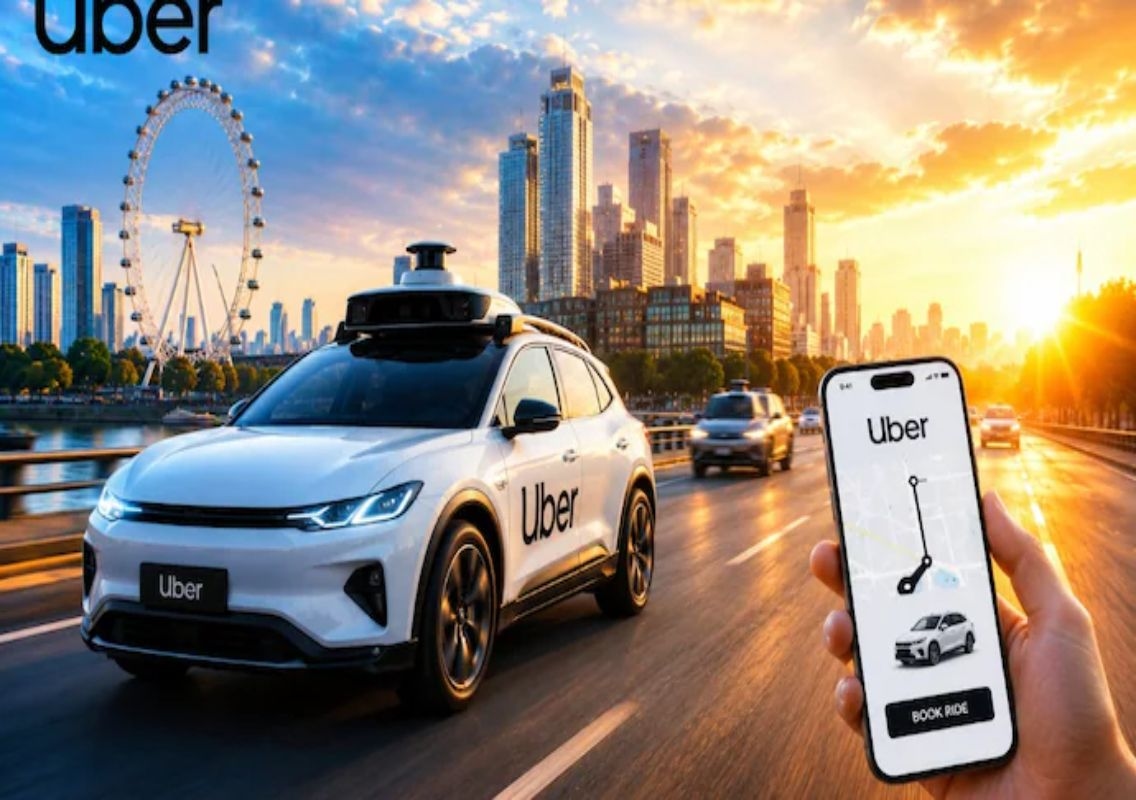


San Francisco: Uber has announced plans to invest over $10 billion (around ₹95,000 crore) to deploy nearly 1.2 lakh driverless cabs globally, marking its most ambitious move yet into autonomous mobility. The development signals a major shift in the future of urban transport, while also raising critical questions about the livelihoods of millions of human drivers associated with the platform.
The move places Uber firmly in the global race to dominate the robotaxi market, competing with major players such as Waymo and Tesla.
Expansion plans and rollout timeline
Uber aims to roll out autonomous ride services across at least 15 cities by 2026, with a long-term vision of building the world’s largest driverless mobility platform. The company’s strategy focuses on scaling operations quickly while leveraging partnerships rather than developing all technology in-house.
Chief Executive Officer Dara Khosrowshahi said the company is making this investment from a position of financial strength, highlighting its growing revenues and operational efficiency.
Uber reported strong financial performance in the recent quarter:
- $2.8 billion (₹23,000 crore approx.) in free cash flow
- $10.1 billion (₹84,000 crore approx.) free cash flow over 12 months
- $58 billion (₹4.8 lakh crore approx.) in gross bookings, up 24 per cent year-on-year
- $14.2 billion (₹1.18 lakh crore approx.) in revenue
These figures underline the company’s capacity to invest heavily in emerging technologies such as autonomous vehicles.
Partnerships driving autonomous ambitions
Instead of building driverless cars entirely on its own, Uber is collaborating with multiple autonomous vehicle developers and investing in companies like Zoox, Rivian and Lucid Motors.
This partnership-led model allows Uber to expand faster while sharing the technological and financial risks associated with self-driving systems.
The company has already seen strong consumer interest in its upcoming services. In London, over 1 lakh users have reportedly registered interest in experiencing driverless rides ahead of the planned launch.
What happens to human drivers?
The large-scale deployment of driverless cabs has sparked concerns about the future of gig workers, particularly drivers who depend on ride-hailing platforms for income.
Short-term outlook
In the near future, human drivers are unlikely to be replaced entirely. Autonomous vehicles will initially operate in:
- Select cities
- Controlled environments
- Specific routes such as airports and central urban zones
Additionally, early deployments are expected to include safety supervisors inside vehicles, and the technology still faces challenges related to regulations, weather conditions and complex traffic scenarios.
As a result, traditional ride-hailing services will continue to coexist alongside robotaxis for several years.
Long-term impact
Over time, as autonomous technology becomes more reliable and cost-effective, driverless vehicles may gradually take over routes where automation is most efficient. This could lead to:
- Reduced demand for human drivers on certain trips
- Increased reliance on autonomous fleets in urban corridors
- Lower operational costs for ride-hailing companies
However, experts believe the transition will be gradual rather than sudden.
New opportunities in autonomous ecosystem
While automation may disrupt traditional driving jobs, it is also expected to create new roles within the mobility ecosystem. These may include:
- Fleet management and operations
- Remote vehicle monitoring
- Maintenance, charging and cleaning services
- Customer support for autonomous rides
Uber has not announced any plans to eliminate human drivers and is expected to maintain a hybrid model combining driver-led rides and robotaxis for the foreseeable future.
Conclusion
Uber’s $10 billion investment in driverless cabs marks a significant turning point in the evolution of urban mobility. While the initiative promises improved efficiency and innovation in transportation, it also brings uncertainty for millions of drivers worldwide.
In the short term, human drivers will remain an integral part of the platform. However, as technology advances, the industry may gradually shift towards automation. Balancing innovation with employment concerns will be crucial as Uber and its competitors shape the future of mobility.