







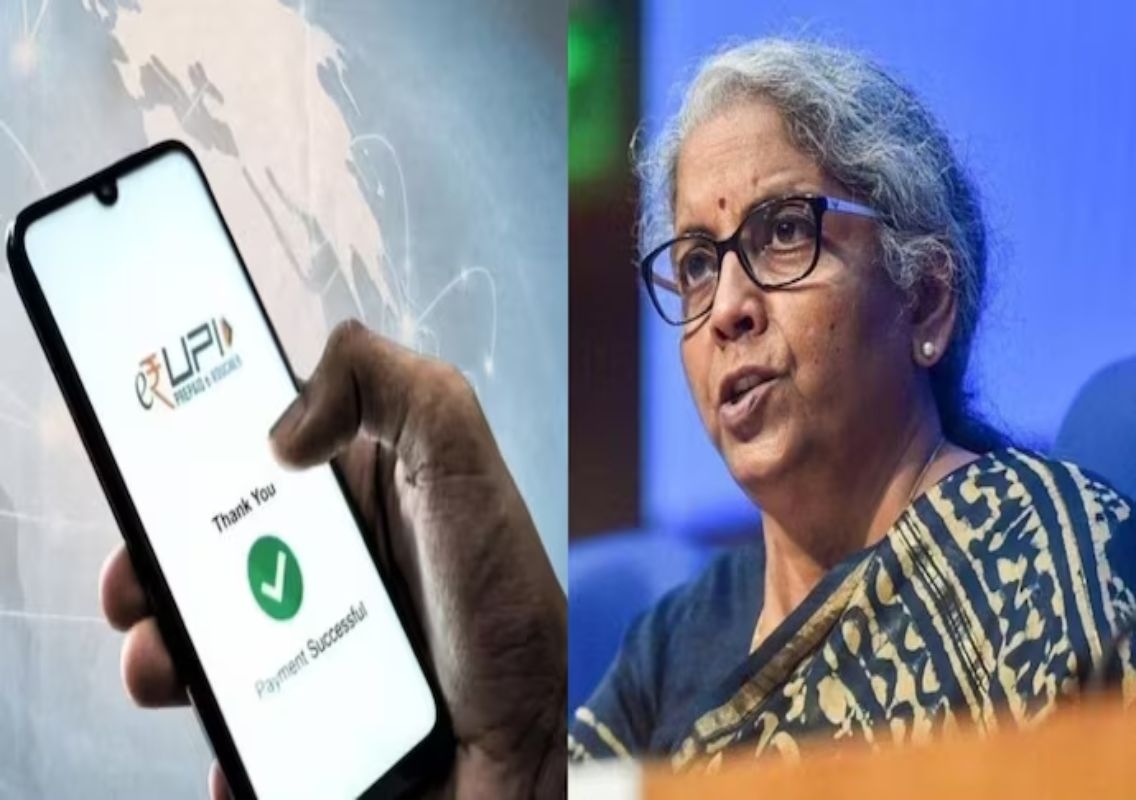


New Delhi: The possibility of charges on Unified Payments Interface (UPI) transactions has triggered widespread concern among digital payment users across India. Addressing these concerns, Finance Minister Nirmala Sitharaman has clarified that any proposed fee on UPI transactions will not affect end users. The clarification comes amid discussions around the Taxation and Other Laws (Amendment) Bill, 2026, which could enable the government to introduce a Merchant Discount Rate (MDR) on certain UPI payments.
The move is being considered as part of a broader effort to strengthen India’s digital payments ecosystem, which has seen exponential growth in recent years. However, the Finance Minister emphasised that the proposal is still under discussion and no final decision has been taken yet.
What is MDR and who will pay it?
The Merchant Discount Rate (MDR) is a fee charged to merchants for processing digital transactions. Currently, UPI transactions are free for both users and merchants, which has contributed significantly to its widespread adoption.
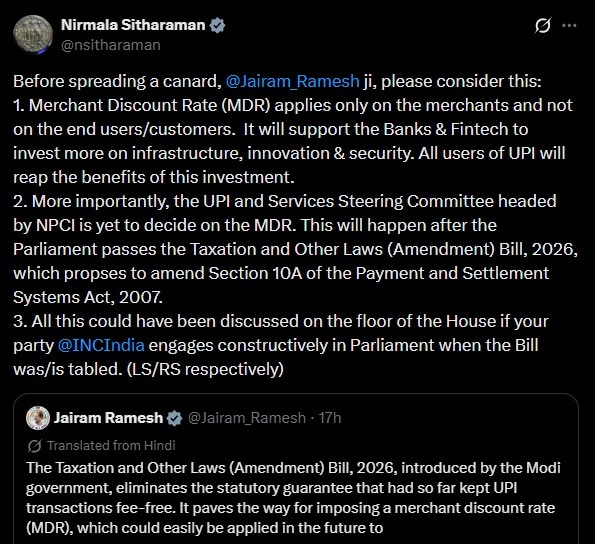
According to Sitharaman, if MDR is introduced on UPI, it will apply only to merchants and not to customers. This means individuals making payments via UPI—whether for groceries, utility bills, or transport services—will continue to enjoy free transactions.
The clarification came in response to concerns raised by Jairam Ramesh, who alleged that the government might eventually extend charges to all digital payments. Sitharaman dismissed these claims and urged against spreading misinformation.
Why is the government considering MDR on UPI?
The government’s rationale behind introducing MDR lies in sustaining and improving the digital payments infrastructure. Banks and fintech companies currently do not earn revenue from UPI transactions, despite handling massive transaction volumes.
Sitharaman explained that introducing a nominal fee for merchants could help banks and fintech firms invest more in technology, security, and innovation. This, in turn, would enhance the overall efficiency and safety of the payment ecosystem.
With UPI handling billions of transactions monthly, stakeholders have increasingly highlighted the need for a sustainable revenue model to support infrastructure upgrades and operational costs.
No final decision yet on implementation
The Finance Minister made it clear that the proposal is still at a preliminary stage. The UPI and Services Steering Committee, led by the National Payments Corporation of India, is yet to take a final call on whether MDR should be implemented.
Any such decision will only be made after Parliament passes the Taxation and Other Laws (Amendment) Bill, 2026. The Bill seeks to amend Section 10A of the Payment and Settlement Systems Act, 2007, thereby providing a legal framework for imposing such charges if deemed necessary.
Until then, UPI users and merchants can continue to operate under the existing no-charge system.
Possible fee structure under discussion
While the government has not officially disclosed the fee structure, reports suggest two possible models under consideration.
The first proposal involves charging an MDR of 0.3 per cent to 0.5 per cent on UPI transactions exceeding Rs 2,000. This would apply to merchants with an annual turnover above Rs 1.5 crore.
Interestingly, transactions above Rs 2,000 constitute only about 5 per cent of total UPI transactions but account for nearly 65 per cent of the total transaction value. This makes them a significant segment from a revenue perspective.
The second proposal suggests linking MDR to a merchant’s annual turnover instead of individual transaction value. The government may also cap the maximum fee that can be charged, ensuring that costs remain manageable for businesses.
Who is likely to be affected?
If implemented, MDR on UPI is expected to primarily impact large businesses rather than small retailers or neighbourhood shops. High-turnover merchants and enterprises handling large-value transactions are likely to bear the cost.
For consumers, the impact is expected to be minimal or non-existent. However, experts caution that merchants could indirectly pass on some costs to customers through pricing adjustments, although no such move has been indicated so far.
It is worth noting that merchants already pay MDR on card transactions. Credit card MDR typically ranges from 1.5 per cent to 3 per cent, while debit card fees are comparatively lower.
Conclusion: No immediate impact on users
The proposed changes to UPI charges have raised important questions about the future of digital payments in India. However, the government has reassured users that any potential fee structure will not directly affect them.
As discussions continue and the legislative process unfolds, clarity is expected in the coming months. For now, UPI remains a free, convenient, and widely accessible payment system for millions across the country.