







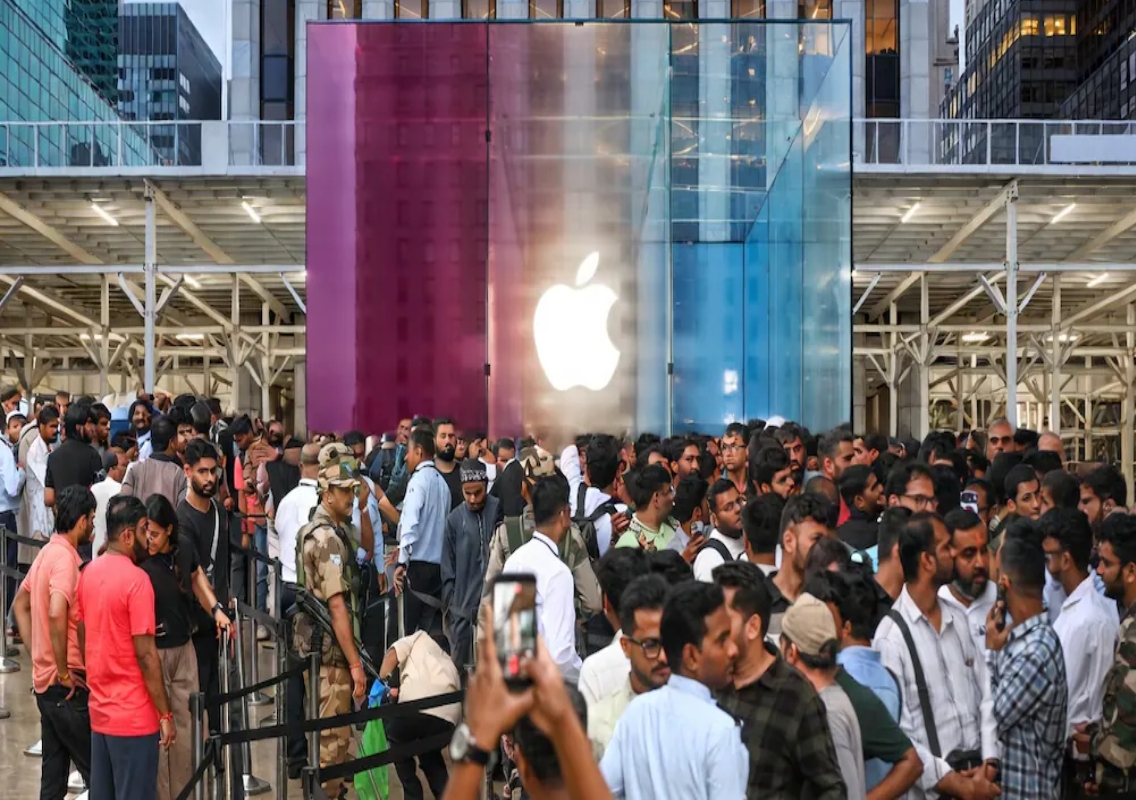


Bengaluru: Apple’s iPhone 18 Pro and iPhone 18 Pro Max went on sale in India on September 18, drawing long queues outside Apple Stores despite the same devices being available online and through quick-commerce platforms with delivery in minutes.
At around 5 am in Bengaluru, a customer named Rahul told reporters that the iPhone launch felt like a “festival”. He had reached an Apple Store before dawn along with enthusiasts who had travelled from Haryana, Delhi and Mumbai. For some of them, attending the launch has become an annual ritual rather than simply a way to purchase a smartphone.
The same scene played out in Mumbai, where a customer from Nashik reportedly began waiting at around 10 pm the previous night. He already knew he had secured a delivery slot but wanted to be among the first customers. He was upgrading from an iPhone 17 Pro Max to an iPhone 18 Pro Max.
The contrast is striking. A customer can order an iPhone 18 Pro through Apple’s online store without leaving home, while quick-commerce platforms such as BigBasket and Blinkit are offering select iPhone 18 models with deliveries advertised in around 10 minutes. Yet customers were still willing to spend the night on pavements outside stores in Delhi, Mumbai and Bengaluru.
The queue is part of the launch spectacle
The phenomenon is not unique to India. Long queues and pre-dawn crowds outside Apple Stores have become a familiar feature of iPhone launch days across major markets, including China, Australia, Europe and the US.
In China, however, the launch-day experience has also become highly transactional. Reports from Shanghai said pre-sales on platforms including JD.com, Taobao and Apple’s own website sold out rapidly. Some customers who queued outside physical stores reportedly could not immediately purchase a phone, but could instead book appointments for later collection.
Scalpers and resellers have also become part of the launch ecosystem. Reports said some networks used automated scripts to place bulk orders, while charging service fees to customers seeking help securing devices. Resale prices for sought-after variants and colours could subsequently rise significantly above official retail prices.
That creates a chain in which scarcity itself becomes part of the consumer experience.
The first wave of buyers wants the device immediately. Resellers want to capture the gap between supply and demand. Social media creators want footage from the launch. Apple benefits from the enormous amount of attention generated around the product.
The result is a spectacle that extends far beyond the simple act of buying a phone.

Scarcity, anticipation and the psychology of waiting
It is easy to interpret overnight queues as irrational consumer behaviour. But the psychology of waiting offers another explanation.
Visible queues can communicate that a product is highly desirable. A crowded store generates curiosity among people who may not otherwise have been interested in the product. The countdown to opening time creates anticipation, while photographs of customers receiving their phones provide a ready-made social media moment.
The sequence is almost perfectly suited to the attention economy: the queue creates buzz, the countdown creates drama, the opening provides a climax and the unboxing supplies the content that follows.
Supply can also influence the perception of scarcity. Popular colours, storage configurations and Pro models can become difficult to obtain immediately after launch, encouraging customers who want a particular configuration to buy early rather than wait.
However, scarcity should not automatically be interpreted as evidence that Apple is deliberately withholding stock. Production, logistics, regional allocations and demand forecasting can all influence launch-day availability.
When waiting becomes part of the product
The phenomenon becomes more interesting when the queue itself starts acquiring value.
Dr Abhinav P Tripathi, Associate Professor at Christ University’s Delhi NCR Campus, told NDTV that the behaviour can be understood through the idea of conspicuous consumption and “conspicuous waiting”.
The concept draws partly on economist Thorstein Veblen’s work on status and consumption. Veblen argued that certain forms of consumption can communicate wealth and social position. In modern consumer culture, waiting publicly for a highly desirable product can similarly become a visible signal.
For some iPhone buyers, therefore, the queue is not merely an obstacle between them and the phone.
It is an experience worth documenting.
A photograph outside an Apple Store, a video showing the overnight wait or a social media post announcing that the customer was among the first buyers can transform an ordinary purchase into an event.
That distinction matters in a world where ownership of a premium smartphone is no longer particularly unusual. The device may be expensive, but millions of people own iPhones. Being among the first to receive a new model provides a different kind of social visibility.
The launch experience becomes part of the story attached to the product.
Apple loyalty and the identity factor
Brand loyalty adds another layer to the phenomenon.
Apple has cultivated a large ecosystem in which the iPhone connects with products and services such as the Apple Watch, AirPods, Macs, iPads and iCloud. For customers already invested in that ecosystem, changing smartphone brands can involve more than simply buying another handset.
Tripathi also referred to an earlier BBC-commissioned experiment involving an Apple enthusiast, which was widely reported as finding similarities between the brain responses associated with Apple imagery and responses observed in religious contexts. However, that experiment involved a single self-described Apple fanatic, making it a weak basis for broad conclusions about iPhone owners.
The larger point is more straightforward: strong brand attachment can make a product launch feel personally significant.
For committed Apple customers, upgrading is not necessarily just a calculation based on specifications. It can also be a familiar annual ritual.
Why are people upgrading less often?
The irony is that the people standing outside Apple Stores represent only a small portion of the overall smartphone market.
Globally, consumers have generally been keeping smartphones for longer. Replacement cycles that once encouraged people to upgrade every two years have gradually extended as modern smartphones have become more powerful, durable and capable of receiving software updates for several years.
For many users, a three- or four-year-old premium smartphone remains perfectly adequate for everyday activities such as messaging, photography, streaming, payments and social media.
Rising smartphone prices and higher component costs can further discourage frequent upgrades.
The result is a widening gap between the launch-day spectacle and normal consumer behaviour.
Those sleeping outside an Apple Store are therefore not necessarily representative of the average smartphone owner. They are a highly self-selected group that can include Apple enthusiasts, resellers, technology creators, early adopters and buyers with enough disposable income to justify an annual upgrade.
The rise of financed upgrades
The financial side of annual upgrading is another important consideration.
The iPhone 18 Pro starts at Rs 1,64,900 in India, while the iPhone 18 Pro Max reaches Rs 3,14,900 for the top 2TB configuration. At the upper end, the price represents several months of gross income for someone earning Rs 1 lakh a month.
Financing can make such a purchase appear more manageable by converting a large upfront payment into monthly instalments. But the total cost of the device does not disappear simply because it is paid over time.
Financial expert Sunisa Arinta told NDTV that EMIs change the timing of the payment rather than reducing the underlying expense.
This is particularly relevant when a consumer upgrades every year. Selling the previous phone, exchanging it, using a bank offer or spreading the remaining cost through EMIs can make the next upgrade appear affordable. But repeated upgrades can still represent a substantial recurring expense.
The festival is real, but it is not the norm
The people camping outside Apple Stores offer a fascinating snapshot of modern consumer culture.
For some, the attraction is the technology. For others, it is the status associated with owning the newest device. For resellers, there may be a financial incentive. For content creators, the launch itself can generate material for social media.
And for some customers, simply being there matters.
That helps explain why a person would spend an entire night waiting for a smartphone that can be ordered online and, in some cases, delivered within minutes.
The answer is not necessarily that consumers do not understand convenience. They do.
Rather, the purchase can represent something beyond convenience: a ritual, a community experience, a status signal or a piece of content.
The iPhone launch queue therefore tells two different stories at the same time. One is about a shrinking group of consumers who continue to upgrade annually and treat every new iPhone as an event. The other is about the much larger population that is keeping smartphones for longer and increasingly has little reason to replace a functioning device every year.
For the customer at home, the iPhone can arrive at the doorstep in minutes.
For the person outside the Apple Store at 5 am, the waiting is part of what they came for.