










New York: AI pioneer Yann LeCun has criticised Anthropic CEO Dario Amodei over his warnings about the potential dangers of open-weight artificial intelligence models. LeCun alleged that Amodei was attempting to exaggerate the risks associated with openly available AI systems to prevent their wider adoption and retain control over the technology.
The comments came after Amodei raised concerns about open-weight AI models during a US congressional hearing, warning that their unrestricted availability could create an “extremely dangerous situation”.
Open-weight models allow developers and users to download a model’s parameters and run it on their own systems, rather than relying entirely on subscription-based cloud services. Their growing popularity has also intensified debate over how governments should regulate powerful AI systems.
LeCun calls Amodei’s approach ‘medieval obscurantism’
LeCun responded to a post on X discussing Amodei’s remarks to US lawmakers. In his response, the AI researcher alleged that the Anthropic chief had been highlighting the dangers of open models since the release of GPT-2 in 2019.
“Dario’s spiel since GPT-2 has always been about hyping the dangers so that open models would be made illegal and he would stay in control,” LeCun wrote.
He also drew a historical comparison to explain his criticism of Amodei’s position. LeCun referred to the Ottoman Empire’s ban on the printing press for Arabic, arguing that restricting access to knowledge could allow powerful institutions to maintain control over what people learn.
“It stops the population from freely accessing diverse knowledge. It’s a new form of medieval obscurantism,” he added.
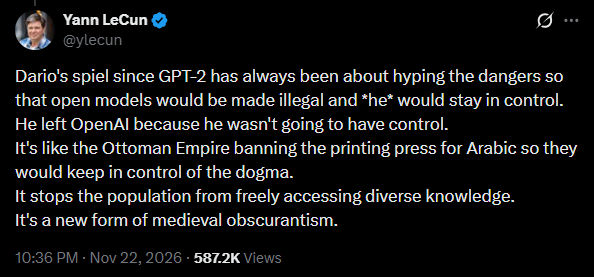
The term medieval obscurantism is generally used to describe the suppression or restriction of knowledge, education and intellectual inquiry by powerful institutions. LeCun used the comparison to argue that restricting open-weight AI could limit public access to technological developments and concentrate influence in the hands of a few companies.
His remarks reflect a wider disagreement within the AI industry over whether advanced models should be made freely available or kept under the control of their developers.
Anthropic’s concerns about open-weight AI
Amodei has repeatedly warned about the risks associated with releasing powerful AI models with publicly accessible weights. His central concern is that once model weights are released, developers cannot easily control how the technology is used or prevent it from being modified.
Earlier this year, several major technology companies, including Nvidia and Microsoft, reportedly urged the White House not to impose a ban on open-weight AI models, including those developed in China. Anthropic, meanwhile, appeared to favour a more cautious regulatory approach.
Amodei later clarified that Anthropic was not seeking an outright ban on open-weight models. However, he maintained that such systems could present greater security risks, particularly if advanced models became available to actors who might misuse them.
“Open-weights models—it does not matter whether they come from China or anywhere else—do potentially present a higher risk than closed models,” Amodei said in July.
He also argued that applying safety measures to open-weight systems was difficult because developers could not continuously monitor their use.
“It is very difficult to apply guardrails to them or monitor their usage, and once weights are released they cannot be withdrawn,” he said.
The disagreement highlights two competing priorities in AI development. Supporters of open-weight models argue that wider access encourages innovation, competition and independent research. Those favouring tighter controls warn that unrestricted access could make it easier for malicious users to exploit advanced AI capabilities.
LeCun claims Amodei left OpenAI over control
LeCun also questioned the circumstances surrounding Amodei’s departure from OpenAI in 2020.
Before establishing Anthropic in 2021, Amodei was a senior member of the OpenAI team. He left the organisation along with several colleagues before going on to co-found the rival AI company.
According to LeCun, Amodei’s departure was linked to his desire to have greater control over the direction of AI development.
“He left OpenAI because he wasn’t going to have control,” LeCun claimed.
Amodei has previously offered a different explanation for his exit. He has said that he disagreed with the vision of OpenAI’s leadership and did not have confidence in the organisation’s direction.
“At the end of the day, why argue with someone when you don’t have the same vision and you don’t trust them,” Amodei told Bloomberg.
The contrasting accounts underline the different interpretations of the split. While LeCun has framed it as a disagreement over control, Amodei has described it as a fundamental difference in vision and trust.
Anthropic’s criticism of Chinese AI companies
Anthropic has also been vocal about the potential misuse of advanced AI models and has repeatedly accused Chinese AI companies of distilling its systems.
Distillation is a technique in which a smaller or newer AI model is trained using the outputs or behaviour of a larger, more capable model. It can help developers build systems that replicate some of the capabilities of more advanced models.
Amodei has argued for stronger safeguards and greater regulation of frontier AI development. He has also supported discussions around temporarily slowing certain forms of advanced AI research to address potential risks.
These positions have placed Anthropic at the centre of an increasingly heated debate over how much access companies, researchers and governments should have to powerful AI technology.
Nvidia’s open-weight AI plans remain unchanged
The debate over open-weight AI is also significant for Nvidia, one of the industry’s major supporters of openly available models.
Nvidia CEO Jensen Huang has previously championed open-weight AI as a way to encourage innovation and expand access to advanced computing capabilities. Despite reports of a leadership transition at the company, Nvidia has maintained that its plans for open-weight AI remain unchanged.
The company’s position suggests that support for open models continues to have strong backing among major technology players, even as concerns about misuse and security grow.
For now, the future of open-weight AI remains uncertain. Governments and technology companies are weighing the benefits of wider access against the challenges of enforcing safeguards once models become publicly available.
LeCun’s criticism of Amodei adds another prominent voice to the debate, exposing the deep differences within the AI industry over who should control powerful models and how much freedom users should have to access them.