







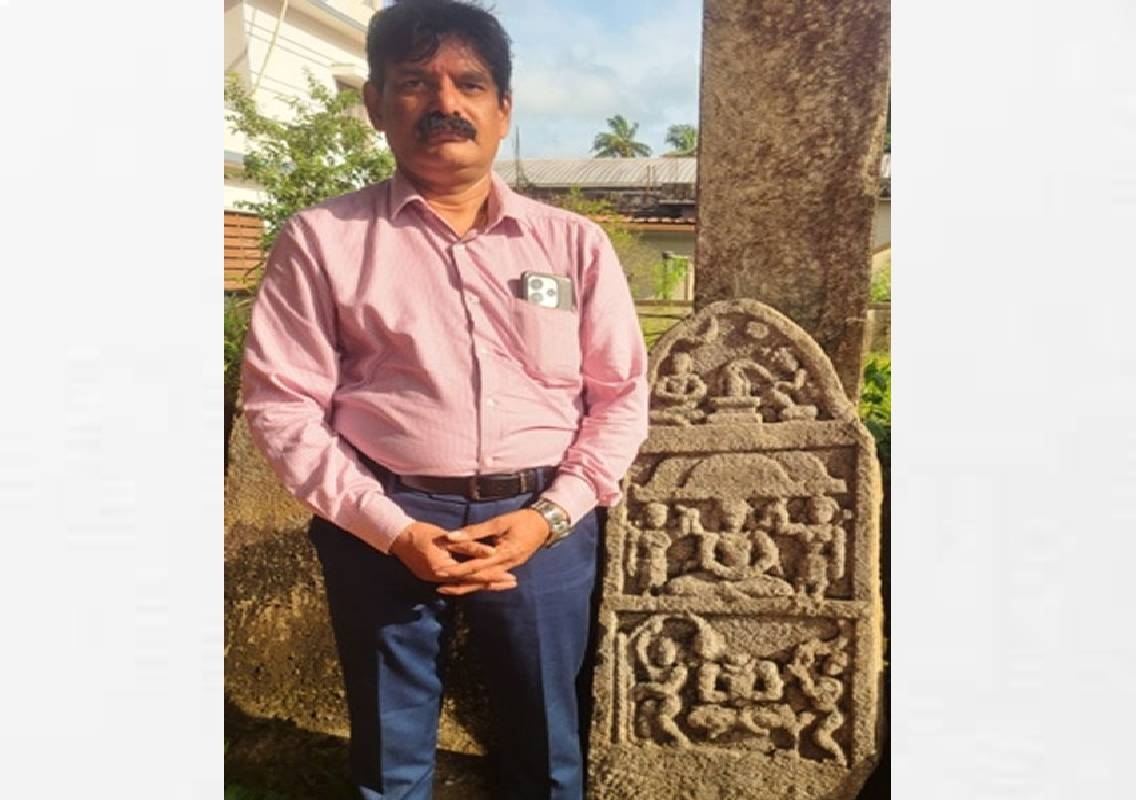


Udupi: A rare 14th-century ‘Siditale’ hero stone has been discovered at the historic Panchalingeshwara Temple in Barkur, offering fresh insights into the region’s archaeological and cultural heritage.
The four-foot-tall stone was found in the outer prakara of the temple during an epigraphical survey carried out amid ongoing renovation work. The survey was jointly undertaken by the Veera Rani Chikkayi Tayi Trust (R), Gulladi, and the Adima Kala Trust (R), Udupi.
Archaeologist Prof T Murugeshi described the discovery as significant, noting that this is the first Siditale-type hero stone identified in Tulunadu. He said self-sacrificing hero stones dating from the ninth to 15th centuries are found in several parts of South India, while three Siditale hero stones from the 10th-century Ganga period had previously been reported in Kodagu.
Stone discovered during temple renovation
The discovery was made while an archaeological and epigraphical survey was being conducted at the Panchalingeshwara Temple in Barkur.
Barkur has considerable historical importance and served as an ancient capital associated with the Alupas and later the Vijayanagara Empire. The discovery of the hero stone at the temple adds another archaeological element to the area’s already significant historical landscape.
The survey team examined the stone and its intricate carvings before identifying it as a Siditale hero stone. Its artistic style and structure indicate that it dates back to the 14th century.
According to Prof Murugeshi, the discovery could provide valuable information about the religious and social practices prevalent in the region during the medieval period.
Four-foot stone has three carved panels
The hero stone is about four feet tall and contains three distinct panels, each depicting a different stage associated with the self-sacrifice of a hero.
The lower panel portrays a person sitting on a mound in a meditative posture. A butcher holding a sword is depicted on the left, while another person on the right is shown holding a bamboo pole. The head of the person being sacrificed is tied to the end of the bamboo pole.
The carving represents the practice known as Siditale. According to the archaeological interpretation, after the person was decapitated, the tension in the bamboo caused the severed head to spring upwards and swing in the air.
The depiction provides an important visual record of a ritualised form of self-sacrifice that was represented in certain medieval hero stones.
Second panel depicts journey to heaven
The middle panel of the stone depicts apsaras carrying the deceased hero to heaven.
The imagery reflects the religious belief that a person who performed such an act of sacrifice would attain a place in the divine realm. The representation of apsaras carrying the deceased is an important element in the visual narrative carved into the stone.
The top panel completes the story by showing the hero seated before Lord Shiva. An archaka is depicted on the right side.
The three-panel arrangement therefore presents a sequence beginning with the act of sacrifice, followed by the hero’s ascent to heaven and his final presence before the deity.
First Siditale stone reported in Tulunadu
The discovery is particularly important because Prof Murugeshi identified it as the first Siditale-type hero stone found in Tulunadu.
Hero stones are found across southern India and were erected to commemorate individuals who died in battle, while some also depict acts of self-sacrifice. Such stones are important archaeological sources because their carvings provide information about beliefs, rituals and social practices that may not be recorded in written sources.
The newly discovered stone’s 14th-century date places it within an important period in the history of the coastal Karnataka region.
Its presence at Barkur could therefore contribute to a better understanding of the cultural practices and religious traditions that existed in medieval Tulunadu.
Archaeological survey receives local support
Prof Murugeshi expressed gratitude to Dr Raghuram Shetty Gulladi for providing financial support for the discovery and survey.
He also acknowledged the assistance of temple administrator Nagashayana and former moktesvar Manjunath Rao.
Students from MSRS College, Shirva, Sinchith and Shodan, also assisted during the archaeological survey. Their participation highlights the role of local academic institutions and students in documenting the region’s heritage.
The collaborative nature of the survey also demonstrates how temple renovation and heritage documentation can provide opportunities to identify previously unrecorded archaeological material.
Discovery highlights Barkur’s historical importance
The Siditale hero stone adds to the historical significance of Barkur, which has long been recognised for its association with medieval dynasties and heritage structures.
The discovery also underlines the importance of carrying out archaeological documentation when restoration or renovation work is undertaken at old temples.
Ancient structures and their surrounding areas can contain inscriptions, sculptures and other artefacts that may remain undocumented for decades. Systematic surveys can help identify and preserve such material before it is damaged or lost.
The Barkur discovery could encourage further archaeological study of the Panchalingeshwara Temple and its surroundings.
New insight into Tulunadu’s heritage
The discovery of the 14th-century Siditale hero stone provides researchers with another piece of evidence about the cultural history of coastal Karnataka.
Its detailed carvings offer a glimpse into the beliefs surrounding sacrifice, death and the afterlife during the medieval period. The fact that it is the first Siditale hero stone identified in Tulunadu makes the discovery particularly noteworthy.
As archaeological surveys continue to document heritage sites across the region, such findings can help build a more comprehensive picture of Tulunadu’s past and preserve its historical legacy for future generations.