







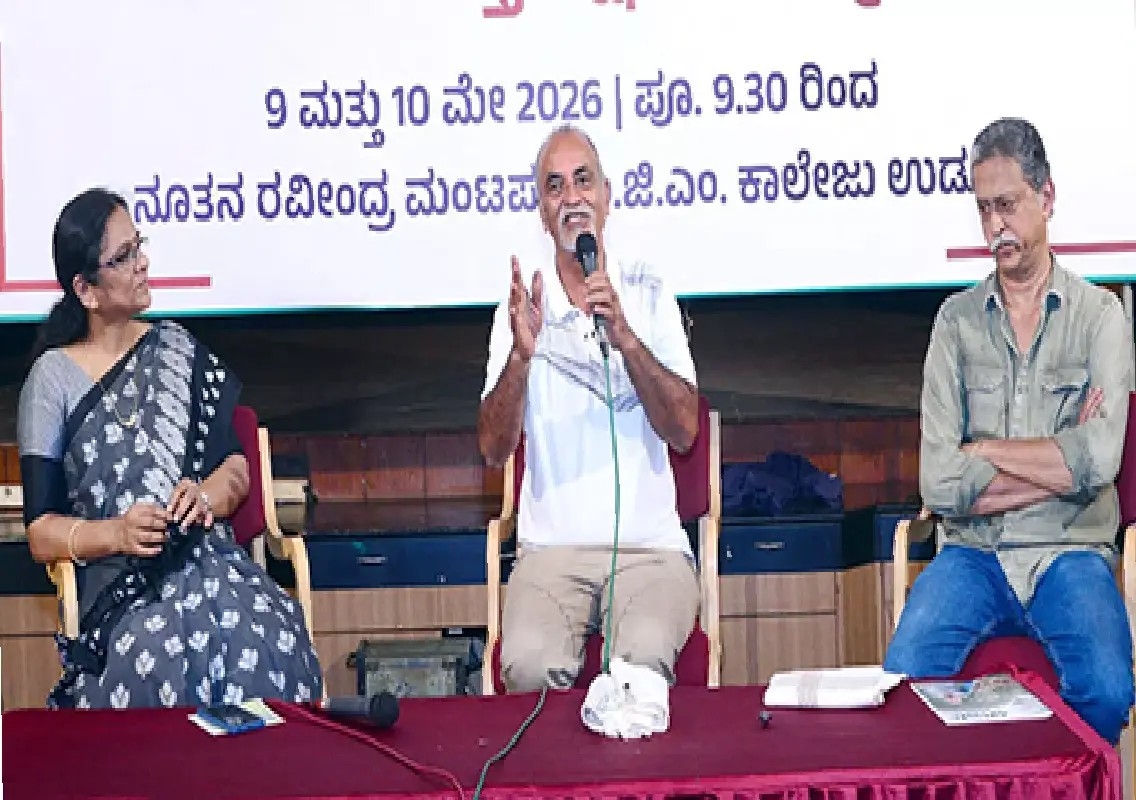


Udupi: Renowned wildlife photographer Krupakar Senani said environmentally destructive projects cannot be effectively resisted unless society elects truly educated and environmentally conscious public representatives.
He was speaking at the Environmental and Education Conference organised in memory of noted ecologist Prof. Madhav Gadgil at the New Ravindra Mantapa of MGM College in Udupi on Saturday. The programme was organised by the Udupi district unit of the Bharat Gyan Vigyan Samiti.
Need for informed leadership
Addressing the gathering, Senani said environmental protection depends more on electing knowledgeable and sensitive representatives than merely degree holders.
He observed that many environmentally damaging projects continue to receive approval because decision-makers and sections of society lack a proper understanding of ecology, wildlife, and conservation.
Referring to an earlier incident in which an Indian Prime Minister had reportedly gifted an elephant calf to another country, Senani termed the act a “grave mistake” and said such decisions are often celebrated due to poor awareness about wildlife protection and animal behaviour.
According to him, genuine environmental awareness must begin with deeper public understanding of nature and biodiversity.
Children must connect directly with nature
Senani stressed the importance of exposing children to nature at an early age instead of limiting environmental education to classroom lessons and textbooks.
“When children are taken outdoors and introduced to trees, forests, birds, and plants, they naturally develop affection and respect for the environment,” he said.
He noted that direct interaction with nature creates a lasting emotional connection that cannot be achieved through theoretical teaching alone.
Criticising the present education system, Senani remarked that many schools had become “plastic schools” focused excessively on marks and examinations rather than curiosity and real-life learning experiences.
He urged teachers to encourage students to ask questions, observe nature, and think creatively beyond textbook-based education.
Concern over social media and virtual lifestyles
Commenting on the growing influence of social media culture, Senani said mobile photography and online trends driven by “likes” had become temporary obsessions among youngsters.
He stressed the need to guide children and youth away from excessive dependence on the virtual world and encourage them to engage more with the natural environment and real-life experiences.
According to him, spending time outdoors helps children develop sensitivity towards wildlife, forests, and ecological balance.
Warning over environmental destruction
Senani also expressed concern over increasing infrastructure projects such as roads and dams, stating that they fragment forests and disturb communication systems among wildlife species.
He pointed out that certain species, including frogs, rely heavily on sound for communication and breeding, and habitat fragmentation caused by development projects disrupts these natural processes.
“Humans are only one among 80 lakh species on Earth. Through wars and destructive activities, humans are ultimately destroying themselves. If such destruction continues, nature may eventually benefit without humans,” he remarked.
The programme also featured an interaction session with Senani. Writer Abhilash S. compered the event.
Conference held in memory of Prof. Madhav Gadgil
The conference was organised in memory of renowned environmentalist and ecologist Prof. Madhav Gadgil, whose work on biodiversity conservation and sustainable development has had a major impact across India, especially in the Western Ghats region.
Participants at the event discussed the importance of balancing development with environmental protection and the role of education in creating environmentally responsible citizens.