







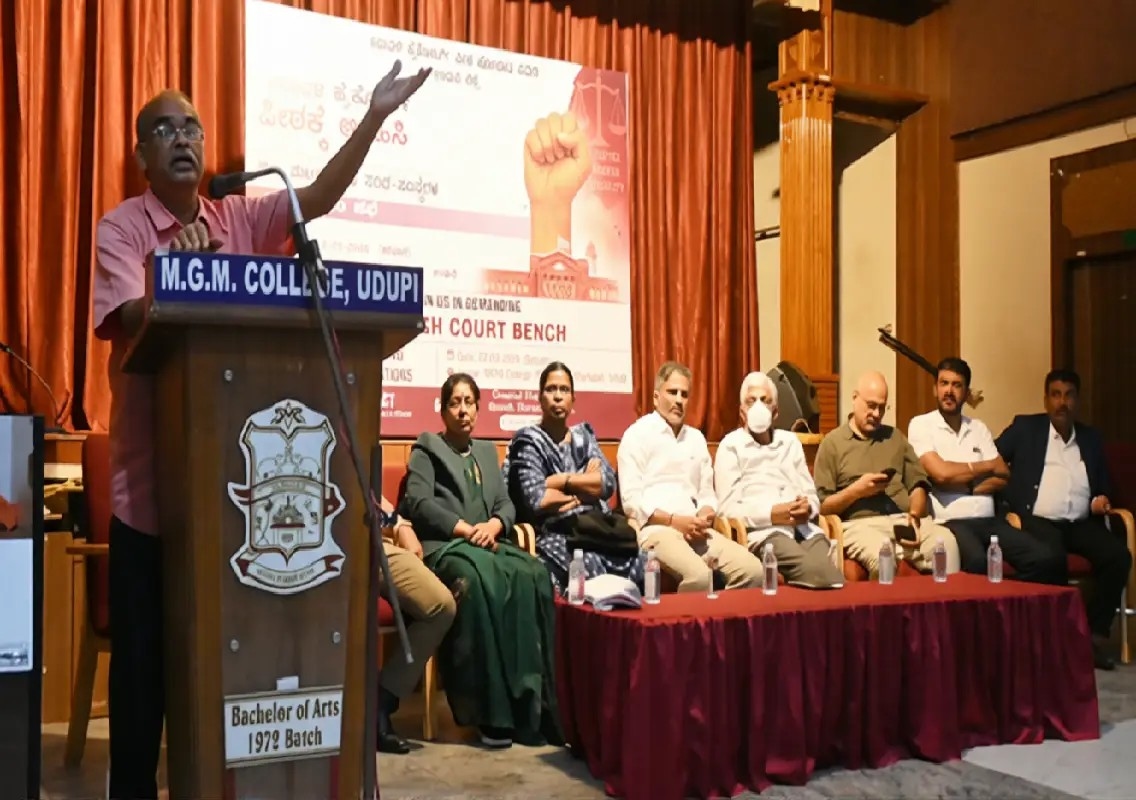


Udupi: The demand for a Karnataka High Court Circuit Bench in Coastal Karnataka, serving Udupi, Dakshina Kannada and Uttara Kannada districts, gained fresh momentum at a meeting held at Ravindra Mantapa, MGM College, Udupi, on August 22.
The meeting was jointly organised by ‘U-Act’ and the Coastal High Court Bench Agitation Committee. Representatives of various organisations, advocates and members of the public participated in the meeting and voiced their support for establishing a High Court bench in the coastal region.
Speakers highlighted the financial and psychological difficulties faced by litigants who have to travel to Bengaluru for High Court proceedings. They said locating a bench closer to the people would make access to justice more affordable and convenient.
Jayaprakash Hegde backs demand
Former minister Jayaprakash Hegde said Coastal Karnataka urgently needs both a High Court bench and a medical college.
He said establishing a High Court bench in the region would substantially reduce the financial burden on litigants from the three coastal districts.
“Advocates here may not charge more, but once a client has to travel to Bengaluru, the expenses increase considerably. If legal expenses are reduced, the burden on the common people will also come down,” he said.
Hegde stressed that speedy justice is closely linked to accessibility and said courts should be located closer to the people who depend on them.
For litigants from Udupi, Dakshina Kannada and Uttara Kannada, travelling to Bengaluru can involve considerable expenditure on transportation, accommodation and other expenses, particularly when cases require repeated appearances.
Litigation can cause financial and mental stress
Psychiatrist Dr PV Bhandary said prolonged legal proceedings and litigation could place considerable psychological and financial pressure on individuals and families.
He said establishing a High Court bench in Coastal Karnataka would help reduce the financial burden on people seeking justice and would serve the broader public interest.
According to him, accessibility to judicial institutions is an important factor in ensuring that people can pursue their legal rights without being discouraged by the cost and inconvenience involved.
The speakers at the meeting said the proposed bench would benefit not only advocates but also ordinary citizens who are required to approach the High Court in connection with their cases.
Bar Council member calls for unity
Shamala Bhandary, member of the Bar Council of Karnataka, said demands of this nature would naturally face both support and opposition.
However, she called upon elected representatives, members of the legal fraternity and the general public to work together to strengthen the campaign.
“I will always stand with this agitation. Not only the public, but advocates from all bar associations must join the movement. Many people hesitate to approach the High Court because of the expenses involved,” she said.
She stressed the need for advocates from different bar associations to participate actively in the campaign and create wider awareness about the issue.
The meeting also emphasised the importance of taking the demand beyond the legal community and building broader public support across Coastal Karnataka.
Senior advocate highlights case backlog
Senior advocate Mattar Rathnakar Hegde said the demand for a High Court bench was shared by people across the coastal districts.
While technological advancements have enabled several court proceedings to be conducted online, he said the need for a dedicated High Court bench in the region continues because of the significant number of cases originating from Coastal Karnataka.
He said a permanent judicial institution closer to the region would provide greater convenience to litigants and members of the legal profession.
The speakers also pointed out that technological facilities, while useful, cannot completely eliminate the need for physical access to courts, particularly in cases where personal appearances and other legal procedures are required.
Campaign to reach every taluk
Prem Prasad Shetty, founder of ‘U-Act’ and convener of the Coastal High Court Bench Agitation Committee, said the campaign would be expanded to reach different sections of society.
He called for meetings to be organised across the coastal districts to explain the demand and build public support.
“The demand must reach more people. Over the next 15 days, meetings should be held in every taluk. Presidents and members of taluk bar associations must take the initiative and spread awareness through social media,” he said.
He urged representatives of taluk bar associations to play an active role in taking the campaign forward.
The proposed outreach programme is expected to involve legal professionals, social organisations, public representatives and citizens, with the aim of turning the demand into a wider public movement.
Support from various organisations
Representatives of several organisations attended the meeting and expressed their support for establishing a High Court bench in Coastal Karnataka.
The demand covers Udupi, Dakshina Kannada and Uttara Kannada districts and has been raised on the grounds of improving access to justice and reducing the cost and inconvenience faced by litigants.
The meeting provided a common platform for advocates, social workers, professionals and members of the public to discuss the issue and outline future steps for the campaign.
Srinath, Yaseen Shiroor, Byndoor Bar Association president Prashanth Poojary, Dr Sabitha Koraga, spokesperson Kokkarne Surendranath Shetty, Chandrashekar Shetty and others were present.
The organisers said the campaign would continue with awareness programmes and meetings at the taluk level.
With renewed calls for collective participation from advocates, elected representatives and the public, the movement for a High Court Circuit Bench in Coastal Karnataka is set to gain further momentum. Supporters of the demand believe that bringing High Court proceedings closer to the coastal districts would help reduce litigation-related expenses and make access to higher judicial remedies more convenient for people in the region.