







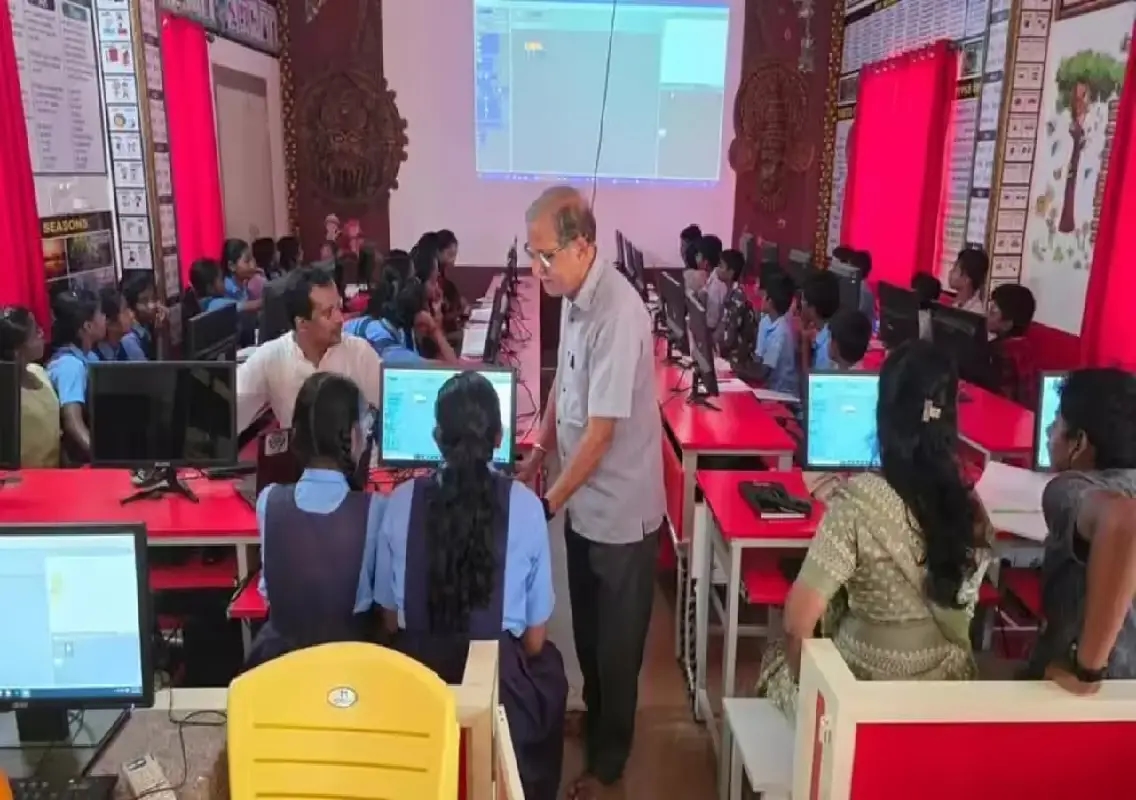


Udupi: Around 10 government primary schools in Udupi district will soon begin using the Kannada version of Scratch, a globally renowned visual coding platform for children. The initiative has been launched by the Vishwa Kannada Foundation, with the programme formally introduced at the Government Higher Primary School, Hesakuthoor, Kundapur, recently. The move marks a significant step towards strengthening early computational thinking among young learners in rural government schools.
Visual programming made accessible in Kannada
Scratch, developed and managed by the US-based Scratch Foundation, is the world’s largest coding community for children. The platform uses block-based programming, allowing students to learn coding concepts by creating digital stories, animations, games, and interactive projects. Its simple drag-and-drop interface has made it a favourite in classrooms worldwide.
With the launch of its Kannada version, children in government schools—many of whom lack English-language proficiency—will now be able to understand coding concepts in their mother tongue, giving them early exposure to technology in an accessible format.
Pavanaja: Children need programming, not just basic computer tools
The programme was officially launched by U B Pavanaja, director of the Vishwa Kannada Foundation and a strong advocate of vernacular computing. Speaking at the event, he said the initiative is aimed primarily at primary school children, as that is when logical thinking and creativity begin to develop rapidly.
“In the name of computer education, children are usually taught only Word, Excel, and Paint. What they truly need is computer programming, which enhances logical thinking and problem-solving ability at a young age,” he said.
Pavanaja highlighted that in the past, programming tools such as LOGO, which encouraged logic and creativity, were available for high school students. “I developed a Kannada version of LOGO and even won an award for it. But it never reached schools in a structured or widespread manner,” he recalled.
He added that the current initiative, supported by technologist Anand Sawanth, is an effort to ensure that children in government schools get the opportunity to learn programming in their own language.
Programme already tested in other Karnataka schools
Explaining the background of the initiative, Pavanaja shared that the programme was first introduced two years ago in select schools including Arivu Mysuru, Sneha School, Sullia, Shri Rama School, Kalladka, and Uppinangady. Teachers associated with the Swami Vivekananda Youth Movement (SVYM) were trained during the initial roll-out.
“After a one-year break due to logistical constraints, we are now scaling it up across 10 government schools in Udupi district this year,” he said. The objective is to gradually expand the programme to more districts in the coming years, he added.
Strong support from education department
The initiative has received enthusiastic backing from the Udupi district education department. DIET principal Ashok Kamath extended full support to the programme and encouraged teachers to integrate the Kannada Scratch platform into classroom activities. DIET lecturer Nagaraj coordinated the event and liaised with the Vishwa Kannada Foundation to ensure a smooth launch.
At the host school in Hesakuthoor, headmaster Shekhar Kumar and English teacher Ashok Thekatte played key roles in facilitating the programme’s implementation. Teachers from other participating schools also attended the event to familiarise themselves with the platform.
Impact on early learning
Educationists believe that exposing children to coding concepts at the primary school stage can significantly enhance their cognitive abilities. With Scratch, children learn sequencing, logic, creative problem-solving, and algorithmic thinking—all through play-based and visual learning.
The addition of Kannada language support will help break linguistic barriers and make technology education more inclusive. The programme aims to empower students in rural and government schools with skills that are increasingly becoming essential in a digital world.
The initiative is expected to be rolled out in phases across the 10 selected schools over the next few months, with teachers receiving training and resource materials in Kannada.