







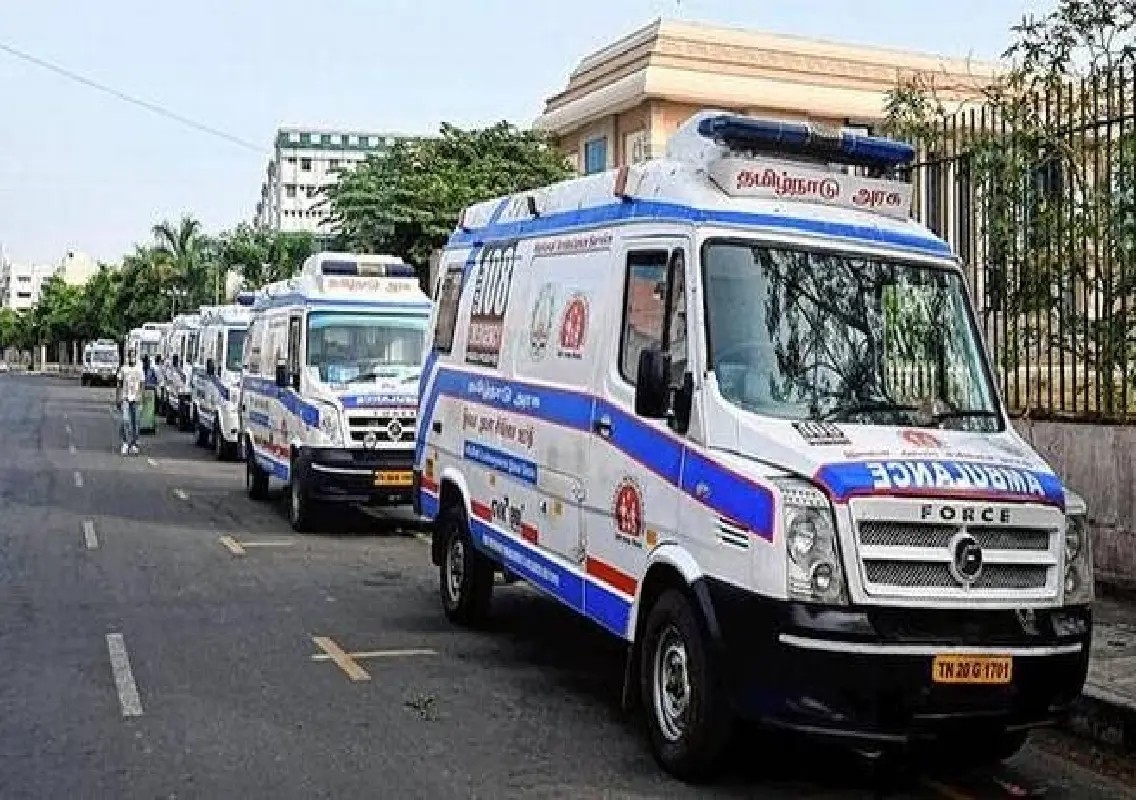


Udupi: In a major reform aimed at improving emergency medical services, the Karnataka government has mandated a 15-minute response time for 108 ambulance services across the state. Health Minister U T Khader announced that ambulance drivers who fail to reach emergency locations within the stipulated time will face a Rs 5,000 penalty, as part of efforts to strengthen accountability and save lives during the crucial “golden hour”.
Government targets faster emergency response
The announcement comes amid growing concerns over delays in ambulance services during medical emergencies such as road accidents, childbirth complications and sudden cardiac arrests.
Delayed ambulance arrivals have frequently been reported from various parts of Karnataka, with response times often exceeding one hour in rural areas and 20 to 30 minutes in urban centres, raising concerns about the efficiency of the state’s emergency response system.
Officials have attributed these delays to ageing ambulances, vehicle breakdowns and operational inefficiencies that have hampered timely medical intervention.
15-minute deadline for ambulances
Speaking in Udupi, Khader said the government would enforce strict timelines to improve the functioning of the 108 emergency ambulance service.
He said ambulances must reach the emergency location within 15 minutes of receiving a distress call.
According to the minister, prompt response during the golden hour can significantly improve survival rates.
“If ambulances reach within 15 minutes, nearly 90 per cent of emergency cases can be stabilised. When response times are delayed, the system fails,” Khader said.
He noted that while the national benchmark for ambulance response is 20 minutes, Karnataka has decided to adopt a more stringent 15-minute target.
The minister added that any ambulance failing to meet the prescribed response time would attract a Rs 5,000 penalty, with detailed operational guidelines to be issued shortly.
Emergency service to undergo major upgrade
As part of the reform programme, the Health Department has proposed a comprehensive modernisation of the state’s emergency ambulance network.
A centralised high-tech control room will be established to monitor emergency calls and track the real-time movement of ambulances, enabling better coordination and quicker dispatch.
Authorities said the upgraded monitoring system would improve operational efficiency and reduce unnecessary delays.
Separate benchmarks for urban and rural areas
While the overall objective is a 15-minute response time, the government has proposed separate operational targets based on location.
The revised framework aims for ambulance arrivals within 15 minutes in urban areas and 20 to 25 minutes in rural regions, recognising the geographical challenges in remote locations.
Continuous monitoring will be carried out to ensure compliance with the prescribed timelines.
Old ambulances to be replaced
The government has also decided to phase out ageing ambulances that are prone to technical failures.
These vehicles will be replaced with modern, fully equipped life-support ambulances capable of providing reliable emergency medical care while ensuring faster deployment.
Khader said Karnataka requires approximately 700 to 800 ambulances in proper working condition to effectively meet emergency healthcare demands across the state.
Real-time tracking for citizens
In a technology-driven initiative, the state plans to introduce a real-time ambulance tracking system similar to ride-hailing platforms.
The proposed system will enable citizens to track the location of ambulances and view estimated arrival times on their mobile phones after placing an emergency call.
Officials believe this feature will improve transparency and provide reassurance to patients and their families during emergencies.
Training for ambulance personnel
The reform package also includes specialised training programmes for ambulance drivers and paramedical staff.
The training will focus on emergency handling, patient care and efficient on-site response, with the objective of improving overall service quality.
Authorities said the reforms are intended to ensure that no life is lost because of avoidable delays in emergency medical transportation.
Conclusion
With stricter response timelines, financial penalties for delays, modern ambulances and technology-driven monitoring, the Karnataka government aims to significantly strengthen the 108 emergency ambulance service. The proposed reforms are expected to improve emergency medical care across both urban and rural areas, ensuring quicker assistance during life-threatening situations.