




Udupi: Manipal Hospice and Respite Care (MHRC), a specialised healthcare facility under the Manipal Academy of Higher Education (MAHE), has completed its first year of clinical services, providing free hospice, palliative, rehabilitative and supportive care to 694 patients and more than 1,300 family caregivers.
Established to provide compassionate care for people living with serious and life-limiting illnesses, MHRC has made all its services available free of charge since it began admitting patients on September 1, 2025. The facility was inaugurated in April 2025.
The centre marked the milestone by highlighting its efforts to improve access to palliative care, support family caregivers and build awareness about the importance of comfort and dignity for patients facing serious illnesses.
MHRC expands capacity, plans further growth
MHRC began its clinical operations with 10 beds and has since expanded its capacity to 40 beds. The centre plans to increase this to 65 beds in 2026, with a particular focus on neuropalliative care, before expanding further to 100 beds by 2027.
The facility follows a multidisciplinary, patient- and family-centred approach, addressing not only medical and nursing needs but also the physical, psychological and social challenges faced by patients and their families.
Its services are designed to improve patients’ quality of life while providing practical and emotional support to caregivers who often face considerable demands while caring for loved ones with serious illnesses.
Admission to MHRC is channelled through the outpatient clinic of the Department of Palliative Medicine and Supportive Care at Kasturba Medical College (KMC), Manipal. The clinic functions from Monday to Saturday between 9 am and 5 pm.
Palliative care focuses on comfort and dignity
MHRC is also working to dispel misconceptions about hospice care, particularly the perception that a hospice is similar to an old-age home.
The institution has clarified that MHRC is a specialised healthcare facility offering professional medical and palliative care to people living with serious illnesses. Its approach focuses on managing symptoms, relieving pain and improving patients’ comfort and dignity.
Dr Seema R Rao, director and consultant in palliative medicine at MHRC, emphasised that palliative care should not be viewed as giving up on treatment or life.
“Pain is one of the biggest fears for patients with a serious illness, and in most cases, it can be managed well. In our first year, we have seen what it means to a family when their loved one is comfortable and free of pain,” she said.
“Palliative care is not about giving up; it is about adding comfort and dignity to every day in a patient’s life. We also stand with the caregivers, who often quietly carry a heavy load. We encourage families and doctors to approach us early, and not only in the last few days,” Dr Rao added.
Her remarks highlighted the importance of early referral to palliative care services, rather than approaching a specialised facility only when a patient’s condition has reached its final stages.
MAHE seeks to develop models suited to India
Beyond providing clinical services, MAHE and MHRC are developing education, training and capacity-building initiatives to strengthen palliative care skills among healthcare professionals.
Dr Sharath K Rao, vice-chancellor of MAHE, said the institution wanted to contribute to the development of palliative care models suited to the needs and circumstances of India and Southeast Asia.
“MAHE has always been a pioneering institution, and our responsibility extends beyond providing healthcare to creating knowledge and building capacity for the future. Much of the existing knowledge and many models of palliative care have emerged from Western settings. Through MHRC, we want to understand and develop what works in the context of India and Southeast Asia,” he said.
He added that the institution would focus on addressing training requirements, equipping healthcare providers with the necessary knowledge and skills, and developing practical models that other institutions could replicate.
The initiative is intended to strengthen the delivery of palliative care by improving professional expertise and encouraging healthcare institutions to incorporate such services into their broader systems.
MAHE calls for community participation
Dr H S Ballal, pro-chancellor of MAHE, said palliative care should be recognised as an extension of healthcare and made accessible to everyone who needs it.
“Palliative care must be seen as an extension of healthcare if it is to become available and accessible to everyone who needs it. Healthcare institutions and universities have an important responsibility to take up this kind of care, and MAHE has taken the lead by establishing MHRC, making MAHE the only university in India to have created a hospice of this kind within its health system,” he said.
Emphasising the institution’s commitment to providing free services, Dr Ballal said a person’s dignity, including at the end of life, should not depend on their ability to pay for care.
He called upon the community to support the initiative and work with MAHE to ensure that compassionate palliative care remains accessible to all.
The development and services of MHRC have received support from the Harish and Bina Shah Foundation, Siemens, the Manipal Foundation and other donors. MAHE has also announced a new partnership with Axis Bank to support MHRC, with further details expected to be shared later.
World Hospice and Palliative Care Day highlights awareness
Through World Hospice and Palliative Care Day (WHPCD) 2026, MAHE and MHRC aim to improve public understanding of palliative care, address common misconceptions and encourage healthcare institutions and communities to recognise it as an integral component of comprehensive healthcare.
The initiative also seeks to encourage families and doctors to explore palliative care at an appropriate stage of illness, helping patients receive symptom relief and emotional support while easing the burden on caregivers.
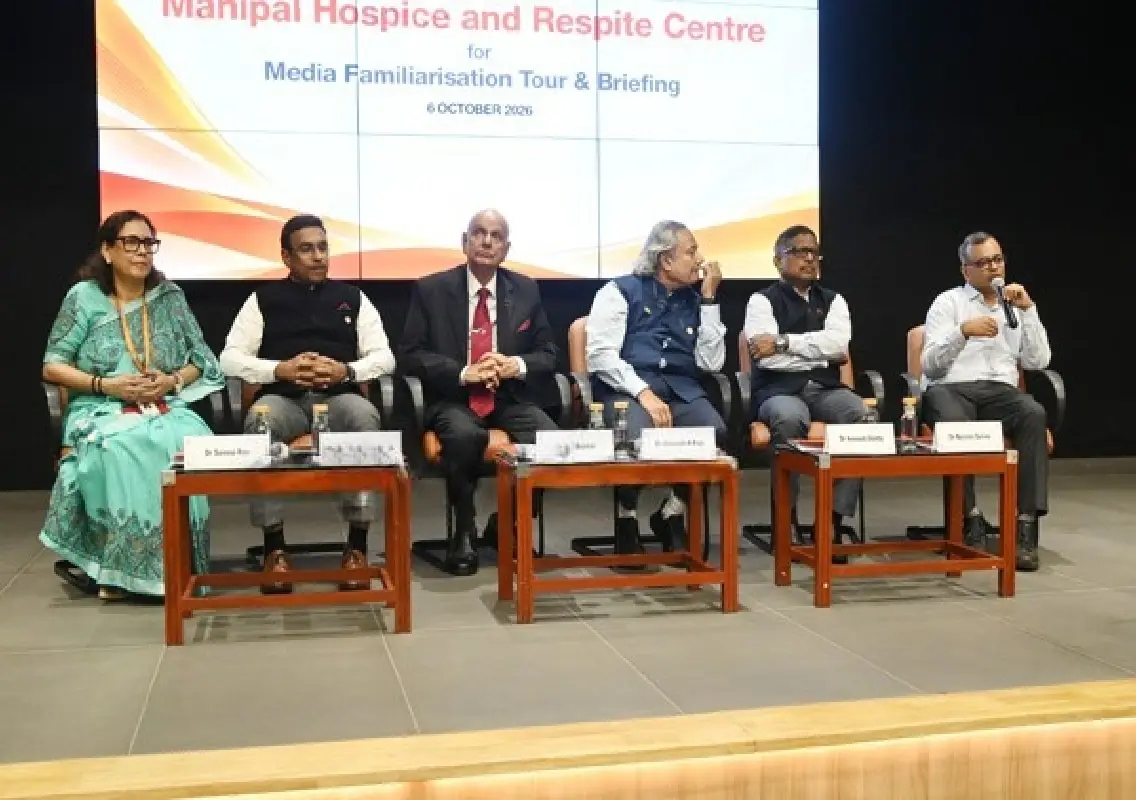
Those present at the press meet included Dr H S Ballal, pro-chancellor of MAHE; Dr Sharath K Rao, vice-chancellor; Maj Gen (Dr) Mathews Jacob, VSM (Retd), pro vice-chancellor of health sciences; Dr Avinash Shetty, medical superintendent of Kasturba Hospital, Manipal; Dr Seema R Rao, director and consultant in palliative medicine at MHRC; and Dr Naveen Salins, director of research and professor of palliative medicine and supportive care.
With plans to expand its bed capacity and strengthen training and research, MHRC aims to build on its first year’s work and widen access to free, specialised care for patients and families navigating serious illnesses.