









Manipal: Surgeons at Kasturba Hospital, Manipal, have successfully completed a highly complex pancreatic cancer operation using a combination of keyhole surgery and advanced robotic technology, allowing a 58-year-old woman to return home just seven days after the procedure.
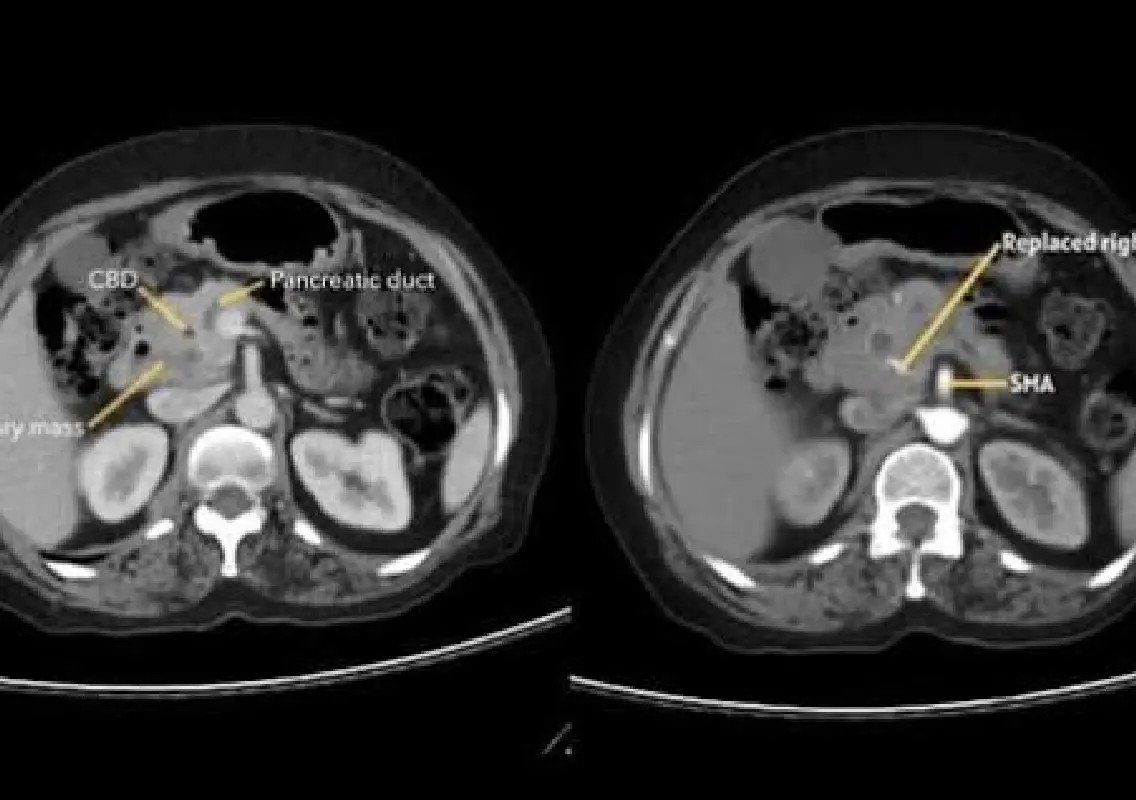
The operation involved removing a bulky periampullary tumour that had affected the wall of the small intestine and the head of the pancreas. The case was made particularly challenging by an unusual blood vessel arrangement, with an artery supplying the liver passing directly through the area where the surgeons needed to operate.
Despite the added risk, the eight-hour procedure was completed without converting to conventional open surgery. Blood loss was limited to around 200 ml, and the patient recovered without major complications.
The successful operation highlights the growing capabilities of advanced cancer surgery at Manipal and offers patients in coastal Karnataka access to highly specialised treatment closer to home.
The warning sign came as jaundice
The patient initially came to the hospital with yellowing of the eyes and skin, a condition commonly known as jaundice.
In her case, the jaundice was caused by an obstruction in the bile duct. The tumour was blocking the normal flow of bile from the liver towards the intestine.
Further scans revealed a bulky periampullary tumour.
The periampullary region is located where the bile duct and pancreatic duct open into the small intestine. Tumours developing in this area can be particularly challenging to treat because several important organs, ducts and blood vessels are located close together.
Doctors found that the cancer had spread into the intestinal wall and the head of the pancreas, making major surgery necessary.
The operation was a demanding Whipple procedure
The surgical team decided to perform a pancreaticoduodenectomy, commonly known as the Whipple procedure.
It is one of the most complex operations performed in abdominal surgery.
During the procedure, surgeons remove the head of the pancreas along with portions of the small intestine and bile duct and the gallbladder. The digestive system must then be reconstructed carefully so that food, bile and pancreatic digestive juices can continue to move through the body normally.
Traditionally, such an operation is performed through a large abdominal incision.
For this patient, however, the surgical team chose a minimally invasive approach.
An unusual artery made the surgery even harder
The patient’s anatomy presented an additional challenge.
An artery supplying the liver was travelling along an unusual route and passed directly through the surgical field close to the tumour.
Such anatomical variations are uncommon, but they can significantly increase the risk during pancreatic surgery.
An accidental injury to an important blood vessel can result in severe bleeding and can potentially compromise the blood supply to vital organs.
The surgeons therefore had to work with an extremely narrow margin for error.
The unusual positioning of the artery made precise identification and handling of the surrounding structures particularly important.
Keyhole surgery reduced the need for a large incision
Instead of carrying out the entire operation through a conventional open incision, the team used a hybrid minimally invasive technique.
The tumour was removed through small keyhole incisions.
The intricate reconstruction that followed was performed with the Hugo RAS robotic surgical system.
Robotic technology provides surgeons with a magnified, three-dimensional view of the operating area and instruments capable of making highly controlled movements within the confined surgical space.
For a procedure involving delicate structures such as the pancreas, bile duct, intestine and major blood vessels, such precision can be particularly valuable.
Eight hours of surgery, but no conversion to open operation
The operation lasted approximately eight hours.
Despite the complexity of the cancer and the patient’s unusual arterial anatomy, the surgeons did not need to convert the procedure into conventional open surgery.
Blood loss was estimated at only 200 ml.
The patient subsequently recovered without major complications and was discharged on the seventh day.
She remains under regular follow-up according to standard cancer-care protocols.
The relatively quick recovery was a significant outcome considering the complexity of the operation.
Precision mattered most in this case
Dr Naveena Kumar A N, head of the Department of Surgical Oncology, said the case was particularly demanding because the abnormal artery passed directly through the operating area.
He explained that combining keyhole tumour removal with robotic reconstruction enabled the team to complete the operation safely and precisely while avoiding the larger incision associated with traditional open surgery.
For the patient, this approach potentially meant less surgical trauma and a shorter recovery period.
The successful outcome also demonstrates how minimally invasive and robotic techniques are increasingly being used for operations that once depended almost entirely on conventional open surgery.
A team effort behind the operation
The surgery was performed by a multidisciplinary team.
The team included Dr Naveena Kumar A N, Dr Nawaz Usman, Dr Preethi S Shetty, Dr Akhil Palod and Dr Ananthakrishnan Balakrishnan.
The department of anaesthesia and operating theatre staff also played an important role in supporting the lengthy and technically demanding procedure.
Complex cancer surgery requires coordination well beyond the surgeon performing the operation.
Anaesthesia, imaging, nursing, operating theatre and postoperative teams all contribute to ensuring that patients can safely undergo major procedures and recover afterwards.
Advanced care closer to home
The successful procedure is also significant for patients in coastal Karnataka.
People requiring highly specialised cancer surgery have traditionally had to consider travelling to major metropolitan centres for certain complex procedures.
The availability of advanced robotic surgery and specialised oncology teams in Manipal provides another option.
Dr Sudhakar Kantipudi, chief operating officer of MAHE teaching hospitals, said the institution’s aim was to bring advanced medical technology and infrastructure to the region so that patients could receive specialised care without travelling long distances.
He highlighted investment in robotic surgical platforms, modern operating theatres and multidisciplinary teams as part of this effort.
Manipal continues to expand its surgical capabilities
Kasturba Hospital is part of the Manipal Academy of Higher Education (MAHE) teaching hospital network.
Over the years, the institution has developed advanced facilities across several medical specialities, including complex cancer care and robotic surgery.
The latest operation adds to that growing capability.
The combination of sophisticated technology and experienced specialists is particularly important in complex procedures where anatomy can vary significantly between patients.
Robotic systems do not replace the expertise of surgeons. Instead, they provide additional visualisation and instrument control that experienced surgical teams can use when performing technically demanding procedures.
What makes the outcome noteworthy?
The significance of the case lies not simply in the use of a robot.
The operation involved several challenges at once: pancreatic cancer, involvement of nearby structures, an unusually positioned artery and the need for extensive reconstruction after tumour removal.
Yet the team completed the procedure through a minimally invasive approach, recorded relatively low blood loss and discharged the patient after seven days.
Such outcomes demonstrate how surgical techniques are evolving.
Procedures that require extremely precise dissection and reconstruction can increasingly be performed through smaller incisions in carefully selected patients.
However, the suitability of robotic or minimally invasive surgery depends on individual patient factors, tumour characteristics and the expertise of the treating team.
A promising step for cancer care in the region
Pancreatic and periampullary cancers remain challenging conditions requiring highly specialised treatment.
Surgery, when appropriate and feasible, can involve complex removal and reconstruction, often alongside other forms of cancer treatment.
The Manipal case shows what can be achieved when advanced technology is combined with specialist surgical expertise and multidisciplinary hospital support.
For patients and families in Karnataka, the availability of such services closer to home can also reduce the practical and emotional burden associated with travelling to distant cities for treatment.
A difficult diagnosis, followed by a remarkable recovery
For the 58-year-old woman, the journey began with a symptom that might initially appear relatively familiar — jaundice.
It ultimately led to the discovery of a complicated tumour requiring one of the most demanding abdominal operations.
Eight hours later, the cancer had been surgically removed without the need for open conversion.
Within a week, she was able to leave the hospital.
Her recovery does not mark the end of her cancer journey, as continued follow-up and appropriate oncology care remain essential. But it represents an important milestone in her treatment.
For Manipal, meanwhile, the operation demonstrates the growing potential of advanced surgical technology outside India’s largest metropolitan centres.
A complex pancreatic cancer, an unusual artery and an eight-hour operation presented an enormous challenge — but precision, technology and teamwork helped turn it into a successful recovery just seven days later.