









Unique Shaiva-Vaishnava blend showcases rich cultural and religious heritage
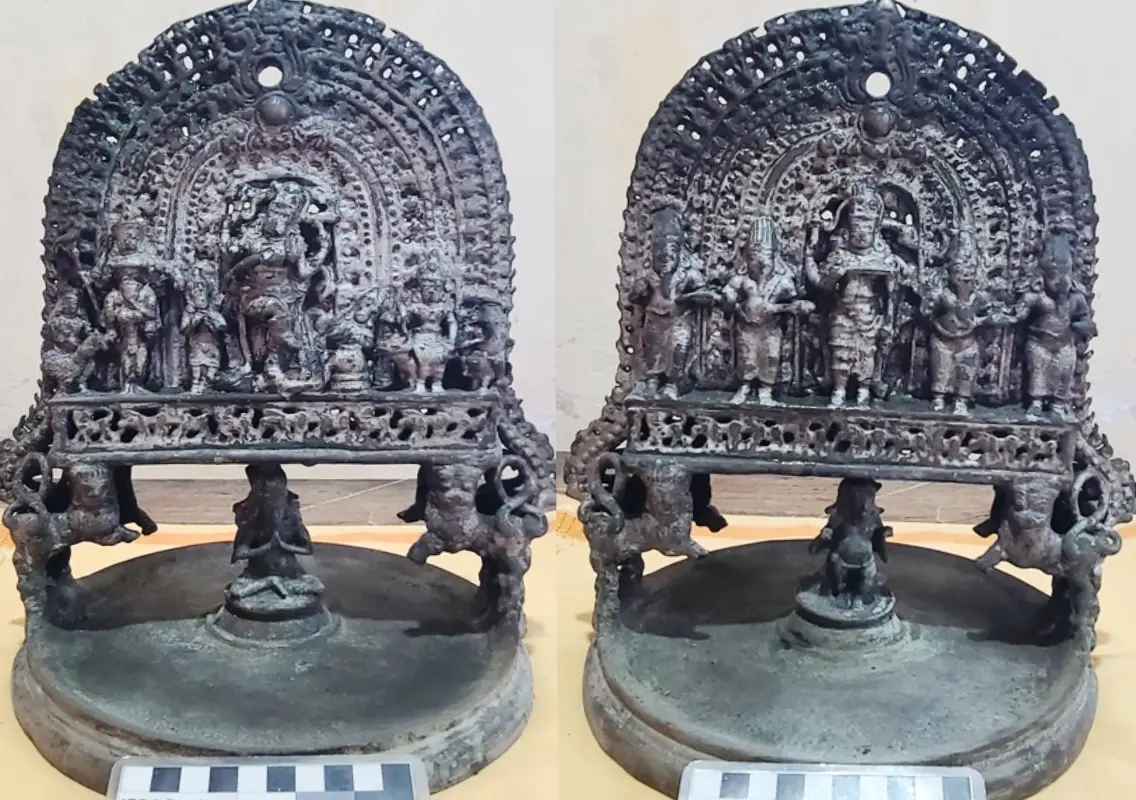
Udupi: A rare antique lamp featuring intricate Shaiva and Vaishnava sculptures has been discovered in the ancient Anantapadmanabha Temple at Perduru, Udupi district. The artefact, believed to date back to the 15th century, represents a remarkable artistic and spiritual synthesis of the Shaiva and Vaishnava traditions.
In a press release issued by Prof. T. Murugeshi, retired Associate Professor of Ancient History and Archaeology and founder trustee of Adima Kala Trust, the lamp was described as an extraordinary single-piece sculpture with two narrative faces, offering insights into puranic mythology and temple rituals.
A blend of mythologies: Pralaya Tandava and divine supplication
On one face, the lamp vividly depicts Lord Shiva as Nataraja, performing the cosmic Pralaya Tandava (destructive dance). He is flanked by various divine figures:
-
Parvati, seated on a bull
-
Ganesha, riding his mouse
-
Bringi, clapping in rhythm
-
Khadga Ravana, seated on a half-naked woman named Mari, holding weapons and symbols including a sword, plough, kapala (skull cup) and severed head
-
Kumara (Murugan), seated on a peacock
This face of the lamp showcases the fearsome form of Shiva, bringing forth fright across the three worlds, according to Prof. Murugeshi. The presence of Khadga Ravana atop Mari, still venerated today in the temple’s outer prakara, connects ancient sculpture with ongoing living traditions.
Vaishnavite calm in the face of cosmic fear
The reverse face of the lamp illustrates deities seeking refuge in Lord Anantapadmanabha, reflecting the Vaishnavite narrative of divine intervention. From right to left, the figures include:
-
Brahma, holding a sacred book
-
Indra, with his thunderbolt (vajra)
-
Anantapadmanabha in a four-handed form, notably holding a uddharane (spoon) in front hands, with a shankha (conch) in one back hand
-
Agni, holding fire
-
Varuna, also shown holding a shankha
All deities are portrayed in samabhanga (balanced standing pose) with distinct headgear, symbolising divine reverence. At the base, Garuda stands guard while Lord Shiva, now calmed, is shown seated behind in Anjalimudra (gesture of prayer), signifying his reconciliation and peace.
Historical legacy
An inscription in the inner prakara of the temple reveals that the lamp was donated by Basavannaras Banga in 1456 A.D., making it a 15th-century treasure of religious art. This inscription, combined with iconographic evidence, provides rare insight into the era’s religious syncretism and artistic mastery.
“This lamp is not just a devotional object but a symbolic portrayal of harmony between Shaiva and Vaishnava traditions and stands as a testimony to the region’s rich sculptural heritage,” said Prof. Murugeshi.
The Perduru Anantapadmanabha Temple has long been revered as a sacred space, and this recent find further enhances its importance in Karnataka’s cultural landscape.