


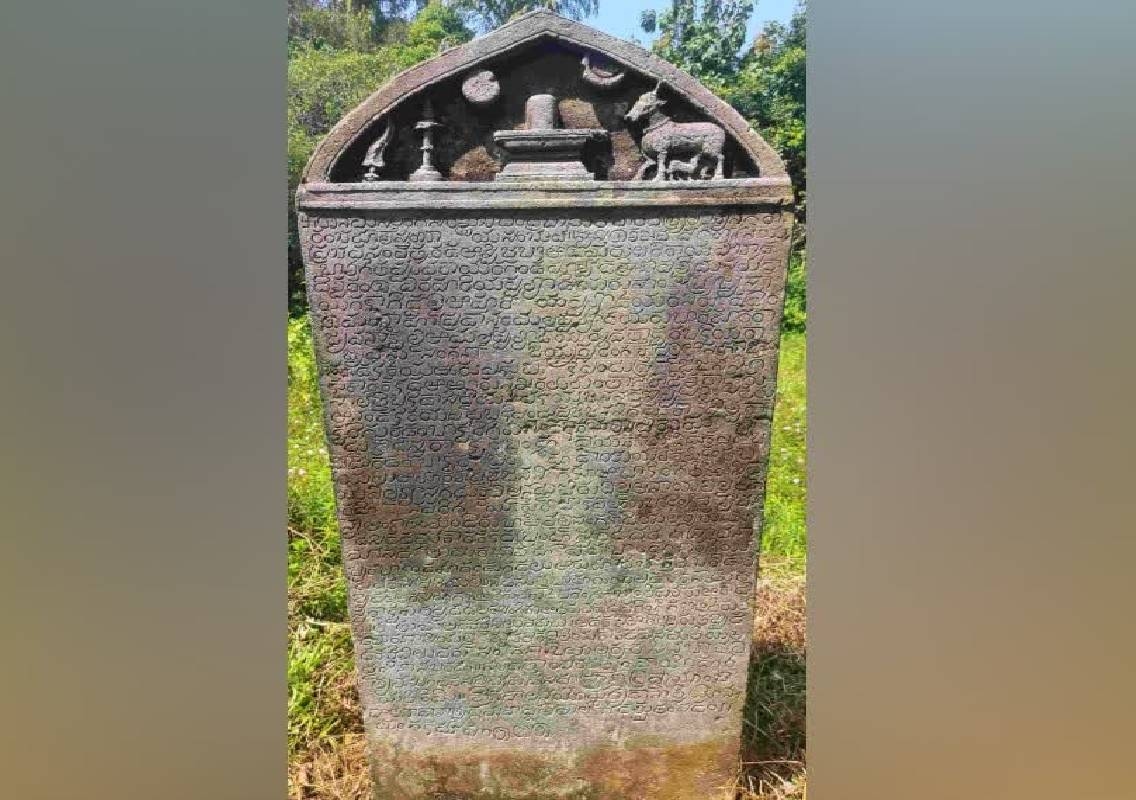


Udupi: A rare stone inscription dating back to the Vijayanagara Empire has been discovered near the Jumadi temple at Dasanda Bakimaru in Kedinje, Belman village, in Karkala taluk. The discovery is significant as the inscription is written in Kannada script and language but contains several Tulu words, offering valuable insights into the region’s linguistic, cultural and administrative history.
The discovery was announced by Professor T. Murugeshi, founder trustee of Adima Kala Trust and a retired professor of archaeology. The inscription provides details about land grants, local administration, religious obligations and the governance of the Barkur kingdom during the Vijayanagara period.
Inscription offers clues to Vijayanagara history
The inscription is carved on green schist, also known as soapstone, and measures 46.5 cm in height and 23 cm in width. Its upper sculptural panel features a Shiva Linga at the centre, with a cow feeding its calf on the left. On the right are a lamp pillar and a raised carving of a ‘Kadsale’, a traditional sword associated with spirit worship in Tulu Nadu.
The lower rectangular portion contains 34 lines of inscriptional text. It begins with an auspicious Swastika symbol, followed by a prayer to Lord Shiva.
According to Professor Murugeshi, the inscription is particularly valuable because it combines Kannada inscriptional writing with Tulu vocabulary, reflecting the linguistic interactions that existed along the coastal region during the medieval period.
Date corrected to 1387 AD
The inscription mentions the Saka year as 1039, Prabhava Samvatsara and Bahula 3. However, this date does not match the historical chronology of the Vijayanagara Empire.
Professor Murugeshi explained that the correct reading should be Saka 1309, Prabhava Samvatsara, corresponding to 1387 AD.
The inscription praises Vijayanagara ruler Immadi Harihara Raya, describing him as the lord of the eastern, southern and western seas through the expression ‘Poorva Dakshina Paschima Samudradhishwaram’.
This reference provides an important historical connection between the inscription and the political authority of the Vijayanagara Empire during the 14th century.
Details of Barkur kingdom administration
The inscription records that Mahapradhana Mallappa Odeya administered the Barkur kingdom under the orders of Hariyappa Odeya.
It further states that Mallappa Odeya later transferred the Dattaluva kingdom to Sanganna Jaya Arasa. The record offers information about the administrative structure and the role of local officials operating under the larger Vijayanagara political system.
Such details are important for understanding how regional territories and local authorities functioned during the period.
Agricultural land granted to two brothers
One of the most significant details in the inscription concerns a land grant made by Sanganna Jaya Arasa.
According to the record, he granted two parcels of agricultural land, known as ‘Balike’, at Nandalike to two brothers, Kotishwaralva and Kadambalva. The lands were granted as Brahmadaya, meaning they were exempted from taxes.
The grant also carried a specific religious responsibility. The two brothers were required to provide six mudis of paddy every year, without interruption, to a Brahmin who recited or taught the Puranas.
The arrangement was formalised through a religious decree issued by Jaya Arasa. This provision highlights the relationship between agricultural land grants, religious institutions and the support extended to scholars during the Vijayanagara period.
Inscription prescribes penalties for violations
The inscription also specifies penalties for anyone violating the land grant, including the ruling authority.
According to the record, violators were required to pay a fine of 250 Gadyanas to the king and 150 Gadyanas to the deity.
The inscription was written by Vittanna, who served as the Senabova, or administrative officer, of Jaya Arasa. It concludes with traditional imprecatory verses warning against anyone who attempts to violate the grant.
These provisions offer insights into the legal and religious safeguards used to protect land endowments during the medieval period.
Archaeology students play key role in discovery
The inscription was identified by Sinchith M. and Shodhan B., first-year BA Archaeology students of Shirva M.S.R.S. College. They brought the discovery to the attention of Professor Murugeshi, enabling further examination and study.
Congratulating the students for identifying the historical record, Professor Murugeshi acknowledged the support received from several individuals and organisations.
He thanked Suhas Hegde of Nandalike Palace and his mother Sarala S. Hegde, Dr Suresh Chitrapu, president of the Mulki Gazani Foundation, and Dr Raghuram Shetty of the Gulladi Rani Chikkayi Thayi Charitable Trust for their assistance.
The discovery is expected to contribute to a better understanding of the Vijayanagara Empire’s influence in coastal Karnataka, particularly the historical administration of Barkur, land grants and the interaction between Kannada and Tulu languages.