







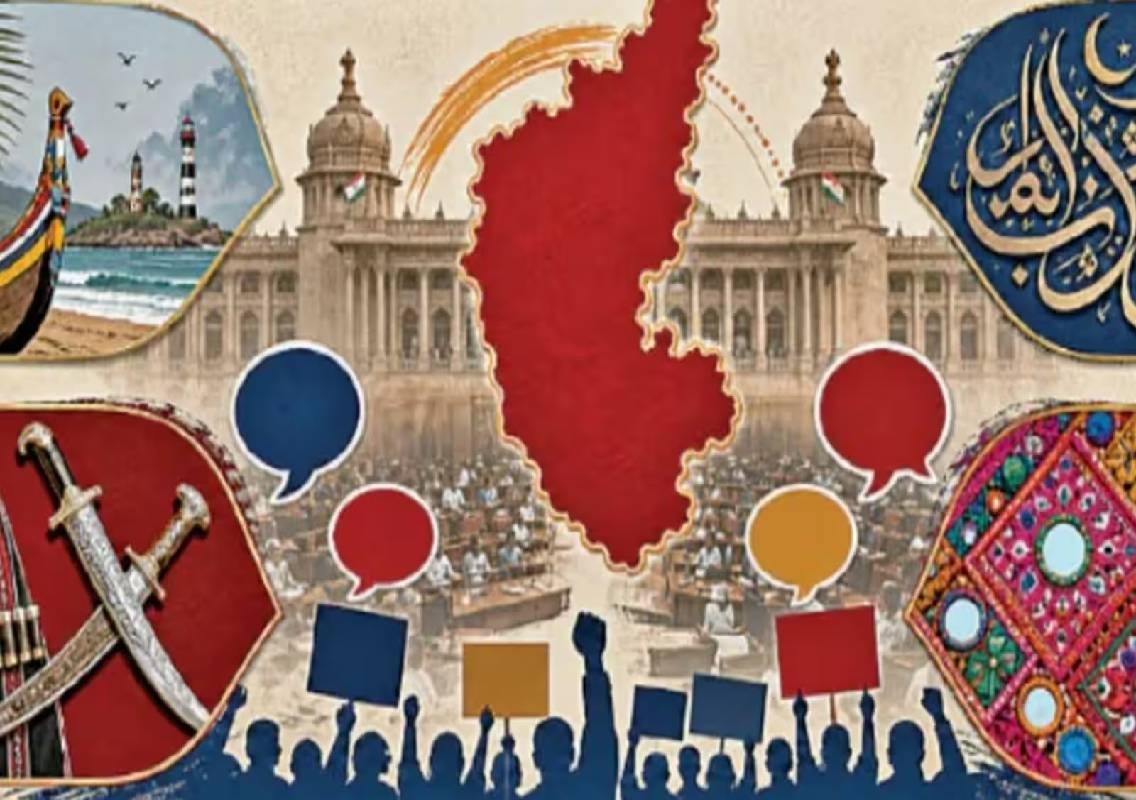


Udupi: The Karnataka Cabinet’s decision to recognise Tulu as an additional official language for administrative purposes in Dakshina Kannada and Udupi districts has brought renewed attention to demands from other linguistic communities for similar recognition. Urdu, Kodava and Lambani speakers, along with speakers of several other languages, are now seeking greater administrative recognition for their respective languages.
The issue has emerged amid a wider discussion on Karnataka’s linguistic diversity and the extent to which languages other than Kannada can receive official recognition for specific administrative purposes. The recent decision on Tulu has also revived the long-standing demand for its inclusion in the Eighth Schedule of the Constitution.
Tulu gets additional official language status
The Karnataka Cabinet, at its special meeting held in Mangaluru on September 18, approved Tulu as the state’s second additional administrative language in Dakshina Kannada and Udupi districts.
The decision followed several years of demands from Tulu organisations, cultural groups, public representatives and members of the community. The government has said the recognition will apply specifically to the two coastal districts where Tulu is widely spoken.
The government has also earmarked Rs. 82 lakh annually for activities connected with the use of Tulu, including translation and training. The implementation will be handled by the administrations of Dakshina Kannada and Udupi.
The move does not replace Kannada as the state’s principal official language. Rather, Tulu has been recognised as an additional administrative language within the specified coastal districts.
Urdu speakers seek similar recognition
Following the Cabinet decision, the demand for official recognition of other languages has gained attention.
According to Vijay Karnataka, Urdu speakers are among those seeking similar recognition. The report cites the 2011 Census data and notes that Urdu is the second-largest mother tongue in Karnataka after Kannada.
SDPI state president Abdul Majeed has sought official recognition for Urdu in Karnataka, pointing to the presence of Urdu-medium schools in the state. He also referred to Telangana, where Urdu has official-language status alongside Telugu, while arguing that recognition of Urdu would not affect Kannada or Tulu.
The demand is part of a broader discussion over how Karnataka could accommodate its substantial linguistic diversity while retaining Kannada’s position in the state’s administration.
Kodava and Lambani communities also in focus
The debate is not limited to Urdu.
Kodava and Lambani are among the other languages mentioned in the report in connection with demands for greater recognition. While the number of speakers differs considerably between these languages, their advocates have also sought greater institutional support and recognition.
The 2011 Census figures cited by Vijay Karnataka put the number of Lambani mother-tongue speakers in Karnataka at around 9.74 lakh, while Kodava speakers were estimated at around 1.13 lakh. The same data put Tulu speakers at about 15.92 lakh in the state.
The figures provide an indication of the linguistic diversity within Karnataka and explain why questions around administrative recognition can involve communities of very different sizes.
What does official language recognition mean?
The constitutional framework allows states to recognise one or more languages for official purposes.
Article 345 of the Constitution provides that a State Legislature may, by law, adopt one or more languages in use in the state, or Hindi, for all or any of the state’s official purposes.
This means official-language recognition does not necessarily have to apply uniformly across every administrative function or the entire geographical area of a state. A state can establish the scope of use through its legal and administrative framework.
In the case of Tulu, the recent Karnataka decision is specifically applicable to administrative purposes in Dakshina Kannada and Udupi.
This distinction is important because the current discussion involves demands for recognition at different levels, ranging from administrative use within particular districts to wider recognition across Karnataka.
Karnataka’s linguistic diversity
The 2011 Census data cited in the Vijay Karnataka report show the scale of Karnataka’s multilingual population.
According to those figures, Kannada was reported as the mother tongue of around 4.06 crore people, accounting for 66.49 per cent of the state’s population. Urdu followed with about 66.17 lakh speakers, while Telugu had approximately 35.65 lakh and Tamil around 21.01 lakh mother-tongue speakers.
The same data list Marathi, Hindi, Tulu, Konkani, Malayalam, Lambani and Kodava among the other significant mother tongues in the state.
The figures also show that smaller linguistic communities form an important part of Karnataka’s cultural landscape. For such communities, official or administrative recognition can be linked to questions concerning education, government communication, cultural preservation and public services.
Tulu’s Eighth Schedule demand continues
The recent State-level recognition of Tulu is separate from the long-standing demand to include the language in the Eighth Schedule of the Constitution.
The Eighth Schedule currently contains 22 languages. Tulu is not among them, and organisations representing Tulu speakers have been campaigning for its inclusion for several years.
Inclusion in the Eighth Schedule and recognition as an additional official language of a state are different constitutional matters. The Karnataka Cabinet’s decision therefore does not by itself amount to Tulu being added to the Eighth Schedule.
The demand for constitutional recognition continues to be raised by Tulu organisations and supporters of the language.
Other languages may seek greater administrative space
The latest development has consequently widened the conversation beyond Tulu.
Vijay Karnataka reports that speakers of Urdu, Tamil, Telugu, Marathi and Hindi could also seek greater recognition, while Kodava and Lambani communities have their own concerns regarding linguistic preservation and institutional support.
The extent of any future recognition would depend on the relevant legal, administrative and policy processes. The Constitution provides states with a framework to adopt languages for official purposes, but the specific scope and implementation are matters for the concerned government and legislature.
The debate therefore involves several separate questions: the size and geographical concentration of language communities, administrative feasibility, educational use, cultural preservation and the legal framework governing official languages.
Recognition debate extends beyond language policy
The discussion also comes at a time when the Karnataka government has taken several decisions concerning coastal Karnataka.
At the September 18 Cabinet meeting in Mangaluru, the government approved the Tulu language decision along with a new tourism policy for the coastal and Malnad regions and several development projects. The Cabinet also initiated the process of considering a change in the name of Dakshina Kannada district to Mangaluru, subject to public objections and suggestions.
The Tulu decision, however, has a distinct linguistic and administrative dimension. It follows a long-standing campaign for recognition and has now prompted renewed discussion among other linguistic communities.
Conclusion
The Karnataka Cabinet’s decision to recognise Tulu as an additional official administrative language in Dakshina Kannada and Udupi has opened a fresh discussion on linguistic recognition in the state. Urdu speakers have sought similar recognition, while Kodava, Lambani and other language communities are also part of the wider debate.
The Constitution’s Article 345 allows states to adopt one or more languages for official purposes, providing the legal framework within which such demands can be considered. Meanwhile, Tulu’s separate demand for inclusion in the Eighth Schedule remains pending.